QUESTION IMAGE
Question
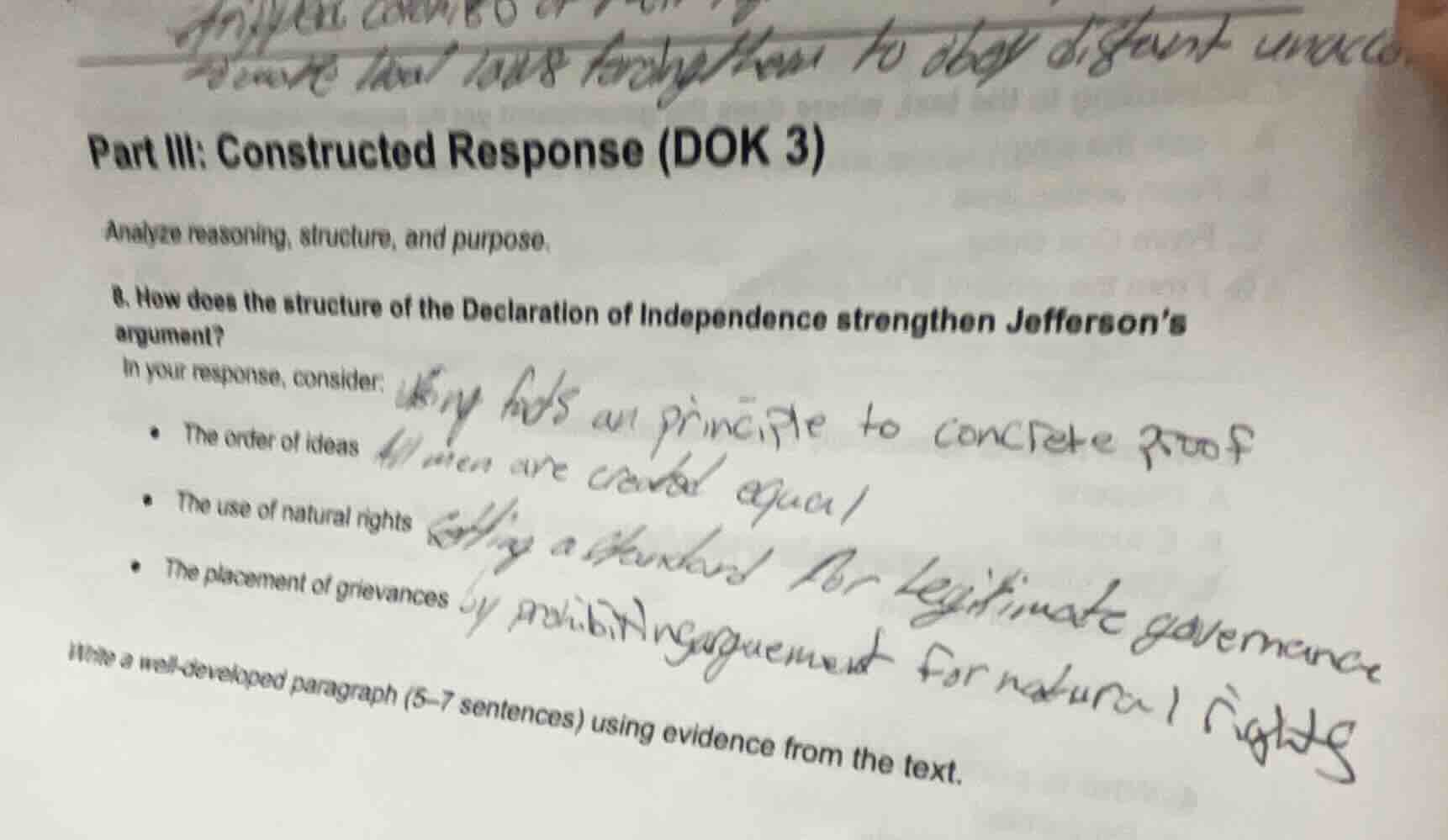
part iii: constructed response (dok 3)
analyze reasoning, structure, and purpose.
- how does the structure of the declaration of independence strengthen jefferson’s argument?
in your response, consider:
- the order of ideas
- the use of natural rights
- the placement of grievances
use a well - developed paragraph (5 - 7 sentences) using evidence from the text.
The Declaration of Independence’s structure builds a logical, unassailable case for independence by moving from foundational principles to concrete action. First, it opens with the Preamble, establishing the natural rights framework ("all men are created equal" with rights to "Life, Liberty and the pursuit of Happiness") to set a moral and legal standard for legitimate governance—this frames the colonies’ break from Britain as a defense of universal rights, not just a rebellion. Next, the list of grievances against King George III is strategically placed after this principle: each grievance (e.g., dissolving colonial legislatures, imposing unfair taxes) acts as concrete proof that the British government violated the natural rights and the social contract outlined earlier. This order, from abstract principle to specific evidence, makes Jefferson’s argument persuasive because it first justifies the right to overthrow an unjust government, then provides irrefutable examples of that injustice. By grounding the argument in widely accepted natural rights, Jefferson frames the colonies’ cause as a moral duty rather than a selfish act, and the sequential structure ensures the reader follows the logical chain from principle to proof, strengthening the legitimacy of the call for independence.

Snap & solve any problem in the app
Get step-by-step solutions on Sovi AI
Photo-based solutions with guided steps
Explore more problems and detailed explanations
The structure of the Declaration of Independence strengthens Jefferson’s argument by building a layered, logically cohesive case for colonial independence. Opening with the Preamble, Jefferson first establishes a universal framework of natural rights ("all men are created equal" with inherent rights to "Life, Liberty and the pursuit of Happiness") and the social contract principle that governments derive their just powers from the consent of the governed. This sets a moral and legal standard that frames the colonies’ actions as a defense of fundamental rights, not a reckless rebellion. Next, the deliberate placement of the list of grievances against King George III immediately after this foundational principle turns abstract ideals into concrete proof: each grievance—from dissolving colonial legislatures to imposing "taxes on us without our consent"—serves as evidence that Britain violated the very natural rights and governing norms the Preamble laid out. This sequence, moving from core principle to specific, documented injustice, guides the reader through an unbroken logical chain: first, defining what a just government must do, then proving Britain failed to meet that standard, and finally justifying the colonies’ decision to sever ties. By anchoring the argument in universally recognizable natural rights before presenting targeted grievances, Jefferson makes the case for independence feel like a necessary, moral duty rather than a political power grab, ensuring the argument resonates both emotionally and logically with readers.