QUESTION IMAGE
Question
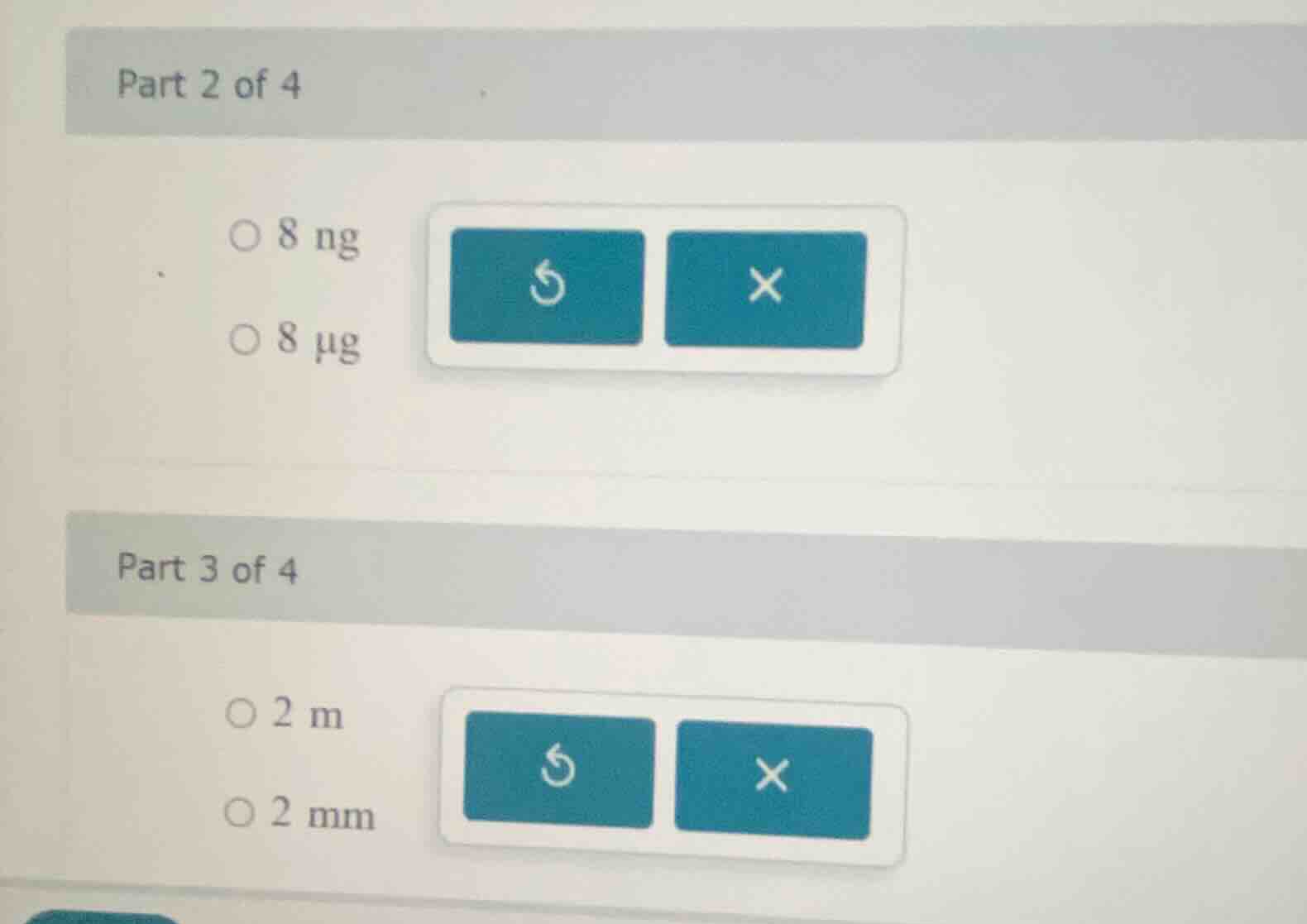
part 2 of 4
○ 8 ng
○ 8 μg
part 3 of 4
○ 2 m
○ 2 mm
To solve these multiple - choice questions, we analyze each part based on the context of metric units and typical usage scenarios:
Part 2 of 4
Step 1: Analyze the units
We know that \(1\ \mu g= 1000\ ng\). In many biological or chemical contexts, when dealing with small quantities of substances (like in some drug dosages or biochemical measurements), \( \mu g\) (microgram) is a more commonly used unit for larger small - scale measurements compared to \(ng\) (nanogram). For example, if we are talking about a substance where an 8 - unit quantity is more likely to be in the microgram range (as nanograms are extremely small), \(8\ \mu g\) is a more reasonable choice than \(8\ ng\).
Part 3 of 4
Step 1: Analyze the units
We know that \(1\ m = 1000\ mm\). When dealing with lengths, \(mm\) (millimeter) is used for relatively small lengths, while \(m\) (meter) is a much larger unit. For example, if we are talking about the length of a small object (like a small component in a device), a length of \(2\ mm\) is more reasonable than \(2\ m\) (since \(2\ m\) is a relatively large length for most small - scale objects we would measure with these options).

Snap & solve any problem in the app
Get step-by-step solutions on Sovi AI
Photo-based solutions with guided steps
Explore more problems and detailed explanations
s:
Part 2 of 4: \(8\ \mu g\)
Part 3 of 4: \(2\ mm\)