QUESTION IMAGE
Question
part c – properties of real numbers
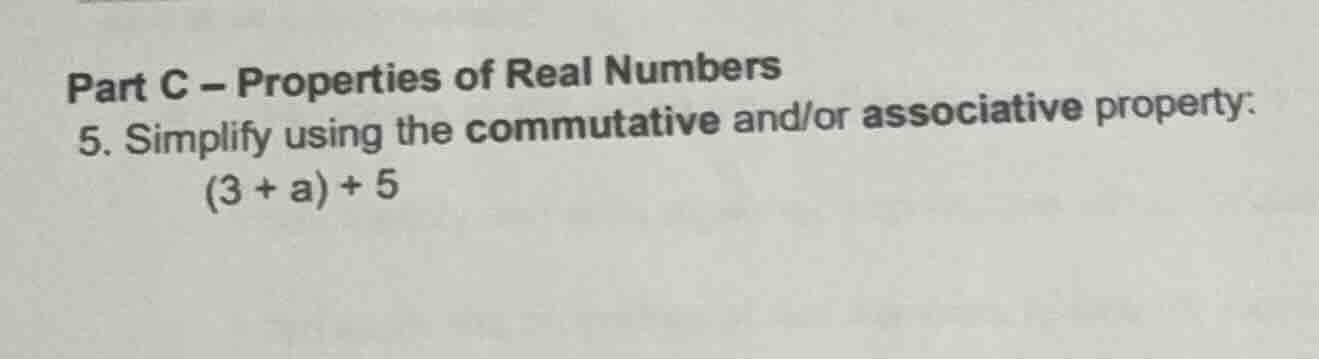
- simplify using the commutative and/or associative property:
(3 + a) + 5
Step1: Recall the associative property of addition
The associative property of addition states that \((x + y) + z = x + (y + z)\). For the expression \((3 + a) + 5\), we can apply the associative property to regroup the terms.
Step2: Apply the associative property
Using the associative property, \((3 + a) + 5 = 3 + (a + 5)\). But we can also use the commutative property (though not necessary here, but to simplify, we can re - order the addition of the constants). Wait, actually, first, we can use the associative property to group \(3\) and \(5\) together. Wait, the associative property allows us to change the grouping. Let's correct that. The associative property is \((x + y)+z=x+(y + z)\). So for \((3 + a)+5\), we can rewrite it as \(3+(a + 5)\), but we can also use the fact that addition is commutative and associative, so we can group \(3\) and \(5\) first. Let's do that. \((3 + a)+5=3+(a + 5)\) (by associative property), but we can also use the commutative property on \(a+5\) to get \(5 + a\), but actually, a better way is: \((3 + a)+5=3+(a + 5)\) (associative), and then since addition is commutative, \(a + 5=5 + a\), but we can also group \(3\) and \(5\) directly. Wait, the associative property is \((x + y)+z=x+(y + z)\), so if we let \(x = 3\), \(y=a\), \(z = 5\), then \((3 + a)+5=3+(a + 5)\). But we can also use the commutative property of addition (which states that \(x + y=y + x\)) on \(a+5\) to get \(5 + a\), and then use the associative property again? No, actually, a simpler way: we know that \((3 + a)+5=3+(a + 5)\) (associative), and then \(a+5 = 5 + a\) (commutative), and then \(3+(5 + a)=(3 + 5)+a\) (associative again). Now, \(3+5 = 8\), so \((3 + 5)+a=8 + a\).
Let's do it step by step with the associative property first.
- Start with \((3 + a)+5\)
- By the associative property of addition \((x + y)+z=x+(y + z)\), here \(x = 3\), \(y=a\), \(z = 5\), so \((3 + a)+5=3+(a + 5)\)
- Now, by the commutative property of addition \(x + y=y + x\), \(a+5 = 5 + a\), so \(3+(a + 5)=3+(5 + a)\)
- By the associative property again, \(3+(5 + a)=(3 + 5)+a\)
- Calculate \(3 + 5=8\), so \((3 + 5)+a=8 + a\)

Snap & solve any problem in the app
Get step-by-step solutions on Sovi AI
Photo-based solutions with guided steps
Explore more problems and detailed explanations
\(8 + a\) (or \(a + 8\) since addition is commutative)