QUESTION IMAGE
Question
part a
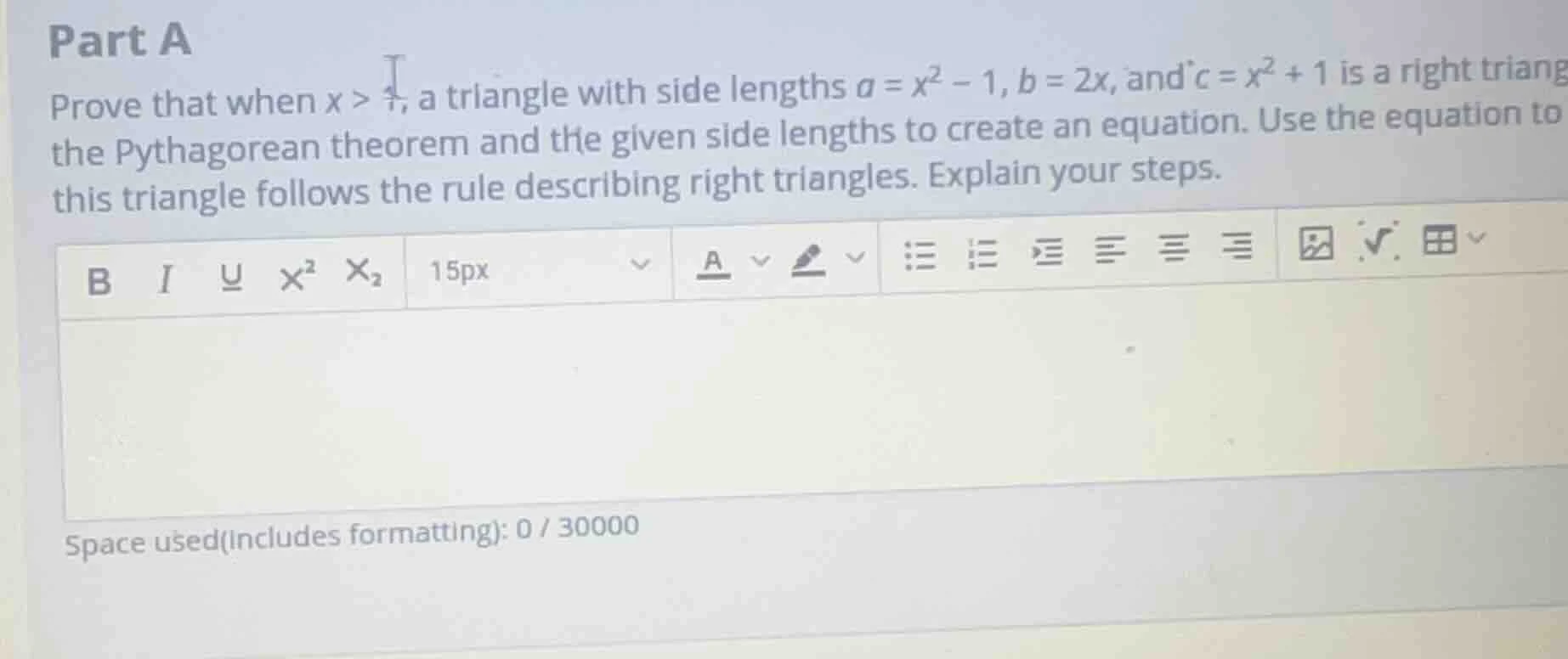
prove that when x > 1, a triangle with side lengths ( a = x^2 - 1 ), ( b = 2x ), and ( c = x^2 + 1 ) is a right triang
the pythagorean theorem and the given side lengths to create an equation. use the equation to
this triangle follows the rule describing right triangles. explain your steps.
Step1: Identify the longest side
For $x>1$, $c=x^2+1$ is the longest side, since $x^2+1 > x^2-1$ and $x^2+1 - 2x=(x-1)^2>0$ for $x
eq1$.
Step2: Apply Pythagorean theorem
Check if $a^2 + b^2 = c^2$. First calculate $a^2$:
$a^2=(x^2-1)^2=x^4-2x^2+1$
Step3: Calculate $b^2$
$b^2=(2x)^2=4x^2$
Step4: Sum $a^2$ and $b^2$
$a^2+b^2=(x^4-2x^2+1)+4x^2=x^4+2x^2+1$
Step5: Calculate $c^2$
$c^2=(x^2+1)^2=x^4+2x^2+1$
Step6: Compare both sides
Since $a^2+b^2=x^4+2x^2+1=c^2$, the Pythagorean theorem holds.

Snap & solve any problem in the app
Get step-by-step solutions on Sovi AI
Photo-based solutions with guided steps
Explore more problems and detailed explanations
When $x>1$, substituting the side lengths into the Pythagorean theorem confirms $a^2 + b^2 = c^2$, so the triangle with sides $a=x^2-1$, $b=2x$, $c=x^2+1$ is a right triangle.