QUESTION IMAGE
Question
part 1 — setting up the problem
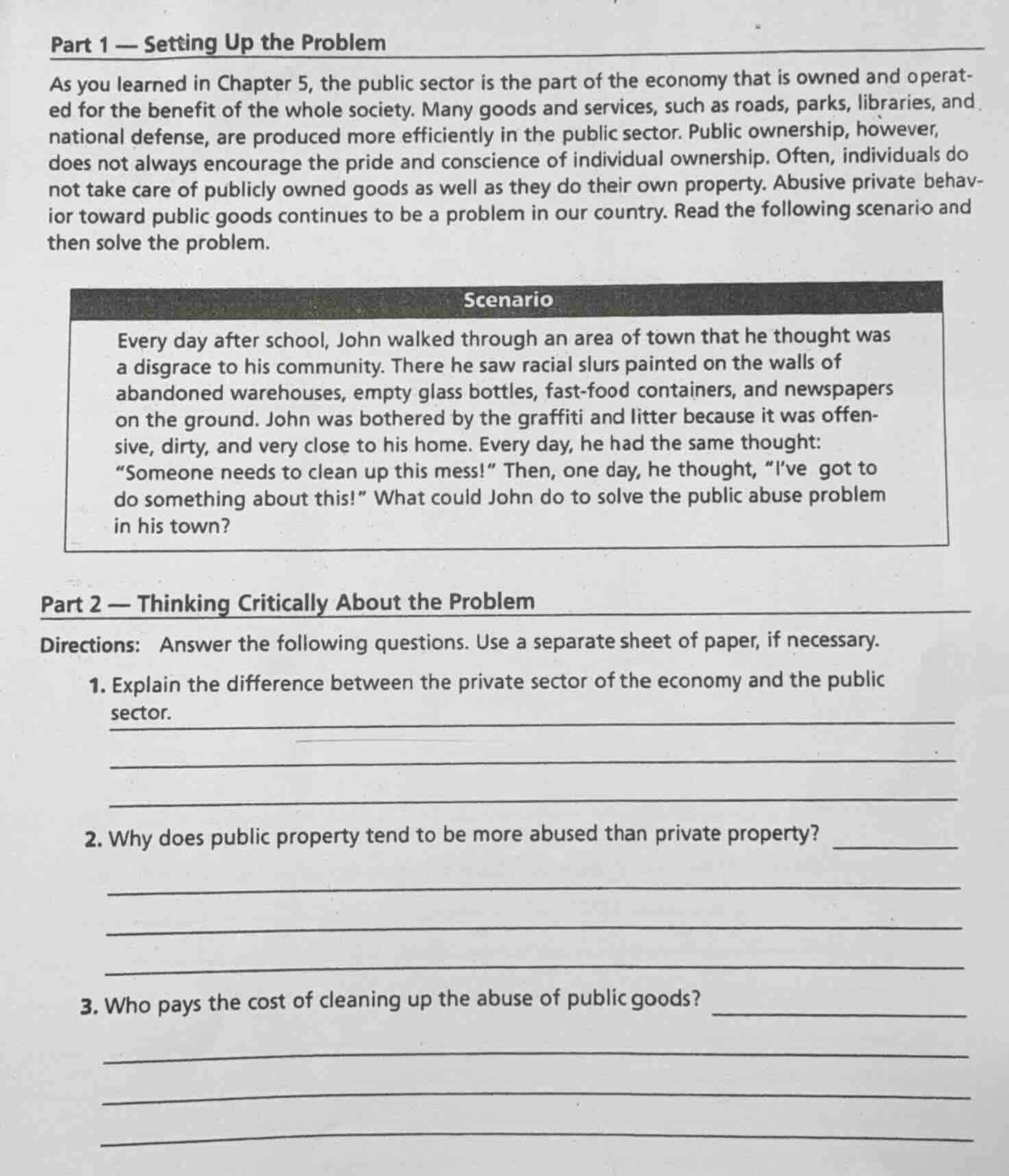
as you learned in chapter 5, the public sector is the part of the economy that is owned and operated for the benefit of the whole society. many goods and services, such as roads, parks, libraries, and national defense, are produced more efficiently in the public sector. public ownership, however, does not always encourage the pride and conscience of individual ownership. often, individuals do not take care of publicly owned goods as well as they do their own property. abusive private behavior toward public goods continues to be a problem in our country. read the following scenario and then solve the problem.
scenario
every day after school, john walked through an area of town that he thought was a disgrace to his community. there he saw racial slurs painted on the walls of abandoned warehouses, empty glass bottles, fast-food containers, and newspapers on the ground. john was bothered by the graffiti and litter because it was offensive, dirty, and very close to his home. every day, he had the same thought: \someone needs to clean up this mess!\ then, one day, he thought, \ive got to do something about this!\ what could john do to solve the public abuse problem in his town?
part 2 — thinking critically about the problem
directions: answer the following questions. use a separate sheet of paper, if necessary.
- explain the difference between the private sector of the economy and the public sector.
- why does public property tend to be more abused than private property?
- who pays the cost of cleaning up the abuse of public goods?
- The private sector is owned/operated by private individuals or businesses to generate profit, while the public sector is owned/operated by government entities to provide services for the collective benefit of society.
- Public property lacks direct individual ownership, so people feel less personal responsibility or pride in caring for it, unlike private property where owners directly bear the costs of damage or neglect.
- The cost of cleaning up abused public goods is typically paid by taxpayers, as government funds (which come from taxes) are used to cover these maintenance and cleanup expenses.

Snap & solve any problem in the app
Get step-by-step solutions on Sovi AI
Photo-based solutions with guided steps
Explore more problems and detailed explanations
- The private sector consists of businesses and organizations owned by private individuals or groups, focused on generating profit. The public sector is made up of government-run entities that provide goods and services (like roads, parks, public safety) for the benefit of all members of society, not for profit.
- Public property tends to be more abused because no single individual owns it directly. People do not have the same sense of personal responsibility, pride, or direct financial stake in caring for public goods as they do for their own private property, where they bear the direct costs of damage or neglect.
- The taxpayers of the community (or broader jurisdiction) pay the cost of cleaning up abused public goods, as these expenses are covered by government funds, which come from tax revenues.