QUESTION IMAGE
Question
part a
short - answer questions (31 - 36)
directions: analyze the documents and answer the short - answer questions that follow each document in the space provided.
document 1
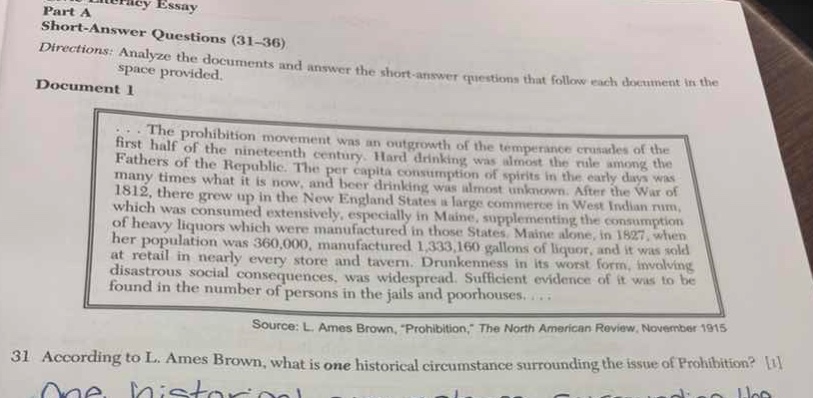
... the prohibition movement was an outgrowth of the temperance crusades of the first half of the nineteenth century. hard drinking was almost the rule among the fathers of the republic. the per capita consumption of spirits in the early days was many times what it is now, and beer drinking was almost unknown. after the war of 1812, there grew up in the new england states a large commerce in west indian rum, which was consumed extensively, especially in maine, supplementing the consumption of heavy liquors which were manufactured in those states. maine alone, in 1827, when her population was 360,000, manufactured 1,333,160 gallons of liquor, and it was sold at retail in nearly every store and tavern. drunkenness in its worst form, involving disastrous social consequences, was widespread. sufficient evidence of it was to be found in the number of persons in the jails and poorhouses....
source: l. ames brown, “prohibition,” the north american review, november 1915
31 according to l. ames brown, what is one historical circumstance surrounding the issue of prohibition? 1
To answer this, we analyze the document. The text mentions that after the War of 1812, there was large commerce in West Indian rum (heavy liquor) consumed extensively, especially in Maine, and liquor manufacturing (Maine made 1,333,160 gallons in 1827) and widespread hard drinking with social consequences (drunkenness, jail and poorhouse populations). One historical circumstance is the extensive consumption of heavy liquors (like West Indian rum) after the War of 1812, along with large - scale liquor manufacturing and the social problems (drunkenness, jail/poorhouse populations) from hard drinking.

Snap & solve any problem in the app
Get step-by-step solutions on Sovi AI
Photo-based solutions with guided steps
Explore more problems and detailed explanations
One historical circumstance surrounding the issue of Prohibition was the extensive consumption of heavy liquors (such as West Indian rum) after the War of 1812, along with large - scale liquor manufacturing (for example, Maine alone manufactured 1,333,160 gallons of liquor in 1827) and the widespread social problems (like drunkenness and a large number of people in jails and poorhouses) resulting from hard drinking.