QUESTION IMAGE
Question
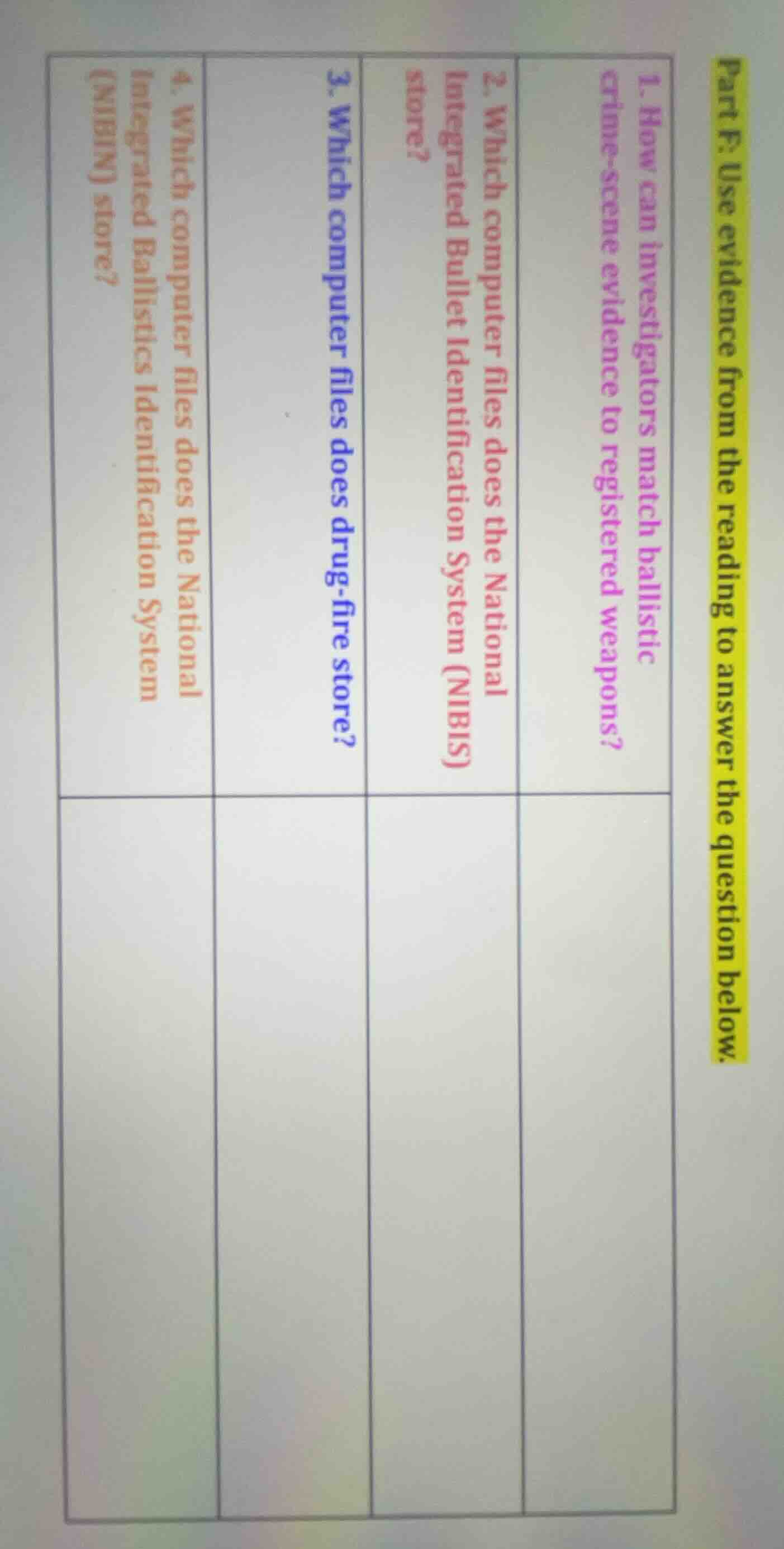
part f: use evidence from the reading to answer the question below.
- how can investigators match ballistic crime - scene evidence to registered weapons?
- which computer files does the national integrated bullet identification system (nibis) store?
- which computer files does drug - fire store?
- which computer files does the national integrated ballistics identification system (nibin) store?
To answer these questions, we would typically refer to knowledge about forensic science and law enforcement databases:
1. How can investigators match ballistic crime - scene evidence to registered weapons?
Investigators use the National Integrated Ballistic Information Network (NIBIN). When a crime - scene has ballistic evidence (like bullet casings or bullets), the evidence is examined and the ballistic details (such as the markings on the bullet or casing) are entered into the NIBIN system. The system then compares these details with the ballistic information of registered weapons (which is also stored in the system, often from test - fires of weapons or previous crime - scenes). If there is a match, it can link a weapon to a crime - scene.
2. Which computer files does the National Integrated Bullet Identification System (NIBIS) store?
The National Integrated Bullet Identification System (NIBIS, now part of NIBIN) stores computer files related to bullet and cartridge case ballistic information. This includes digital images of the ballistic markings on bullets and cartridge cases, as well as data about the caliber, manufacturer, and other relevant details of the ammunition. These files are used to compare evidence from crime - scenes with evidence from other crime - scenes or with test - fires of weapons to identify potential matches.
3. Which computer files does drug - fire store?
It seems there might be a typo (possibly “drug - related fire” or a misnomer). If we assume it's related to drug - related firearm crimes, the relevant computer files would likely include information about firearms used in drug - related offenses, such as the ballistic details of weapons involved in drug - related shootings, the ownership information of the weapons (if available), and the connection between the weapons, the drug - related crime, and the suspects. This could also include data on how the weapons were used in the drug trade (e.g., for intimidation, distribution protection).
4. Which computer files does the National Integrated Ballistics Identification System (NIBIN) store?
The National Integrated Ballistics Identification System (NIBIN) stores computer files that contain ballistic data of bullets and cartridge cases. This includes high - resolution images of the striations (unique markings) on bullets and cartridge cases, data about the firearm that fired them (if known, such as make, model, caliber), and information about the crime - scene (location, date, type of crime) where the ballistic evidence was found. It also stores data from test - fires of weapons (both from law enforcement agencies and from the manufacturing process for reference) to help in the identification and matching process.
(Note: For more accurate and detailed answers, referring to official sources on NIBIN and forensic ballistics databases is recommended.)

Snap & solve any problem in the app
Get step-by-step solutions on Sovi AI
Photo-based solutions with guided steps
Explore more problems and detailed explanations
To answer these questions, we would typically refer to knowledge about forensic science and law enforcement databases:
1. How can investigators match ballistic crime - scene evidence to registered weapons?
Investigators use the National Integrated Ballistic Information Network (NIBIN). When a crime - scene has ballistic evidence (like bullet casings or bullets), the evidence is examined and the ballistic details (such as the markings on the bullet or casing) are entered into the NIBIN system. The system then compares these details with the ballistic information of registered weapons (which is also stored in the system, often from test - fires of weapons or previous crime - scenes). If there is a match, it can link a weapon to a crime - scene.
2. Which computer files does the National Integrated Bullet Identification System (NIBIS) store?
The National Integrated Bullet Identification System (NIBIS, now part of NIBIN) stores computer files related to bullet and cartridge case ballistic information. This includes digital images of the ballistic markings on bullets and cartridge cases, as well as data about the caliber, manufacturer, and other relevant details of the ammunition. These files are used to compare evidence from crime - scenes with evidence from other crime - scenes or with test - fires of weapons to identify potential matches.
3. Which computer files does drug - fire store?
It seems there might be a typo (possibly “drug - related fire” or a misnomer). If we assume it's related to drug - related firearm crimes, the relevant computer files would likely include information about firearms used in drug - related offenses, such as the ballistic details of weapons involved in drug - related shootings, the ownership information of the weapons (if available), and the connection between the weapons, the drug - related crime, and the suspects. This could also include data on how the weapons were used in the drug trade (e.g., for intimidation, distribution protection).
4. Which computer files does the National Integrated Ballistics Identification System (NIBIN) store?
The National Integrated Ballistics Identification System (NIBIN) stores computer files that contain ballistic data of bullets and cartridge cases. This includes high - resolution images of the striations (unique markings) on bullets and cartridge cases, data about the firearm that fired them (if known, such as make, model, caliber), and information about the crime - scene (location, date, type of crime) where the ballistic evidence was found. It also stores data from test - fires of weapons (both from law enforcement agencies and from the manufacturing process for reference) to help in the identification and matching process.
(Note: For more accurate and detailed answers, referring to official sources on NIBIN and forensic ballistics databases is recommended.)