QUESTION IMAGE
Question
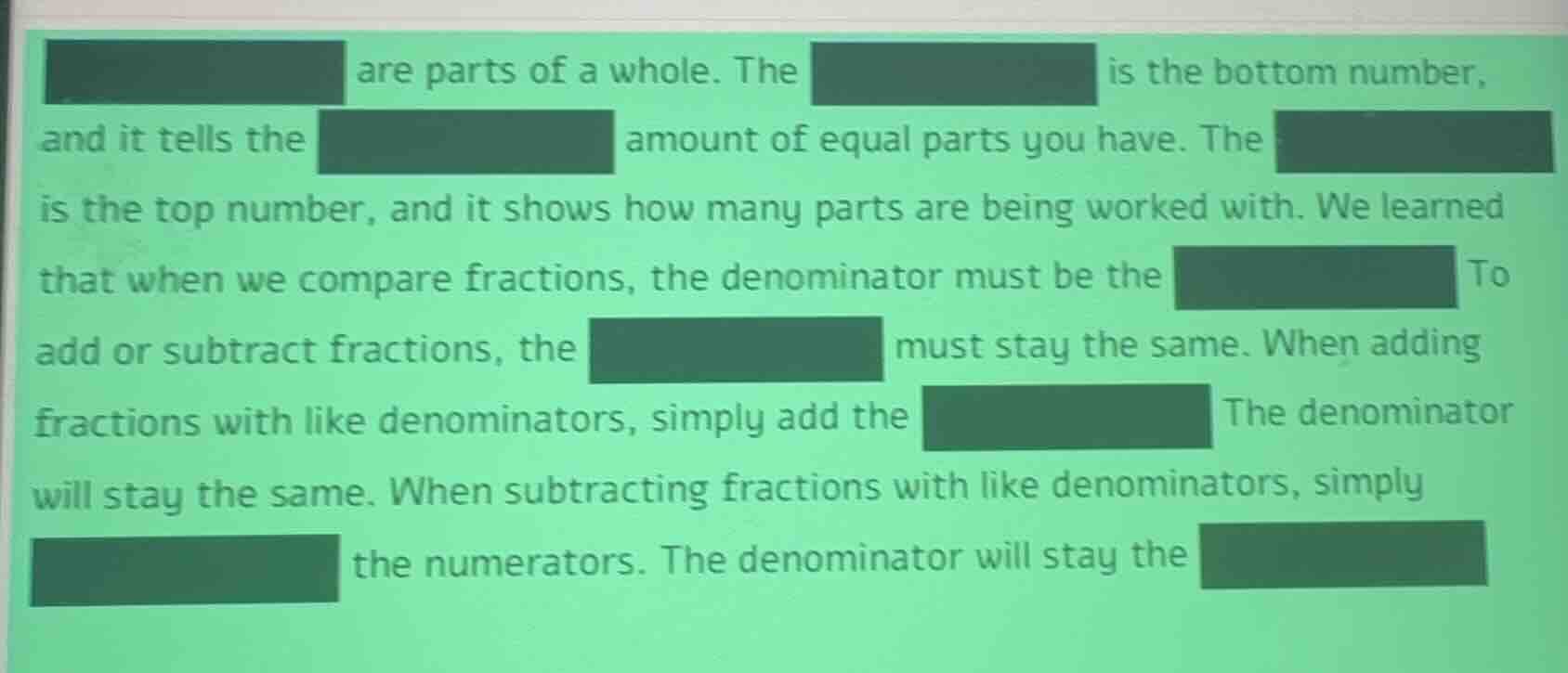
are parts of a whole. the is the bottom number, and it tells the amount of equal parts you have. the is the top number, and it shows how many parts are being worked with. we learned that when we compare fractions, the denominator must be the to add or subtract fractions, the must stay the same. when adding fractions with like denominators, simply add the the denominator will stay the same. when subtracting fractions with like denominators, simply the numerators. the denominator will stay the
Brief Explanations
The text is about fractions. Let's fill in the blanks:
- "Fractions" are parts of a whole.
- The "denominator" is the bottom number, and it tells the "total" amount of equal parts you have.
- The "numerator" is the top number, and it shows how many parts are being worked with.
- When we compare fractions, the denominator must be the "same" (for like - denominator comparison, or we find a common denominator).
- To add or subtract fractions, the "denominator" must stay the same (for like - denominator operations).
- When adding fractions with like denominators, simply add the "numerators".
- When subtracting fractions with like denominators, simply "subtract" the numerators.
- The denominator will stay the "same".

Snap & solve any problem in the app
Get step-by-step solutions on Sovi AI
Photo-based solutions with guided steps
Explore more problems and detailed explanations
- Fractions
- denominator; total
- numerator
- same (or we find a common denominator, but in the context of the sentence structure, "same" fits for like - denominator comparison)
- denominator
- numerators
- subtract
- same