QUESTION IMAGE
Question
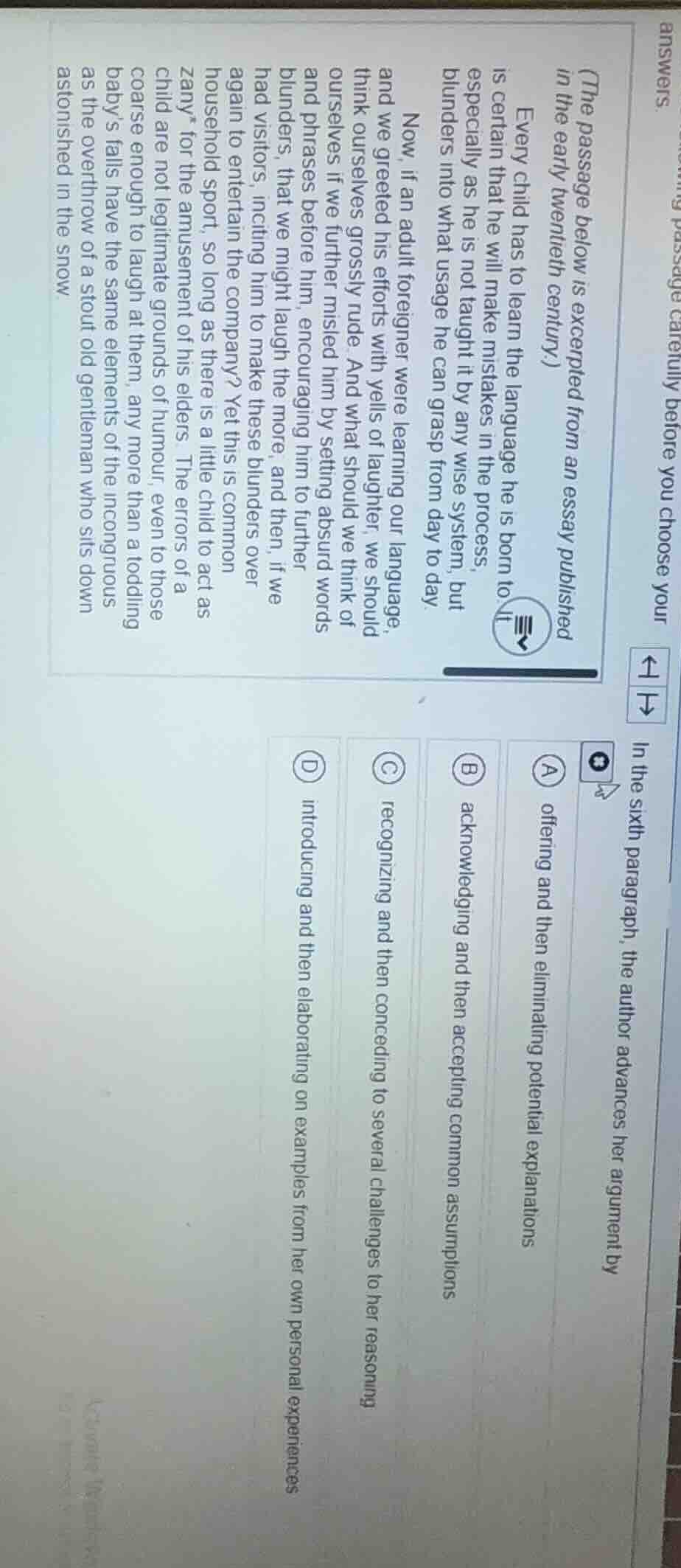
(the passage below is excerpted from an essay published in the early twentieth century.) every child has to learn the language he is born to. it is certain that he will make mistakes in the process, especially as he is not taught it by any wise system, but blunders into what usage he can grasp from day to day. now, if an adult foreigner were learning our language, and we greeted his efforts with yells of laughter, we should think ourselves grossly rude. and what should we think of ourselves if we further misled him by setting absurd words and phrases before him, encouraging him to further blunders, that we might laugh the more, and then, if we had visitors, inciting him to make these blunders over again to entertain the company? yet this is common household sport, so long as there is a little child to act as zany* for the amusement of his elders. the errors of a child are not legitimate grounds of humour, even to those coarse enough to laugh at them, any more than a toddling baby’s falls have the same elements of the incongruous as the overthrow of a stout old gentleman who sits down astonished in the snow in the sixth paragraph, the author advances her argument by a offering and then eliminating potential explanations b acknowledging and then accepting common assumptions c recognizing and then conceding to several challenges to her reasoning d introducing and then elaborating on examples from her own personal experiences
The sixth paragraph first introduces the common reaction to a language-learning adult's blunders (laughing, seeing rudeness), then raises a counter question, and elaborates with an analogy of a child's blunders and a gentleman falling in the snow as examples to support the argument that such blunders are not legitimate grounds for humour. This matches the pattern of introducing a scenario and then elaborating with examples.

Snap & solve any problem in the app
Get step-by-step solutions on Sovi AI
Photo-based solutions with guided steps
Explore more problems and detailed explanations
D. introducing and then elaborating on examples from her own personal experiences