QUESTION IMAGE
Question
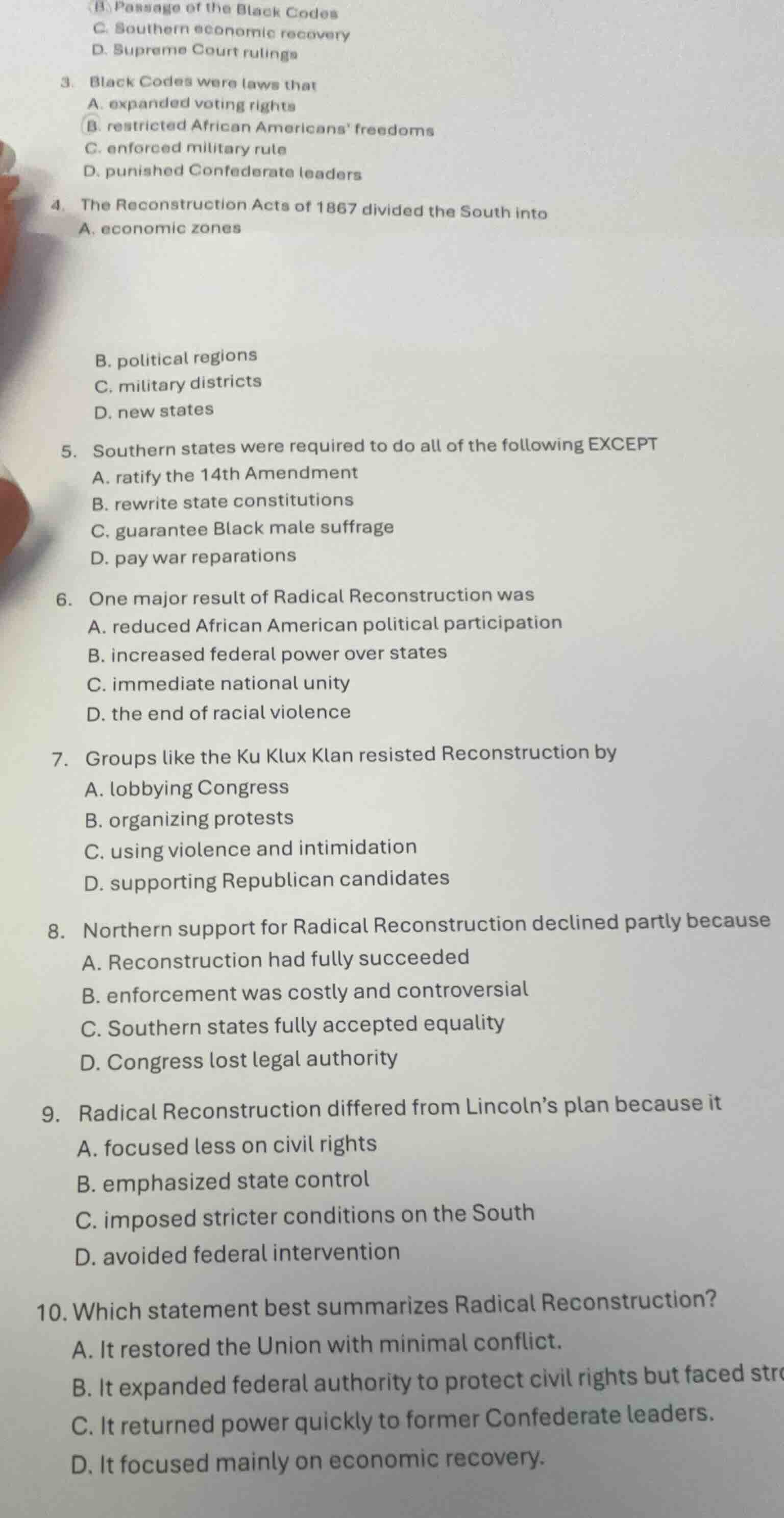
b. passage of the black codes
c. southern economic recovery
d. supreme court rulings
- black codes were laws that
a. expanded voting rights
b. restricted african americans freedoms
c. enforced military rule
d. punished confederate leaders
- the reconstruction acts of 1867 divided the south into
a. economic zones
b. political regions
c. military districts
d. new states
- southern states were required to do all of the following except
a. ratify the 14th amendment
b. rewrite state constitutions
c. guarantee black male suffrage
d. pay war reparations
- one major result of radical reconstruction was
a. reduced african american political participation
b. increased federal power over states
c. immediate national unity
d. the end of racial violence
- groups like the ku klux klan resisted reconstruction by
a. lobbying congress
b. organizing protests
c. using violence and intimidation
d. supporting republican candidates
- northern support for radical reconstruction declined partly because
a. reconstruction had fully succeeded
b. enforcement was costly and controversial
c. southern states fully accepted equality
d. congress lost legal authority
- radical reconstruction differed from lincolns plan because it
a. focused less on civil rights
b. emphasized state control
c. imposed stricter conditions on the south
d. avoided federal intervention
- which statement best summarizes radical reconstruction?
a. it restored the union with minimal conflict.
b. it expanded federal authority to protect civil rights but faced str
c. it returned power quickly to former confederate leaders.
d. it focused mainly on economic recovery.
- Black Codes were post-Civil War laws in the South designed to limit the rights and freedoms of African Americans, forcing them into exploitative labor systems.
- The 1867 Reconstruction Acts established military oversight of the former Confederate states by dividing the South into five military districts.
- During Reconstruction, Southern states were required to ratify the 14th Amendment, rewrite their constitutions, and guarantee Black male suffrage, but no requirement to pay war reparations was imposed.
- Radical Reconstruction involved strong federal intervention in Southern states, which significantly increased federal power over state governments to enforce civil rights.
- The Ku Klux Klan and similar white supremacist groups used violence, threats, and intimidation to terrorize African Americans and their allies, undermining Reconstruction efforts.
- Northern support for Radical Reconstruction waned in part because enforcing federal policies in the South was financially costly and politically divisive among Northern voters.
- Lincoln's Reconstruction plan was lenient towards the South, while Radical Reconstruction imposed much stricter conditions, including military rule and civil rights mandates, to ensure racial equality.
- Radical Reconstruction expanded federal authority to protect the civil rights of African Americans, but it faced fierce resistance from white Southerners, limiting its long-term success.

Snap & solve any problem in the app
Get step-by-step solutions on Sovi AI
Photo-based solutions with guided steps
Explore more problems and detailed explanations
- B. restricted African Americans' freedoms
- C. military districts
- D. pay war reparations
- B. increased federal power over states
- C. using violence and intimidation
- B. enforcement was costly and controversial
- C. imposed stricter conditions on the South
- B. It expanded federal authority to protect civil rights but faced strong resistance