QUESTION IMAGE
Question
passage 1
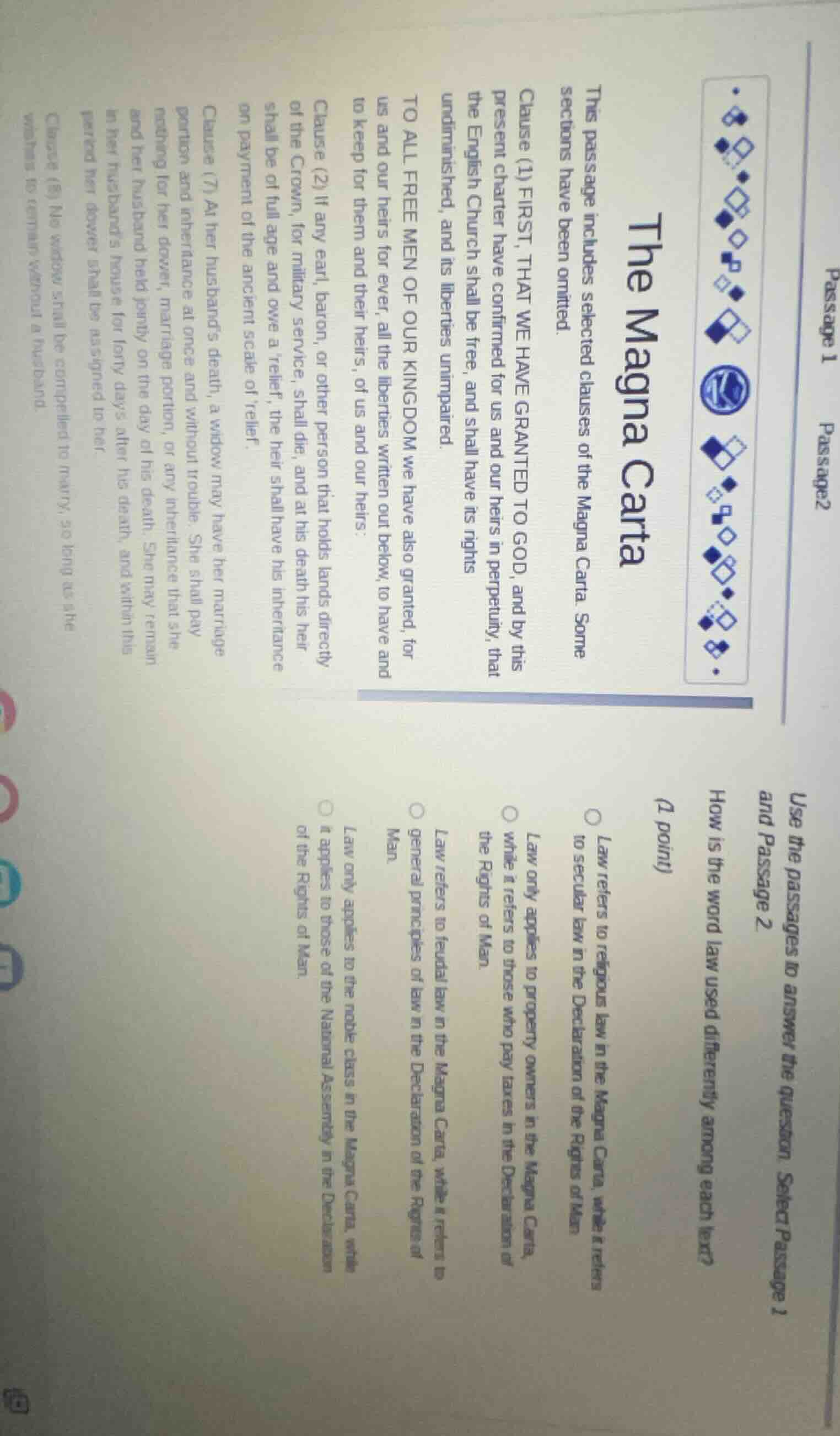
the magna carta
this passage includes selected clauses of the magna carta. some sections have been omitted.
clause (1) first, that we have granted to god, and by this present charter have confirmed for us and our heirs in perpetuity, that the english church shall be free, and shall have its rights undiminished, and its liberties unimpaired.
to all free men of our kingdom we have also granted, for us and our heirs for ever, all the liberties written out below, to have and to keep for them and their heirs, of us and our heirs.
clause (2) if any earl, baron, or other person that holds lands directly of the crown, for military service, shall die, and at his death his heir shall be of full age and owe a relief, the heir shall have his inheritance on payment of the ancient scale of relief.
clause (7) at her husband’s death, a widow may have her marriage portion and inheritance at once and without trouble. she shall pay nothing for her dower, marriage portion, or any inheritance that she and her husband held jointly on the day of his death. she may remain in her husband’s house for forty days after his death, and within this period her dower shall be assigned to her.
clause (8) no widow shall be compelled to marry, so long as she wishes to remain without a husband.
use the passages to answer the question. select passage 1 and passage 2
how is the word law used differently among each text?
(1 point)
- law refers to religious law in the magna carta, while it refers to secular law in the declaration of the rights of man.
- law only applies to property owners in the magna carta, while it refers to those who pay taxes in the declaration of the rights of man.
- law refers to feudal law in the magna carta, while it refers to general principles of law in the declaration of the rights of man.
- law only applies to the noble class in the magna carta, while it applies to those of the national assembly in the declaration of the rights of man.
To solve this, we analyze the Magna Carta (feudal - related, specific to nobility/lords) and the Declaration of the Rights of Man (general principles for all). The third option states "Law refers to feudal law in the Magna Carta, while it refers to general principles of law in the Declaration of Man", which matches the historical context: Magna Carta dealt with feudal legal relationships (e.g., between king and nobles), and the Declaration of the Rights of Man established general legal and human - rights principles for all. Other options are incorrect: first option misrepresents the Magna Carta's law as religious (it's feudal/secular - legal), second option's tax - payer focus is wrong, fourth option's "applies to noble class in Magna Carta" is too narrow (Magna Carta also had broader impacts, but the key is the type of law: feudal vs. general principles).

Snap & solve any problem in the app
Get step-by-step solutions on Sovi AI
Photo-based solutions with guided steps
Explore more problems and detailed explanations
The correct option is: Law refers to feudal law in the Magna Carta, while it refers to general principles of law in the Declaration of Man.