QUESTION IMAGE
Question
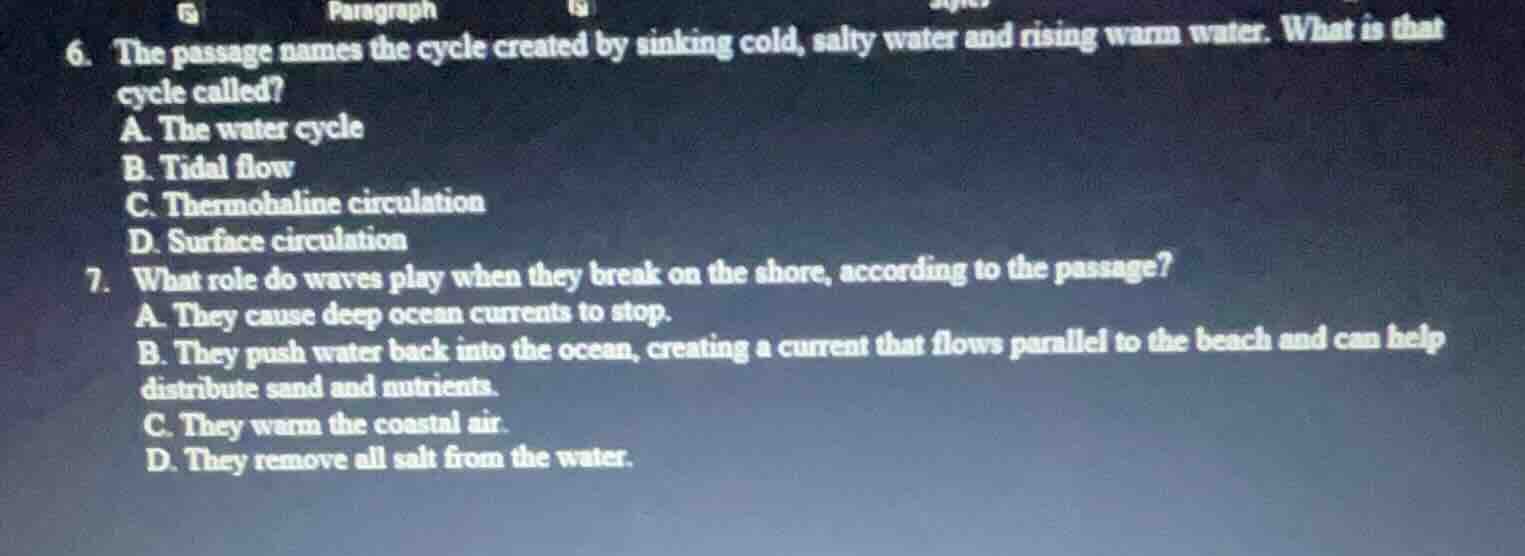
- the passage names the cycle created by sinking cold, salty water and rising warm water. what is that cycle called?
a. the water cycle
b. tidal flow
c. thermohaline circulation
d. surface circulation
- what role do waves play when they break on the shore, according to the passage?
a. they cause deep ocean currents to stop.
b. they push water back into the ocean, creating a current that flows parallel to the beach and can help distribute sand and nutrients.
c. they warm the coastal air.
d. they remove all salt from the water.
Response
Question 6
Brief Explanations
To solve this, we analyze each option:
- Option A: The water cycle involves evaporation, condensation, precipitation, etc., not specifically sinking cold salty water and rising warm water.
- Option B: Tidal flow is related to the gravitational pull of the moon and sun, not this specific cycle of water based on temperature and salinity.
- Option C: Thermohaline circulation is driven by differences in water density due to temperature (thermo - heat) and salinity (haline - salt), which matches the description of sinking cold, salty water and rising warm water.
- Option D: Surface circulation is mainly driven by wind, not the temperature and salinity differences described.
Brief Explanations
We analyze each option:
- Option A: Waves breaking on the shore do not stop deep - ocean currents. Deep - ocean currents are driven by other factors like thermohaline circulation.
- Option B: When waves break on the shore, they push water back into the ocean, creating a longshore current (a current parallel to the beach) which helps in distributing sand and nutrients along the shore. This is a known role of waves breaking on the shore.
- Option C: Waves breaking on the shore do not warm the coastal air. The warming of coastal air is more related to factors like ocean - air heat transfer over a larger area, not wave breaking.
- Option D: Waves breaking on the shore do not remove all salt from the water. Desalination is a complex process and not related to wave breaking.

Snap & solve any problem in the app
Get step-by-step solutions on Sovi AI
Photo-based solutions with guided steps
Explore more problems and detailed explanations
C. Thermohaline circulation