QUESTION IMAGE
Question
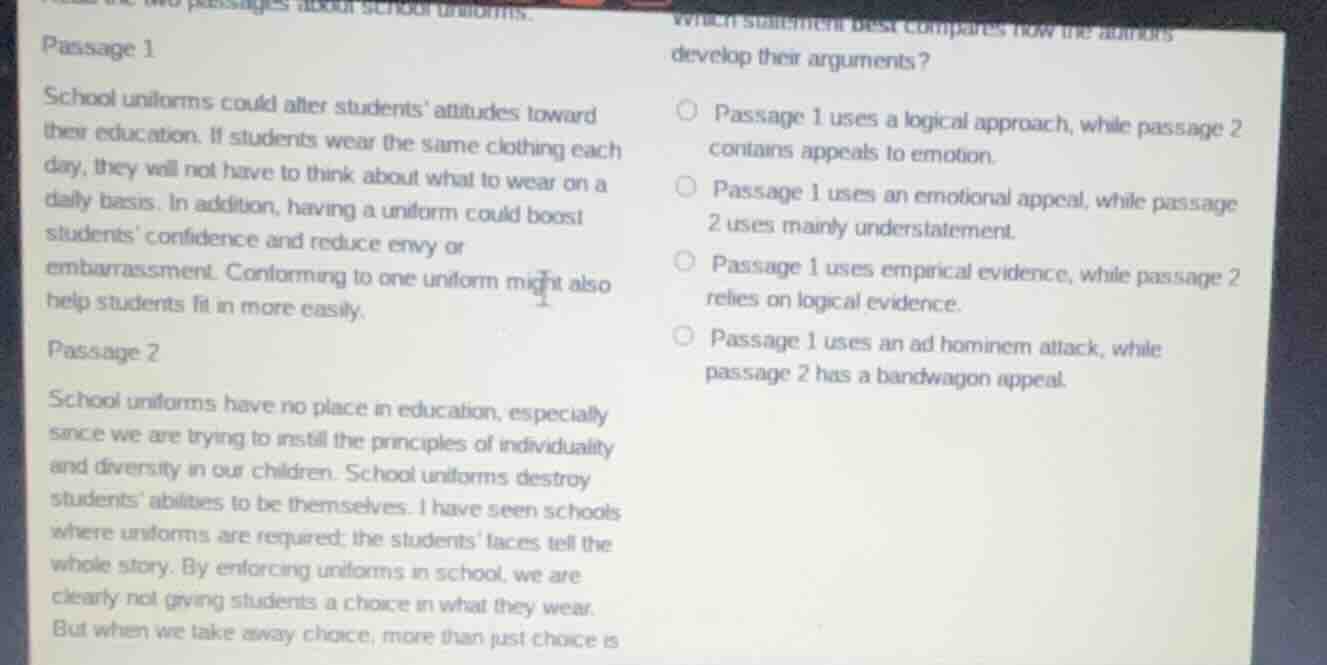
passage 1
school uniforms could alter students attitudes toward their education. if students wear the same clothing each day, they will not have to think about what to wear on a daily basis. in addition, having a uniform could boost students confidence and reduce envy or embarrassment. conforming to one uniform might also help students fit in more easily.
passage 2
school uniforms have no place in education, especially since we are trying to instill the principles of individuality and diversity in our children. school uniforms destroy students abilities to be themselves. i have seen schools where uniforms are required; the students faces tell the whole story. by enforcing uniforms in school, we are clearly not giving students a choice in what they wear. but when we take away choice, more than just choice is
which statement best compares how the authors develop their arguments?
- passage 1 uses a logical approach, while passage 2 contains appeals to emotion.
- passage 1 uses an emotional appeal, while passage 2 uses mainly understatement.
- passage 1 uses empirical evidence, while passage 2 relies on logical evidence.
- passage 1 uses an ad hominem attack, while passage 2 has a bandwagon appeal.
Passage 1 uses logical, practical reasoning: it outlines concrete, rational benefits of uniforms (saving decision time, boosting confidence, reducing envy, aiding inclusion). Passage 2 uses emotional appeals: it focuses on ideas of individuality, frames uniforms as "destroying" self-expression, and uses subjective, evocative language like "students' faces tell the whole story" to stir sentiment. The other options are incorrect: Passage 1 has no emotional appeal/ad hominem/empirical evidence, and Passage 2 has no understatement/logical evidence/bandwagon appeal.

Snap & solve any problem in the app
Get step-by-step solutions on Sovi AI
Photo-based solutions with guided steps
Explore more problems and detailed explanations
A. Passage 1 uses a logical approach, while passage 2 contains appeals to emotion.