QUESTION IMAGE
Question
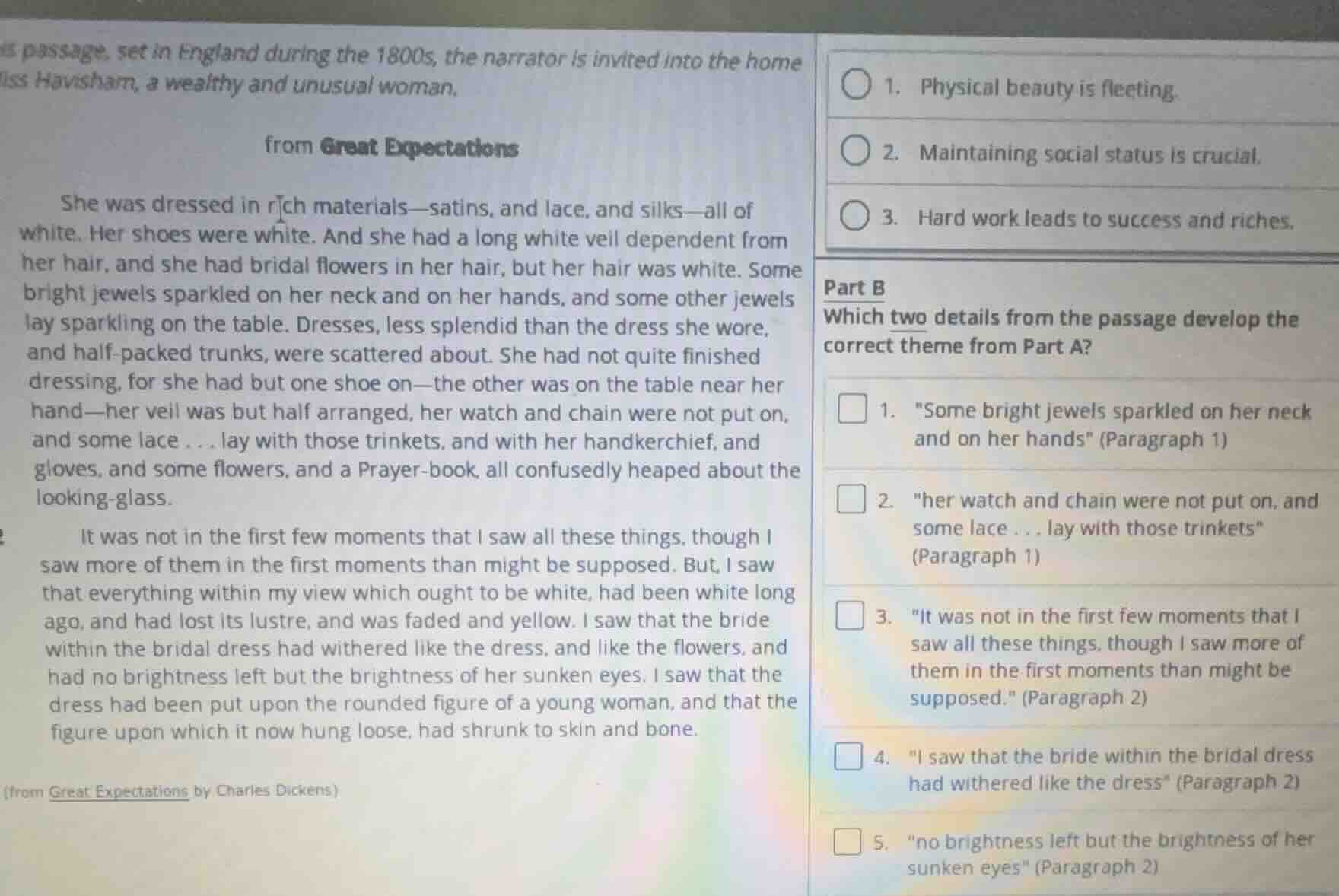
is passage, set in england during the 1800s, the narrator is invited into the home miss havisham, a wealthy and unusual woman. from great expectations she was dressed in rich materials—satins, and lace, and silks—all of white. her shoes were white. and she had a long white veil dependent from her hair, and she had bridal flowers in her hair, but her hair was white. some bright jewels sparkled on her neck and on her hands, and some other jewels lay sparkling on the table. dresses, less splendid than the dress she wore, and half - packed trunks, were scattered about. she had not quite finished dressing, for she had but one shoe on—the other was on the table near her hand—her veil was but half arranged, her watch and chain were not put on, and some lace... lay with those trinkets, and with her handkerchief, and gloves, and some flowers, and a prayer - book, all confusedly heaped about the looking - glass. it was not in the first few moments that i saw all these things, though i saw more of them in the first moments than might be supposed. but, i saw that everything within my view which ought to be white, had been white long ago, and had lost its lustre, and was faded and yellow. i saw that the bride within the bridal dress had withered like the dress, and like the flowers, and had no brightness left but the brightness of her sunken eyes. i saw that the dress had been put upon the rounded figure of a young woman, and that the figure upon which it now hung loose, had shrunk to skin and bone. (from great expectations by charles dickens)
- physical beauty is fleeting.
- maintaining social status is crucial.
- hard work leads to success and riches.
part b
which two details from the passage develop the correct theme from part a?
- \some bright jewels sparkled on her neck and on her hands\ (paragraph 1)
- \her watch and chain were not put on, and some lace... lay with those trinkets\ (paragraph 1)
- \it was not in the first few moments that i saw all these things, though i saw more of them in the first moments than might be supposed.\ (paragraph 2)
- \i saw that the bride within the bridal dress had withered like the dress\ (paragraph 2)
5.
o brightness left but the brightness of her sunken eyes\ (paragraph 2)
Part A
To determine the theme, we analyze the passage. Miss Havisham is in bridal attire but has withered, her dress and beauty faded. Option 1 ("Physical beauty is fleeting") matches as her beauty and the freshness of her attire are gone. Option 2 is incorrect as social status isn't the focus. Option 3 is incorrect as hard work isn't discussed.
We first confirm the correct theme from Part A is "Physical beauty is fleeting". Now we analyze each option:
- Option 1: Describes jewels, not related to beauty fading. Eliminate.
- Option 2: Describes unfinished dressing, not about beauty. Eliminate.
- Option 3: About the narrator's observation time, not beauty. Eliminate.
- Option 4: Compares the bride (representing beauty) to the withered dress, showing beauty fades. Correct.
- Option 5: Shows the bride has lost brightness, indicating beauty is fleeting. Correct.

Snap & solve any problem in the app
Get step-by-step solutions on Sovi AI
Photo-based solutions with guided steps
Explore more problems and detailed explanations
- Physical beauty is fleeting.