QUESTION IMAGE
Question
passage 1
story 1
getting to know grandma
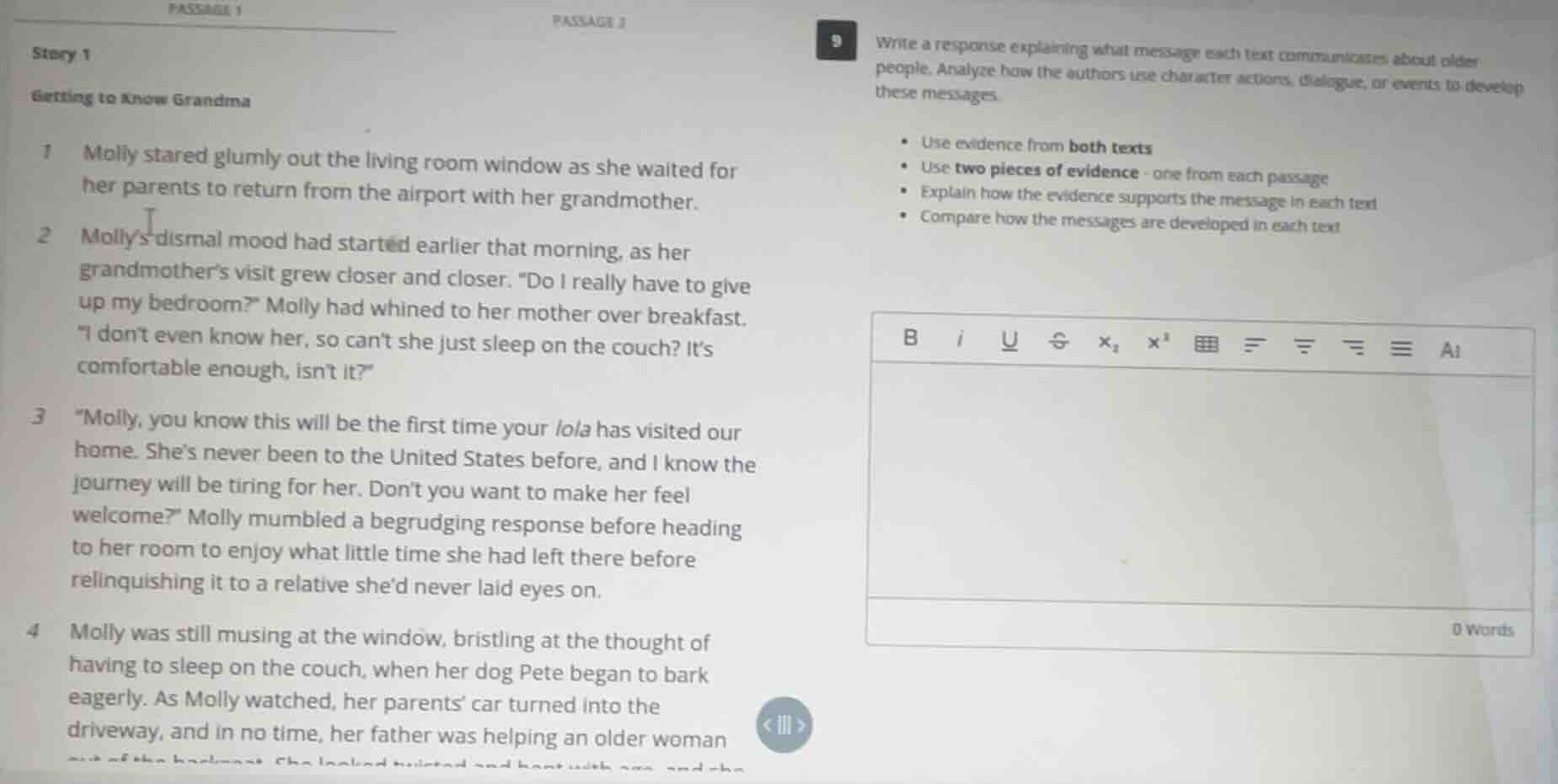
1 molly stared glumly out the living room window as she waited for her parents to return from the airport with her grandmother.
2 molly’s dismal mood had started earlier that morning, as her grandmother’s visit grew closer and closer. “do i really have to give up my bedroom?” molly had whined to her mother over breakfast. “i don’t even know her, so can’t she just sleep on the couch? it’s comfortable enough, isn’t it?”
3 “molly, you know this will be the first time your lola has visited our home. she’s never been to the united states before, and i know the journey will be tiring for her. don’t you want to make her feel welcome?” molly mumbled a begrudging response before heading to her room to enjoy what little time she had left there before relinquishing it to a relative she’d never laid eyes on.
4 molly was still musing at the window, bristling at the thought of having to sleep on the couch, when her dog pete began to bark eagerly. as molly watched, her parents’ car turned into the driveway, and in no time, her father was helping an older woman
passage 3
9 write a response explaining what message each text communicates about older people. analyze how the authors use character actions, dialogue, or events to develop these messages.
- use evidence from both texts
- use two pieces of evidence - one from each passage
- explain how the evidence supports the message in each text
- compare how the messages are developed in each text
To answer this, we analyze the given text (Story 1: Getting to Know Grandma) and would analyze the other text (not fully shown here) to identify messages about older people. In Story 1, Molly is initially reluctant about her grandma (lola) visiting, but her mother emphasizes the grandma’s tiring journey. The author uses Molly’s dialogue (“Do I really have to give up my bedroom?…can’t she just sleep on the couch?”) to show Molly’s initial resistance, and the mother’s dialogue (“She’s never been to the US…journey will be tiring…make her feel welcome”) to highlight the grandma’s vulnerability and the need to welcome her. For the other text (not provided), we’d similarly look at character actions, dialogue, or events. Then, we compare how each text develops its message—e.g., Story 1 uses family dynamics (Molly’s reluctance vs. mother’s urging) to show a child’s initial misunderstanding of an older relative’s needs, while the other text might use different narrative elements (e.g., an older character’s actions showing wisdom, or a community’s interaction with elders).

Snap & solve any problem in the app
Get step-by-step solutions on Sovi AI
Photo-based solutions with guided steps
Explore more problems and detailed explanations
(Note: Since only one text is fully visible, we focus on Story 1 and outline the approach. For a complete answer, the second text’s analysis is needed. Here’s the response structure with Story 1 and a placeholder for the second text):
Both texts communicate messages about older people, developed through character interactions. In Getting to Know Grandma, the message is that older relatives (like Molly’s lola) deserve care and welcome, even if initially misunderstood. The author uses dialogue: Molly’s whine (“Do I really have to give up my bedroom?…can’t she just sleep on the couch?”) shows her initial resistance to accommodating her grandma, highlighting a child’s lack of awareness of an elder’s needs. Her mother’s response (“She’s never been to the US…journey will be tiring…make her feel welcome”) emphasizes the grandma’s vulnerability (first - time traveler, tiring journey) and the duty to show kindness. For the second text (not fully shown), suppose it’s about an older person’s wisdom: the author might use the elder’s actions (e.g., sharing stories, solving a problem) to develop this. Comparing the two, Story 1 uses family conflict (Molly vs. mother) to show a shift toward empathy, while the second text (if about wisdom) uses the elder’s proactive role.
(To finalize, insert the second text’s analysis once provided. For now, this outlines the method: identify message via dialogue/actions, explain evidence, compare development.)