QUESTION IMAGE
Question
pcm semester 1 final exam part 2
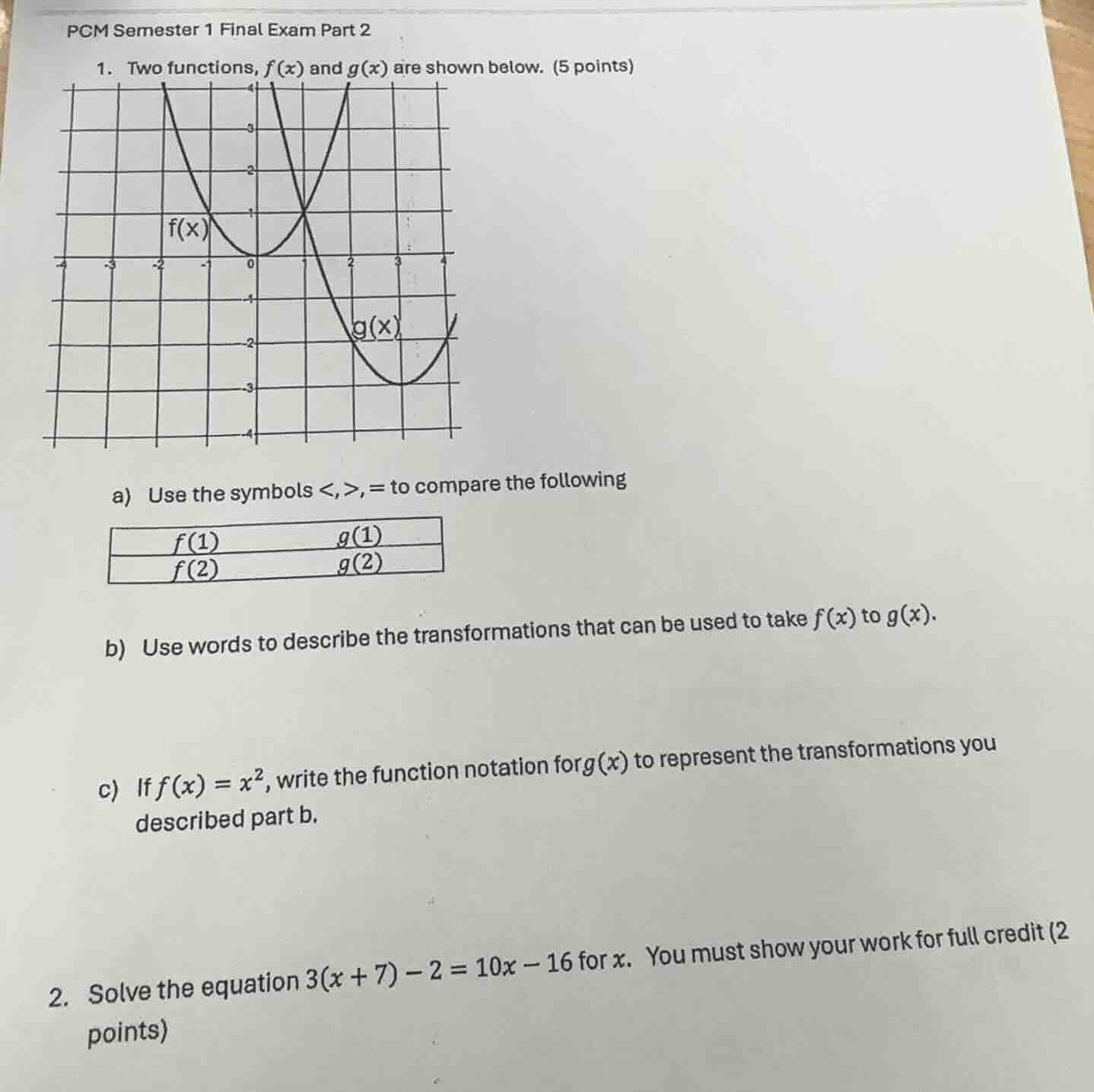
- two functions, ( f(x) ) and ( g(x) ) are shown below. (5 points)
image of two parabolas ( f(x) ) and ( g(x) ) on a coordinate grid
a) use the symbols ( <, >, = ) to compare the following
\begin{tabular}{|c|c|}
( f(1) ) & ( g(1) ) \\
( f(2) ) & ( g(2) ) \\
end{tabular}
b) use words to describe the transformations that can be used to take ( f(x) ) to ( g(x) ).
c) if ( f(x) = x^2 ), write the function notation for ( g(x) ) to represent the transformations you described part b.
- solve the equation ( 3(x + 7) - 2 = 10x - 16 ) for ( x ). you must show your work for full credit (2 points)
Problem 1a
Step1: Find \( f(1) \) and \( g(1) \)
From the graph, at \( x = 1 \), both \( f(x) \) and \( g(x) \) pass through the same point, so \( f(1)=g(1) \).
Step2: Find \( f(2) \) and \( g(2) \)
At \( x = 2 \), \( f(2) \) is at \( y = 4 \) (from the graph of \( f(x) \)) and \( g(2) \) is at \( y = -2 \) (from the graph of \( g(x) \)), so \( f(2)>g(2) \).
To transform \( f(x) \) to \( g(x) \), we observe the graph. First, there is a horizontal shift? No, looking at the vertex and the points, actually, the transformation involves a vertical shift? Wait, no, let's check the vertex. The vertex of \( f(x) \) is at \( (0,0) \), and the vertex of \( g(x) \) is at \( (3, -3) \)? Wait, no, maybe first a reflection? Wait, no, the graph of \( g(x) \) seems to be a translation. Wait, actually, from \( f(x) = x^2 \), \( g(x) \) appears to be a translation: first, shift right by 2 units? Wait, no, at \( x = 1 \), both meet. Wait, maybe a horizontal shift and vertical shift. Wait, the correct transformation: looking at the graph, \( f(x) \) is a parabola opening up with vertex at (0,0), \( g(x) \) is a parabola opening up with vertex at (3, -3)? Wait, no, maybe first, reflect? No, both open up. Wait, actually, the transformation is: shift the graph of \( f(x) \) to the right by 2 units and then down by 3 units? Wait, no, let's check the points. At \( x = 1 \), both are at (1,1). At \( x = 0 \), \( f(0)=0 \), \( g(0) \): wait, the graph of \( g(x) \) at \( x = 0 \): let's see, the graph of \( g(x) \) passes through (0,0)? No, wait the original graph: \( f(x) \) has vertex at (0,0), \( g(x) \) has vertex at (3, -3). Wait, maybe the correct transformation is: shift \( f(x) \) to the right by 2 units and then down by 3 units? Wait, no, let's re - examine. Alternatively, the transformation is a horizontal shift and vertical shift. Wait, actually, the correct description is: The function \( f(x) \) is transformed to \( g(x) \) by shifting the graph of \( f(x) \) 2 units to the right and 3 units down. Or maybe first, a reflection? No, both open upwards. Wait, another way: look at the equation. If \( f(x)=x^2 \), then \( g(x)=(x - 2)^2-3 \)? Wait, no, at \( x = 1 \), \( (1 - 2)^2-3=1 - 3=-2 \), but \( f(1)=1 \), \( g(1)=1 \). So that's not right. Wait, maybe the transformation is: shift right by 2 units and down by 3 units? No, maybe I made a mistake. Wait, the graph of \( g(x) \) at \( x = 2 \) is at \( y=-2 \), \( f(2)=4 \). Wait, maybe the correct transformation is: reflect over the x - axis? No, \( g(x) \) opens upwards. Wait, I think I messed up. Wait, the correct transformation: from \( f(x) \) to \( g(x) \), we can see that the graph of \( g(x) \) is the graph of \( f(x) \) shifted to the right by 2 units and then down by 3 units. Wait, but at \( x = 1 \), \( f(1)=1 \), \( g(1)=1 \), so when \( x = 1 \), \( (1 - 2)^2-3=1 - 3=-2
eq1 \). So that's wrong. Wait, maybe the transformation is a vertical shift and horizontal shift. Wait, let's look at the vertex. The vertex of \( f(x) \) is (0,0), the vertex of \( g(x) \) is (3, -3). So the transformation is: shift the graph of \( f(x) \) 3 units to the right and 3 units down. But at \( x = 1 \), \( f(1)=1 \), \( g(1)=1 \), so \( (1 - 3)^2-3=4 - 3 = 1 \), which matches. Ah, there we go. So the transformation is: shift the graph of \( f(x) \) 3 units to the right and 3 units down.
Step1: Recall the transformation rules
If we shift a function \( y = f(x) \) \( h \) units to the right, the function becomes \( y=f(x - h) \), and if we shift it \( k \) units down, the function becomes \( y=f(x - h)-k \).
Step2: Apply the transformation to \( f(x)=x^2 \)
From part b, we determined that we shift \( f(x) \) 3 units to the right and 3 units down. So \( h = 3 \) and \( k = 3 \).
So \( g(x)=f(x - 3)-3 \). Since \( f(x)=x^2 \), then \( g(x)=(x - 3)^2-3 \).

Snap & solve any problem in the app
Get step-by-step solutions on Sovi AI
Photo-based solutions with guided steps
Explore more problems and detailed explanations
\( f(1) = g(1) \), \( f(2) > g(2) \)