QUESTION IMAGE
Question
4
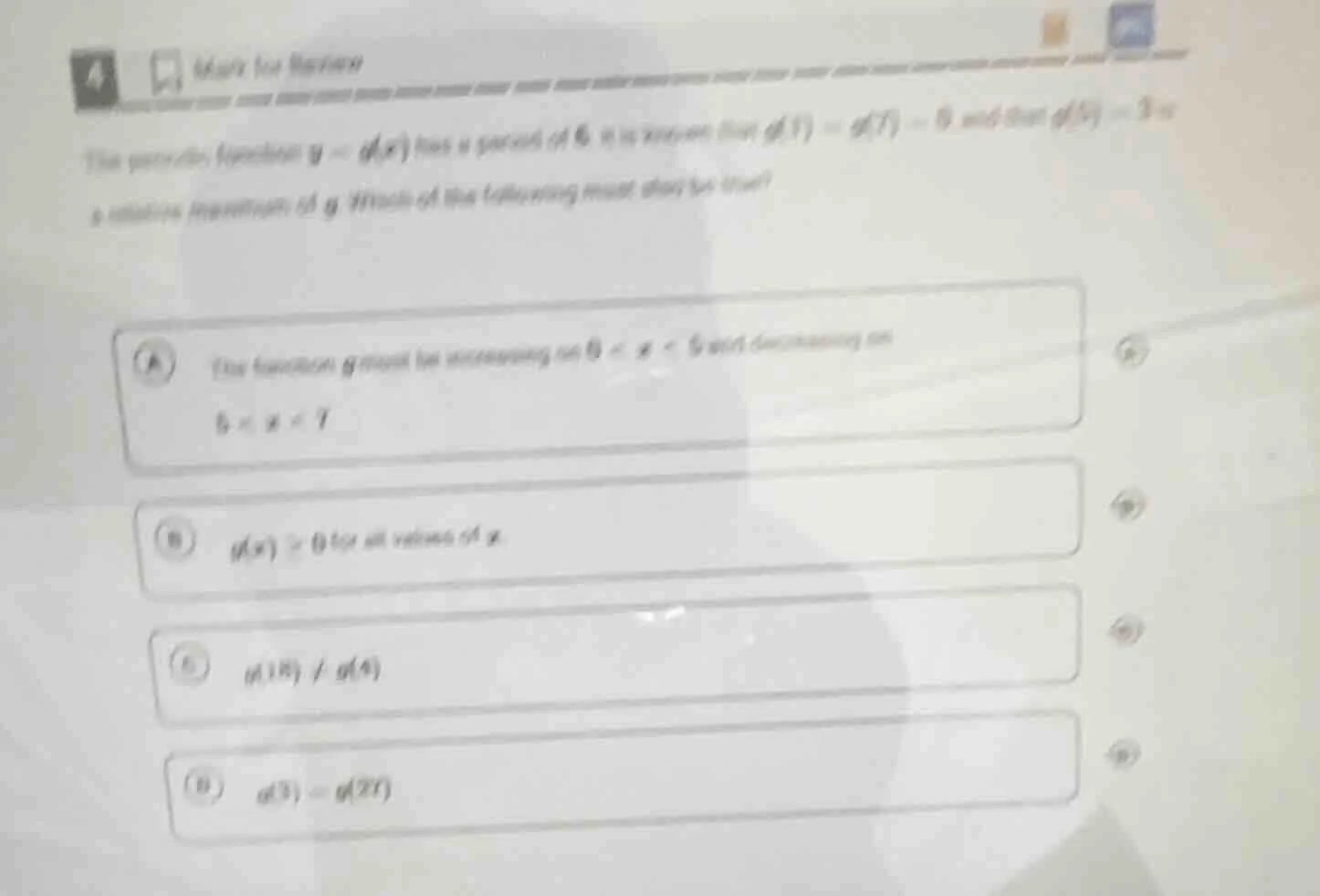
the periodic function $y = g(x)$ has a period of 6. it is known that $g(1) = g(7) = 0$, and that $g(5) = 3$ is a relative maximum of $g$. which of the following must also be true?
a. the function $g$ must be increasing on $0 < x < 5$ and decreasing on $5 < x < 7$
b. $g(x) \geq 0$ for all values of $x$
c. $g(13) \
eq g(1)$
d. $g(3) = g(21)$
Step1: Recall periodic function property
For a periodic function \(g(x)\) with period \(P\), \(g(x + nP) = g(x)\) for all integers \(n\). Here \(P=6\).
Step2: Analyze option A
A relative maximum at \(x=5\) does not guarantee monotonic intervals on \((0,5)\) and \((5,7)\); the function could fluctuate. This is not necessarily true.
Step3: Analyze option B
There is no information given that \(g(x)\geq0\) for all \(x\); this is not guaranteed.
Step4: Analyze option C
Using periodicity: \(g(13)=g(12+1)=g(6\times2 + 1)=g(1)\). We know \(g(1)=g(7)=g(6+1)=g(1)\), but \(g(1)
eq g(5)\) (since \(x=5\) is a relative max, not equal to \(g(1)\)). However, \(g(13)=g(1)\), so \(g(13)
eq g(5)\) is not necessarily false, but we check option D first.
Step5: Analyze option D
Using periodicity: \(g(23)=g(18+5)=g(6\times3 + 5)=g(5)\). This must be true.

Snap & solve any problem in the app
Get step-by-step solutions on Sovi AI
Photo-based solutions with guided steps
Explore more problems and detailed explanations
D. \(g(5)=g(23)\)