QUESTION IMAGE
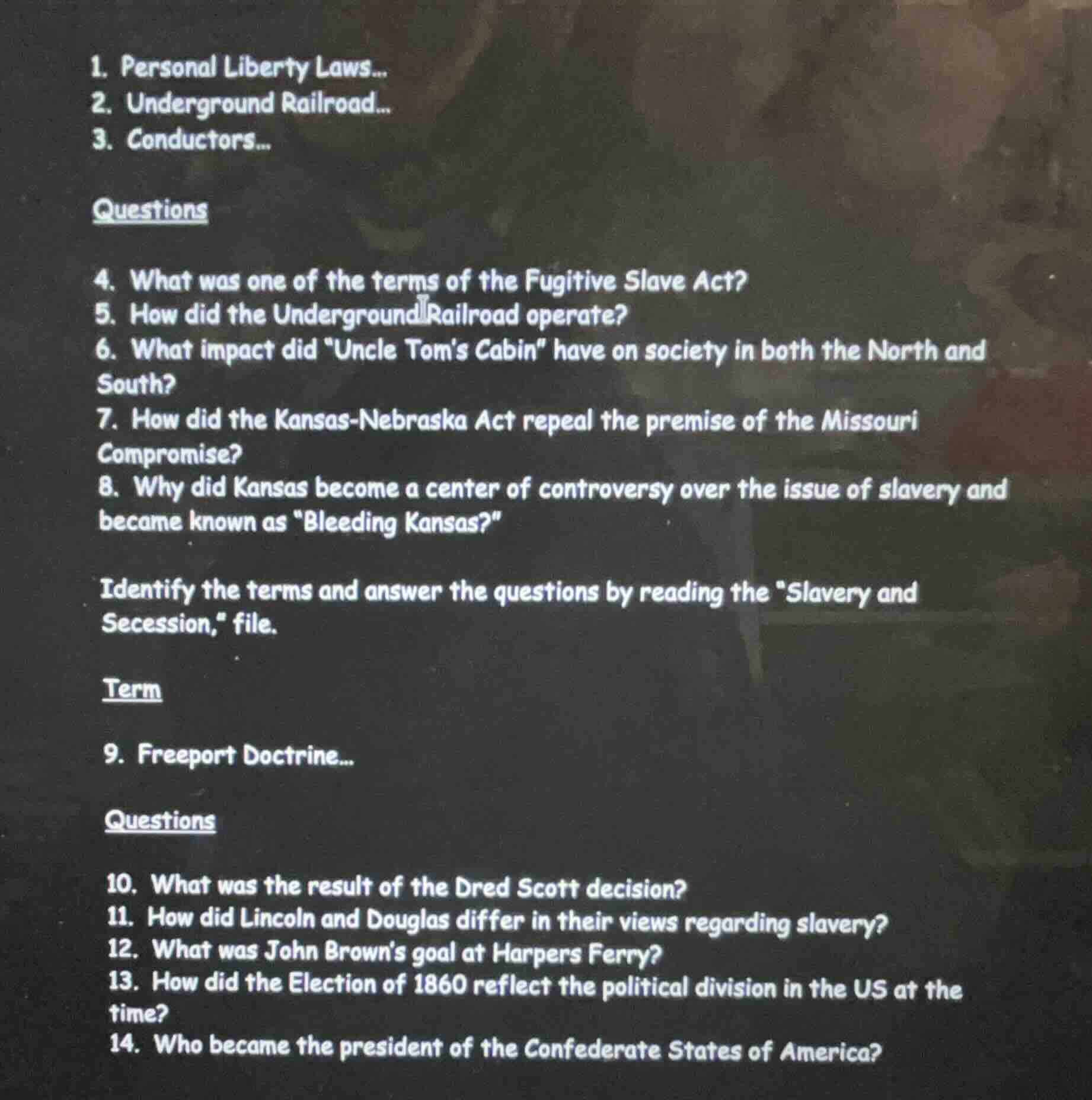
Question
- personal liberty laws...
- underground railroad...
- conductors...
questions
- what was one of the terms of the fugitive slave act?
- how did the underground railroad operate?
- what impact did \uncle toms cabin\ have on society in both the north and south?
- how did the kansas-nebraska act repeal the premise of the missouri compromise?
- why did kansas become a center of controversy over the issue of slavery and became known as \bleeding kansas?\
identify the terms and answer the questions by reading the \slavery and secession,\ file.
term
- freeport doctrine...
questions
- what was the result of the dred scott decision?
- how did lincoln and douglas differ in their views regarding slavery?
- what was john browns goal at harpers ferry?
- how did the election of 1860 reflect the political division in the us at the time?
- who became the president of the confederate states of america?
To answer these questions, we refer to historical knowledge about the era of slavery and secession in the US:
Question 4: What was one of the terms of the Fugitive Slave Act?
The Fugitive Slave Act (1850) required that escaped slaves be returned to their owners, even if found in free states. Federal marshals and citizens were obligated to assist in capturing fugitive slaves, and those who helped slaves escape could face fines or imprisonment.
Question 5: How did the Underground Railroad operate?
The Underground Railroad was a network of secret routes and safe houses. Enslaved people escaped at night, guided by “conductors” (abolitionists or free Black people) using coded signals (e.g., lanterns, songs). Stations (homes, churches) provided food, shelter, and directions to the next stop, often leading to Canada or free states.
Question 6: What impact did “Uncle Tom’s Cabin” have on society?
In the North, Harriet Beecher Stowe’s novel humanized enslaved people, fueling abolitionist sentiment. In the South, it was criticized as propaganda, deepening regional tensions over slavery. It also influenced international views, reducing support for the Confederacy.
Question 7: How did the Kansas - Nebraska Act repeal the Missouri Compromise?
The Missouri Compromise (1820) banned slavery north of 36°30′. The Kansas - Nebraska Act (1854) introduced “popular sovereignty,” allowing settlers in Kansas and Nebraska to vote on slavery, effectively nullifying the Missouri Compromise’s geographic restriction.
Question 8: Why was Kansas “Bleeding Kansas”?
After the Kansas - Nebraska Act, pro - slavery (Border Ruffians) and anti - slavery (Free - Soilers) settlers flooded Kansas to influence the slavery vote. Violent conflicts (e.g., Pottawatomie Massacre, raids) erupted between the groups, leading to the “Bleeding Kansas” label as a preview of the Civil War.
Question 10: What was the result of the Dred Scott decision?
The Supreme Court ruled (1857) that Dred Scott, an enslaved man, was not a citizen and could not sue. It also declared the Missouri Compromise unconstitutional (Congress could not ban slavery in territories), affirming slavery as a property right, which intensified sectional strife.
Question 11: Lincoln and Douglas on slavery?
Lincoln opposed the spread of slavery (believing it was morally wrong) and supported limiting it to existing slave states. Douglas, via “popular sovereignty,” argued settlers should decide slavery in territories, prioritizing self - government over the morality of slavery.
Question 12: John Brown’s goal at Harpers Ferry?
John Brown aimed to seize the federal arsenal at Harpers Ferry, arm enslaved people, and spark a slave rebellion across the South. He hoped this would destroy slavery, but the raid failed, and he was executed, becoming a martyr for abolitionists and a symbol of terror to slaveholders.
Question 13: How did the Election of 1860 reflect division?
The election had four candidates: Lincoln (Republican, anti - spread of slavery), Breckinridge (Southern Democrat, pro - slavery), Douglas (Northern Democrat, popular sovereignty), and Bell (Constitutional Union, unity). Lincoln won without Southern support, leading Southern states to secede, as they saw his victory as a threat to slavery.
Question 14: Who became the president of the Confederate States?
Jefferson Davis was elected president of the Confederate States of America in 1861, leading the seceded Southern states during the Civil War.
Term 9: Freeport Doctrine
During the Lincoln - Douglas debates, Dou…

Snap & solve any problem in the app
Get step-by-step solutions on Sovi AI
Photo-based solutions with guided steps
Explore more problems and detailed explanations
To answer these questions, we refer to historical knowledge about the era of slavery and secession in the US:
Question 4: What was one of the terms of the Fugitive Slave Act?
The Fugitive Slave Act (1850) required that escaped slaves be returned to their owners, even if found in free states. Federal marshals and citizens were obligated to assist in capturing fugitive slaves, and those who helped slaves escape could face fines or imprisonment.
Question 5: How did the Underground Railroad operate?
The Underground Railroad was a network of secret routes and safe houses. Enslaved people escaped at night, guided by “conductors” (abolitionists or free Black people) using coded signals (e.g., lanterns, songs). Stations (homes, churches) provided food, shelter, and directions to the next stop, often leading to Canada or free states.
Question 6: What impact did “Uncle Tom’s Cabin” have on society?
In the North, Harriet Beecher Stowe’s novel humanized enslaved people, fueling abolitionist sentiment. In the South, it was criticized as propaganda, deepening regional tensions over slavery. It also influenced international views, reducing support for the Confederacy.
Question 7: How did the Kansas - Nebraska Act repeal the Missouri Compromise?
The Missouri Compromise (1820) banned slavery north of 36°30′. The Kansas - Nebraska Act (1854) introduced “popular sovereignty,” allowing settlers in Kansas and Nebraska to vote on slavery, effectively nullifying the Missouri Compromise’s geographic restriction.
Question 8: Why was Kansas “Bleeding Kansas”?
After the Kansas - Nebraska Act, pro - slavery (Border Ruffians) and anti - slavery (Free - Soilers) settlers flooded Kansas to influence the slavery vote. Violent conflicts (e.g., Pottawatomie Massacre, raids) erupted between the groups, leading to the “Bleeding Kansas” label as a preview of the Civil War.
Question 10: What was the result of the Dred Scott decision?
The Supreme Court ruled (1857) that Dred Scott, an enslaved man, was not a citizen and could not sue. It also declared the Missouri Compromise unconstitutional (Congress could not ban slavery in territories), affirming slavery as a property right, which intensified sectional strife.
Question 11: Lincoln and Douglas on slavery?
Lincoln opposed the spread of slavery (believing it was morally wrong) and supported limiting it to existing slave states. Douglas, via “popular sovereignty,” argued settlers should decide slavery in territories, prioritizing self - government over the morality of slavery.
Question 12: John Brown’s goal at Harpers Ferry?
John Brown aimed to seize the federal arsenal at Harpers Ferry, arm enslaved people, and spark a slave rebellion across the South. He hoped this would destroy slavery, but the raid failed, and he was executed, becoming a martyr for abolitionists and a symbol of terror to slaveholders.
Question 13: How did the Election of 1860 reflect division?
The election had four candidates: Lincoln (Republican, anti - spread of slavery), Breckinridge (Southern Democrat, pro - slavery), Douglas (Northern Democrat, popular sovereignty), and Bell (Constitutional Union, unity). Lincoln won without Southern support, leading Southern states to secede, as they saw his victory as a threat to slavery.
Question 14: Who became the president of the Confederate States?
Jefferson Davis was elected president of the Confederate States of America in 1861, leading the seceded Southern states during the Civil War.
Term 9: Freeport Doctrine
During the Lincoln - Douglas debates, Douglas stated that while the Dred Scott decision allowed slavery in territories, settlers could still prevent it by refusing to pass laws protecting slave property (e.g., no slave codes). This clarified his “popular sovereignty” stance but split the Democratic Party.
(Note: For a more detailed and accurate response, consulting the “Slavery and Secession” file is recommended, as it may provide specific context or details.)