QUESTION IMAGE
Question
physical states and changes
name:
a. boiling
d. evaporation
g. liquid
j. solid
b. condensation
e. freezing
h. melting
k. sublimation
c. deposition
f. gas
i. plasma
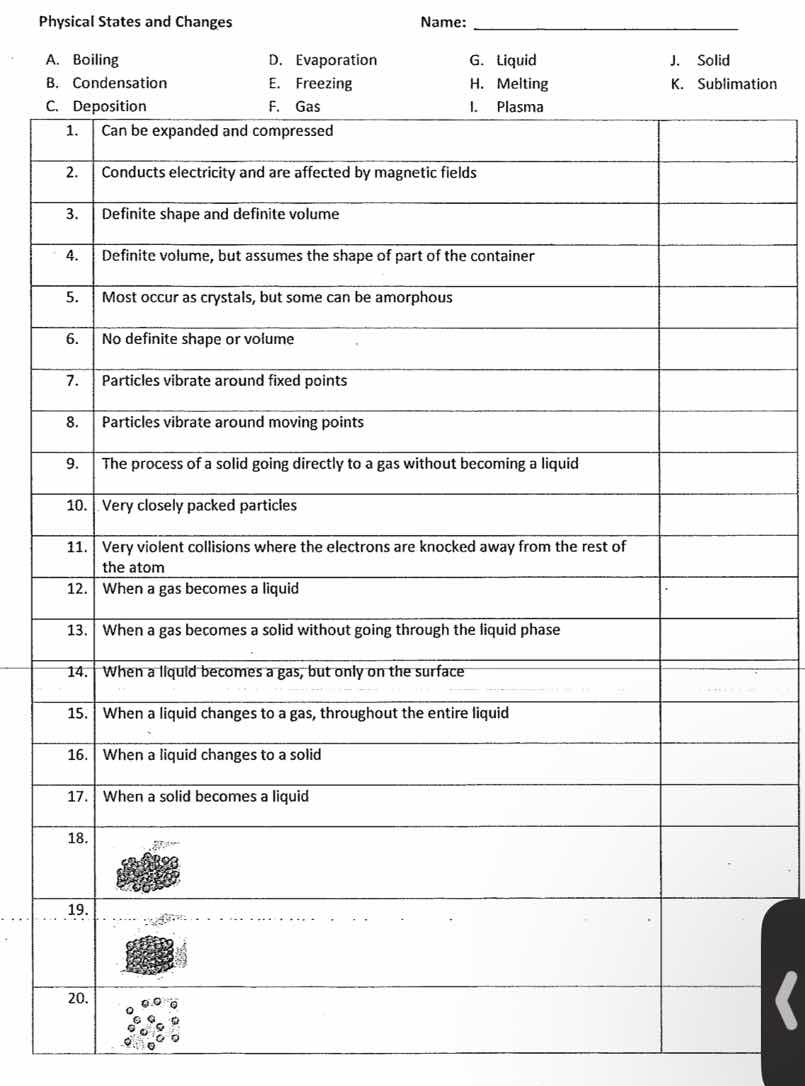
- can be expanded and compressed
- conducts electricity and are affected by magnetic fields
- definite shape and definite volume
- definite volume, but assumes the shape of part of the container
- most occur as crystals, but some can be amorphous
- no definite shape or volume
- particles vibrate around fixed points
- particles vibrate around moving points
- the process of a solid going directly to a gas without becoming a liquid
- very closely packed particles
- very violent collisions where the electrons are knocked away from the rest of the atom
- when a gas becomes a liquid
- when a gas becomes a solid without going through the liquid phase
- when a liquid becomes a gas, but only on the surface
- when a liquid changes to a gas, throughout the entire liquid
- when a liquid changes to a solid
- when a solid becomes a liquid
- image
- image
- image
Brief Explanations
Each item is matched to the correct physical state or phase change based on key properties and definitions:
- Gases have particles with large spacing, allowing expansion/compression.
- Plasma consists of charged particles, enabling conductivity and magnetic response.
- Solids have fixed particle positions, giving definite shape/volume.
- Liquids have fixed volume but take the container's shape.
- Solids commonly form crystals; some are amorphous (non-crystalline).
- Gases have no fixed shape/volume, filling their container.
- Solid particles vibrate in fixed positions.
- Liquid particles vibrate while moving freely within the volume.
- Sublimation is solid-to-gas phase change without liquid.
- Solid particles are tightly packed with minimal spacing.
- Plasma forms when electrons are stripped from atoms via high-energy collisions.
- Condensation is gas-to-liquid phase change.
- Deposition is gas-to-solid phase change without liquid.
- Evaporation is surface-only liquid-to-gas phase change.
- Boiling is liquid-to-gas phase change throughout the liquid.
- Freezing is liquid-to-solid phase change.
- Melting is solid-to-liquid phase change.
- The diagram shows closely packed, slightly disordered particles (liquid).
- The diagram shows tightly packed, ordered particles (solid).
- The diagram shows widely spaced, random particles (gas).

Snap & solve any problem in the app
Get step-by-step solutions on Sovi AI
Photo-based solutions with guided steps
Explore more problems and detailed explanations
- F. Gas
- I. Plasma
- J. Solid
- G. Liquid
- J. Solid
- F. Gas
- J. Solid
- G. Liquid
- K. Sublimation
- J. Solid
- I. Plasma
- B. Condensation
- C. Deposition
- D. Evaporation
- A. Boiling
- E. Freezing
- H. Melting
- G. Liquid
- J. Solid
- F. Gas