QUESTION IMAGE
Question
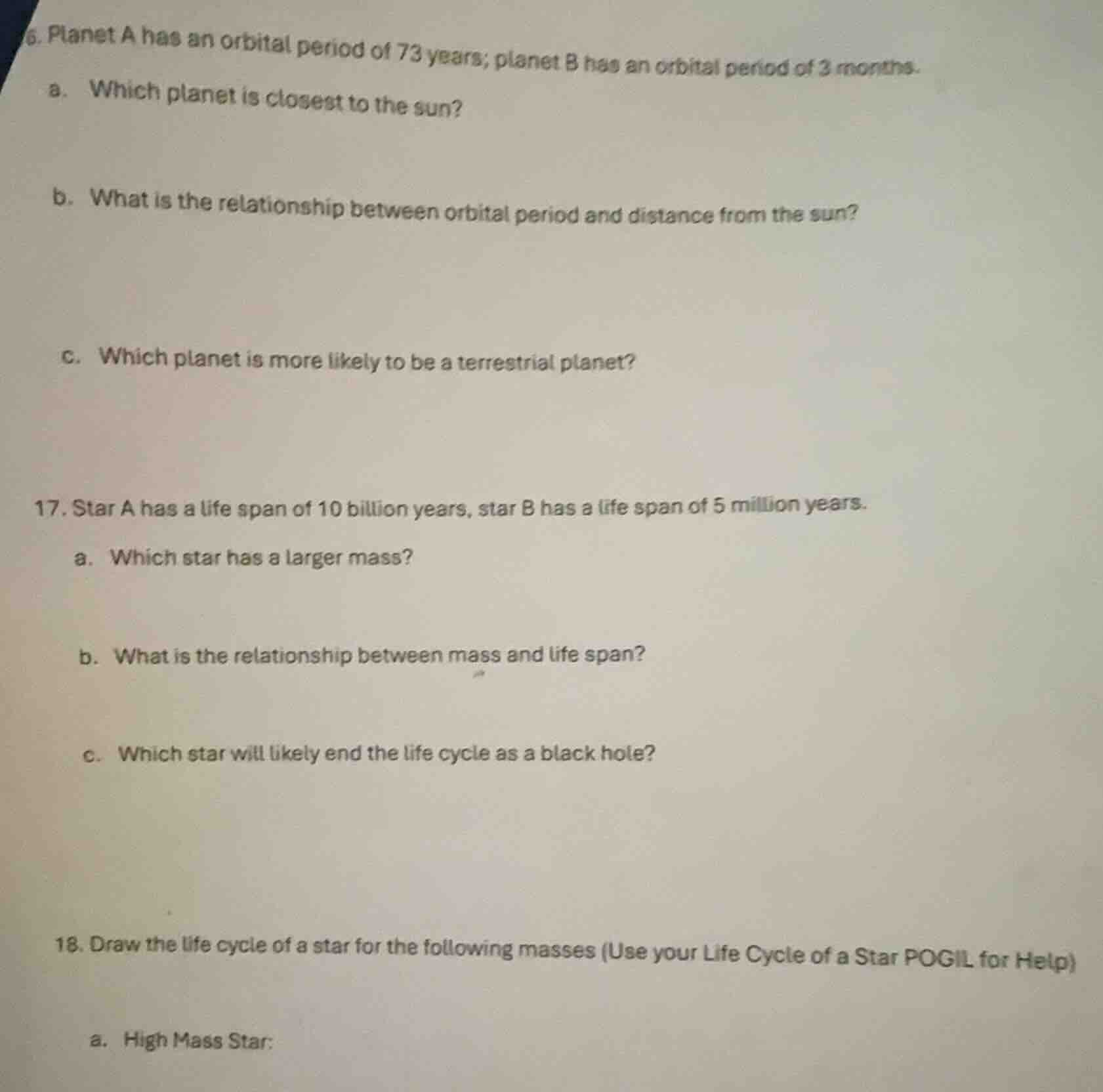
- planet a has an orbital period of 73 years; planet b has an orbital period of 3 months.
a. which planet is closest to the sun?
b. what is the relationship between orbital period and distance from the sun?
c. which planet is more likely to be a terrestrial planet?
- star a has a life span of 10 billion years, star b has a life span of 5 million years.
a. which star has a larger mass?
b. what is the relationship between mass and life span?
c. which star will likely end the life cycle as a black hole?
- draw the life cycle of a star for the following masses (use your life cycle of a star pogil for help)
a. high mass star:
For Question 16:
a. Based on orbital mechanics, shorter orbital periods mean a planet is closer to the sun, as it orbits faster due to stronger gravitational pull from the sun.
b. This relationship is defined by Kepler's Third Law, which formalizes the link between orbital period and orbital distance.
c. Terrestrial planets are typically found closer to their star, where rocky materials can condense and volatile ices/gases are stripped away by solar radiation.
For Question 17:
a. More massive stars burn through their nuclear fuel at a much faster rate, leading to shorter lifespans.
b. The core fusion rate in stars scales with mass in a non-linear way, so higher mass leads to drastically faster fuel consumption.
c. Only the most massive stars (those with much shorter lifespans) have the core mass required to collapse into a black hole at the end of their life.
For Question 18a:
High-mass stars follow a specific evolutionary path driven by their rapid fuel consumption and massive core.

Snap & solve any problem in the app
Get step-by-step solutions on Sovi AI
Photo-based solutions with guided steps
Explore more problems and detailed explanations
Question 16
a. Planet B
b. The longer a planet's orbital period, the greater its average distance from the sun (described by Kepler's Third Law: $T^2 \propto a^3$, where $T$ is orbital period and $a$ is semi-major axis of the orbit).
c. Planet B
Question 17
a. Star B
b. The greater a star's mass, the shorter its life span (massive stars burn fuel far more rapidly).
c. Star B
Question 18a
High Mass Star Life Cycle:
- Nebula (cloud of gas/dust)
- Protostar (gravitational collapse heats core)
- Main Sequence Star (hydrogen fuses to helium in core)
- Red Supergiant (helium core collapses, outer layers expand; heavier elements fuse in shells)
- Supernova (core collapses violently, outer layers explode)
- Black Hole or Neutron Star (core remains: if mass > 20x solar mass, it becomes a black hole; if 8-20x solar mass, a neutron star)