QUESTION IMAGE
Question
- planetary nebula
section four - understanding main ideas - high mass star
time
____ 1. black hole
____ 2. supernova
____ 3. protostar
____ 4. gravity causes this to condense into a protostar
____ 5. main sequence star
____ 6. when a star begins to run out of fuel and grows larger
____ 7. neutron star
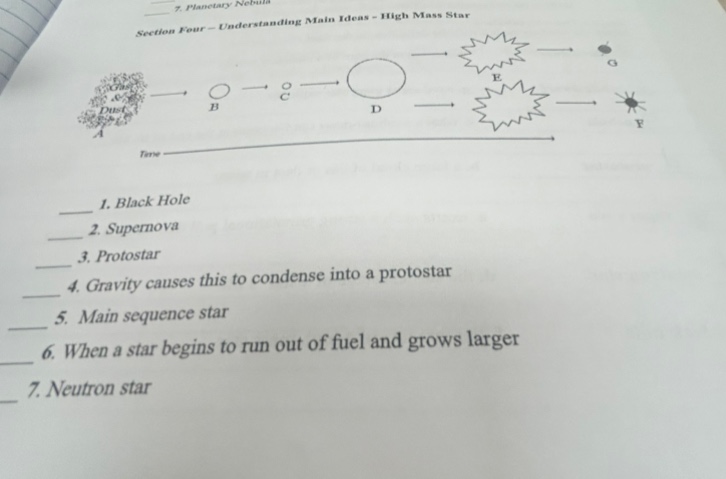
To solve this, we analyze the life cycle of a high - mass star:
1. Black Hole
A high - mass star, after a supernova explosion, can collapse further to form a black hole. In the diagram, the final stage for the upper sequence (related to black hole formation) is G. So the answer is G.
2. Supernova
A supernova is an explosion that occurs at the end of a high - mass star's life before it becomes a neutron star or black hole. In the diagram, E represents the supernova. So the answer is E.
3. Protostar
A protostar is the early stage of a star's formation, formed from a cloud of gas and dust (A) that condenses under gravity. In the diagram, B is the protostar. So the answer is B.
4. Gravity causes this to condense into a protostar
The cloud of gas and dust (A) is condensed by gravity into a protostar. So the answer is A.
5. Main sequence star
After the protostar (B) stage, the star enters the main sequence stage. In the diagram, C is the main sequence star. So the answer is C.
6. When a star begins to run out of fuel and grows larger
When a main sequence star (C) runs out of fuel, it expands to become a red giant (or in the case of high - mass stars, a supergiant). In the diagram, D represents this expanded stage. So the answer is D.
7. Neutron star
After a supernova (E), a high - mass star can form a neutron star. In the diagram, F represents the neutron star. So the answer is F.
Final Answers:
- G
- E
- B
- A
- C
- D
- F

Snap & solve any problem in the app
Get step-by-step solutions on Sovi AI
Photo-based solutions with guided steps
Explore more problems and detailed explanations
To solve this, we analyze the life cycle of a high - mass star:
1. Black Hole
A high - mass star, after a supernova explosion, can collapse further to form a black hole. In the diagram, the final stage for the upper sequence (related to black hole formation) is G. So the answer is G.
2. Supernova
A supernova is an explosion that occurs at the end of a high - mass star's life before it becomes a neutron star or black hole. In the diagram, E represents the supernova. So the answer is E.
3. Protostar
A protostar is the early stage of a star's formation, formed from a cloud of gas and dust (A) that condenses under gravity. In the diagram, B is the protostar. So the answer is B.
4. Gravity causes this to condense into a protostar
The cloud of gas and dust (A) is condensed by gravity into a protostar. So the answer is A.
5. Main sequence star
After the protostar (B) stage, the star enters the main sequence stage. In the diagram, C is the main sequence star. So the answer is C.
6. When a star begins to run out of fuel and grows larger
When a main sequence star (C) runs out of fuel, it expands to become a red giant (or in the case of high - mass stars, a supergiant). In the diagram, D represents this expanded stage. So the answer is D.
7. Neutron star
After a supernova (E), a high - mass star can form a neutron star. In the diagram, F represents the neutron star. So the answer is F.
Final Answers:
- G
- E
- B
- A
- C
- D
- F