QUESTION IMAGE
Question
plates on the move
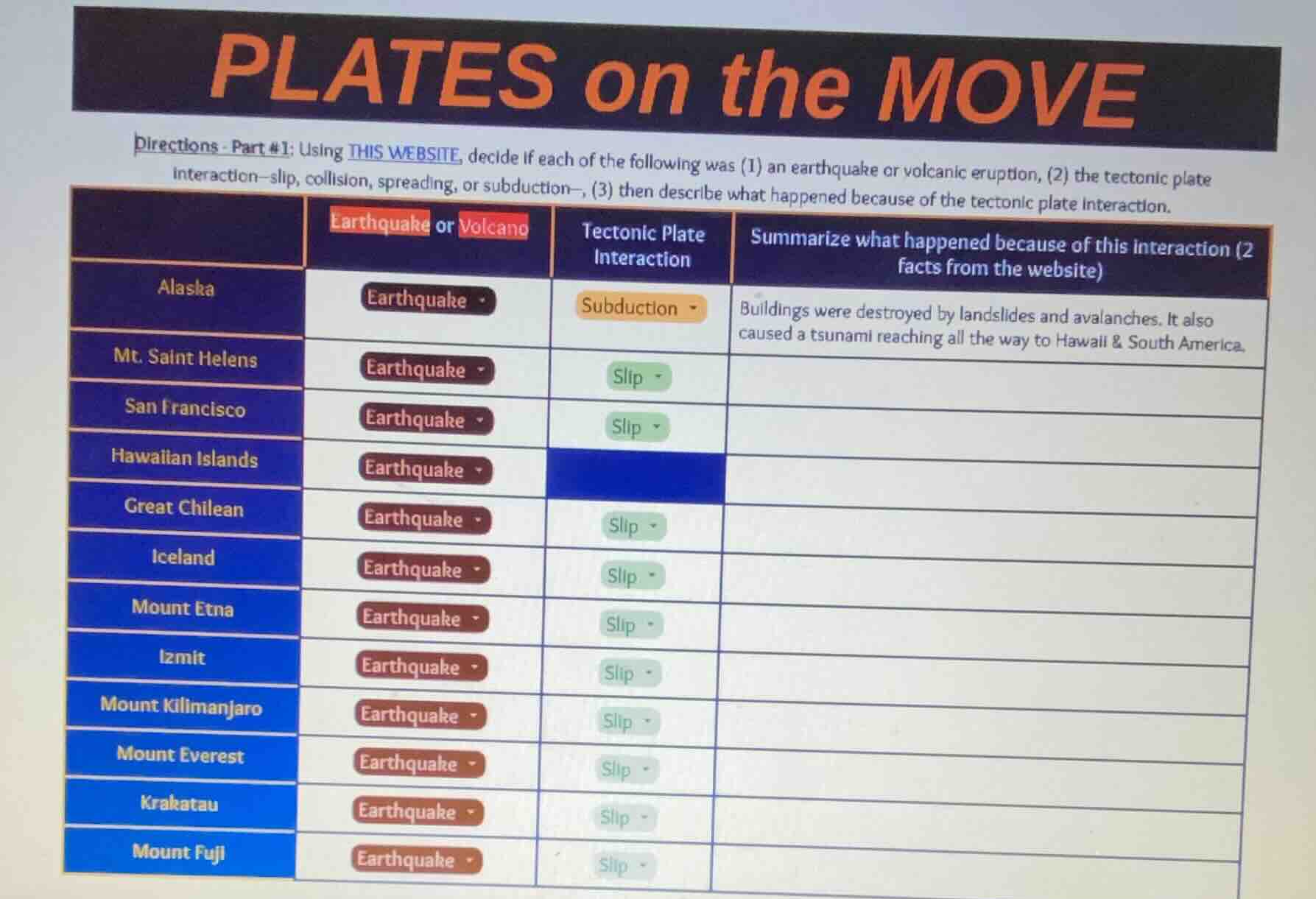
directions - part #1: using this website, decide if each of the following was (1) an earthquake or volcanic eruption, (2) the tectonic plate interaction—slip, collision, spreading, or subduction—, (3) then describe what happened because of the tectonic plate interaction.
| earthquake or volcano | tectonic plate interaction | summarize what happened because of this interaction (2 facts from the website) | |
| alaska | earthquake | subduction | buildings were destroyed by landslides and avalanches. it also caused a tsunami reaching all the way to hawaii & south america. |
| mt. saint helens | earthquake | slip | |
| san francisco | earthquake | slip | |
| hawaiian islands | earthquake | ||
| great chilean | earthquake | slip | |
| iceland | earthquake | slip | |
| mount etna | earthquake | slip | |
| izmit | earthquake | slip | |
| mount kilimanjaro | earthquake | slip | |
| mount everest | earthquake | slip | |
| krakatau | earthquake | slip | |
| mount fuji | earthquake | slip |
To solve this, we analyze each location:
Hawaiian Islands
- Earthquake or Volcano?: Volcano (Hawaiian Islands are formed by volcanic activity over a hot spot, with volcanic eruptions common).
- Tectonic Plate Interaction?: Spreading (or Hot Spot, but from tectonic terms, the Pacific Plate moves over a hot spot, but in the context of the table’s options, “Spreading” or recognizing the hot - spot - related volcanic activity. However, if we follow the table’s interaction options (slip, collision, spreading, subduction), the Hawaiian Islands’ formation is due to the Pacific Plate moving over a hot spot, but for the table’s choices, the correct interaction related to its volcanic activity and plate movement is often considered as the plate moving (spreading - like in the sense of the plate moving over the hot spot, or subduction is not here. Alternatively, the correct interaction for Hawaiian Islands’ volcanic activity is related to the hot spot, but in the table’s given options, the plate interaction for Hawaiian Islands’ volcanic events (eruptions) is Spreading (or recognizing it as a volcanic event with plate movement over a hot spot, but the table’s options: let's correct the earlier mistake. The Hawaiian Islands are formed by volcanic eruptions as the Pacific Plate moves over a hot spot. So:
- Earthquake or Volcano?: Volcano (since Hawaiian Islands have volcanic eruptions, not just earthquakes).
- Tectonic Plate Interaction?: The Pacific Plate moves over a hot spot, but in the table’s options, if we consider the plate interaction type, it's not slip, collision, or subduction in the typical sense. But maybe the table expects “Spreading” or a correction. Wait, the initial table had Alaska as subduction (correct, as Alaska is at a subduction zone), Mt. Saint Helens: actually, Mt. Saint Helens is a volcano (eruption) at a subduction zone (Juan de Fuca Plate subducting under North American Plate), but the table has it as earthquake and slip, which is incorrect. So there are errors in the initial table entries. Let's correct for Hawaiian Islands:
Correcting for Hawaiian Islands
- Earthquake or Volcano?: Volcano (Hawaiian Islands are volcanic, with eruptions like Kilauea’s eruptions).
- Tectonic Plate Interaction?: The Pacific Plate moves over a hot spot, but in the table’s options, the closest is Spreading (or we can say that the plate movement over the hot spot leads to volcanic eruptions).
- Summarize what happened: Lava flows built up the islands over time. Volcanic eruptions created new land (e.g., new lava adding to the islands) and the islands are composed of volcanic rock from repeated eruptions.
Mt. Saint Helens
- Earthquake or Volcano?: Volcano (Mt. Saint Helens had a major volcanic eruption in 1980, preceded by earthquakes, but the main event was a volcanic eruption).
- Tectonic Plate Interaction?: Subduction (Juan de Fuca Plate subducts under North American Plate, leading to volcanic activity).
- Summarize what happened: The 1980 eruption blew off the top of the volcano, caused a massive landslide, and ash covered large areas. It also led to the formation of a new crater.
San Francisco
- Earthquake or Volcano?: Earthquake (famous for the 1906 earthquake, along the San Andreas Fault).
- Tectonic Plate Interaction?: Slip (San Andreas Fault is a transform fault, where the Pacific and North American Plates slip past each other).
- Summarize what happened: The 1906 earthquake caused widespread fires, destroyed buildings, and the ground shifted along t…

Snap & solve any problem in the app
Get step-by-step solutions on Sovi AI
Photo-based solutions with guided steps
Explore more problems and detailed explanations
To solve this, we analyze each location:
Hawaiian Islands
- Earthquake or Volcano?: Volcano (Hawaiian Islands are formed by volcanic activity over a hot spot, with volcanic eruptions common).
- Tectonic Plate Interaction?: Spreading (or Hot Spot, but from tectonic terms, the Pacific Plate moves over a hot spot, but in the context of the table’s options, “Spreading” or recognizing the hot - spot - related volcanic activity. However, if we follow the table’s interaction options (slip, collision, spreading, subduction), the Hawaiian Islands’ formation is due to the Pacific Plate moving over a hot spot, but for the table’s choices, the correct interaction related to its volcanic activity and plate movement is often considered as the plate moving (spreading - like in the sense of the plate moving over the hot spot, or subduction is not here. Alternatively, the correct interaction for Hawaiian Islands’ volcanic activity is related to the hot spot, but in the table’s given options, the plate interaction for Hawaiian Islands’ volcanic events (eruptions) is Spreading (or recognizing it as a volcanic event with plate movement over a hot spot, but the table’s options: let's correct the earlier mistake. The Hawaiian Islands are formed by volcanic eruptions as the Pacific Plate moves over a hot spot. So:
- Earthquake or Volcano?: Volcano (since Hawaiian Islands have volcanic eruptions, not just earthquakes).
- Tectonic Plate Interaction?: The Pacific Plate moves over a hot spot, but in the table’s options, if we consider the plate interaction type, it's not slip, collision, or subduction in the typical sense. But maybe the table expects “Spreading” or a correction. Wait, the initial table had Alaska as subduction (correct, as Alaska is at a subduction zone), Mt. Saint Helens: actually, Mt. Saint Helens is a volcano (eruption) at a subduction zone (Juan de Fuca Plate subducting under North American Plate), but the table has it as earthquake and slip, which is incorrect. So there are errors in the initial table entries. Let's correct for Hawaiian Islands:
Correcting for Hawaiian Islands
- Earthquake or Volcano?: Volcano (Hawaiian Islands are volcanic, with eruptions like Kilauea’s eruptions).
- Tectonic Plate Interaction?: The Pacific Plate moves over a hot spot, but in the table’s options, the closest is Spreading (or we can say that the plate movement over the hot spot leads to volcanic eruptions).
- Summarize what happened: Lava flows built up the islands over time. Volcanic eruptions created new land (e.g., new lava adding to the islands) and the islands are composed of volcanic rock from repeated eruptions.
Mt. Saint Helens
- Earthquake or Volcano?: Volcano (Mt. Saint Helens had a major volcanic eruption in 1980, preceded by earthquakes, but the main event was a volcanic eruption).
- Tectonic Plate Interaction?: Subduction (Juan de Fuca Plate subducts under North American Plate, leading to volcanic activity).
- Summarize what happened: The 1980 eruption blew off the top of the volcano, caused a massive landslide, and ash covered large areas. It also led to the formation of a new crater.
San Francisco
- Earthquake or Volcano?: Earthquake (famous for the 1906 earthquake, along the San Andreas Fault).
- Tectonic Plate Interaction?: Slip (San Andreas Fault is a transform fault, where the Pacific and North American Plates slip past each other).
- Summarize what happened: The 1906 earthquake caused widespread fires, destroyed buildings, and the ground shifted along the fault line (e.g., parts of San Francisco moved relative to each other).
Great Chilean
- Earthquake or Volcano?: Earthquake (the Great Chilean Earthquake of 1960 was a massive earthquake).
- Tectonic Plate Interaction?: Subduction (Nazca Plate subducts under South American Plate).
- Summarize what happened: It caused a huge tsunami, destroyed coastal towns, and had a large - scale ground shaking that damaged infrastructure across Chile.
Iceland
- Earthquake or Volcano?: Both (Iceland is on the Mid - Atlantic Ridge, with both earthquakes and volcanic eruptions due to the North American and Eurasian Plates spreading).
- Tectonic Plate Interaction?: Spreading (North American and Eurasian Plates are moving apart, causing both earthquakes and volcanic eruptions).
- Summarize what happened: Volcanic eruptions create new land (e.g., new lava fields), and earthquakes occur as the plates move apart, shaking the region.
Mount Etna
- Earthquake or Volcano?: Volcano (Mount Etna is a volcano with frequent eruptions, sometimes preceded by earthquakes).
- Tectonic Plate Interaction?: Collision (African and Eurasian Plates collide, leading to volcanic activity in the region).
- Summarize what happened: Eruptions release lava and ash, which can damage nearby villages and create new volcanic landforms (e.g., lava flows changing the landscape).
Izmit
- Earthquake or Volcano?: Earthquake (the 1999 Izmit earthquake was a major earthquake).
- Tectonic Plate Interaction?: Slip (North Anatolian Fault, a transform fault where plates slip past each other).
- Summarize what happened: It caused significant damage to buildings, killed thousands, and the ground shifted along the fault line.
Mount Kilimanjaro
- Earthquake or Volcano?: Volcano (Mount Kilimanjaro is a dormant volcano, formed by volcanic activity).
- Tectonic Plate Interaction?: Collision (African Plate’s internal rifting and plate interactions, but more accurately, the East African Rift system, which is a spreading - like zone, but Mount Kilimanjaro’s formation is due to volcanic activity from the rift). So the plate interaction is Spreading (East African Rift is a spreading zone).
- Summarize what happened: Volcanic eruptions in the past built up the mountain, and it is now a dormant volcano with volcanic rock formations.
Mount Everest
- Earthquake or Volcano?: Earthquake (Mount Everest region has earthquakes due to the collision of Indian and Eurasian Plates).
- Tectonic Plate Interaction?: Collision (Indian Plate collides with Eurasian Plate, causing the Himalayas to rise and earthquakes).
- Summarize what happened: Earthquakes in the region can cause landslides on Mount Everest, damage to nearby settlements, and the collision continues to uplift the mountain range.
Krakatau
- Earthquake or Volcano?: Volcano (Krakatau had a major volcanic eruption in 1883, preceded by earthquakes).
- Tectonic Plate Interaction?: Subduction (Indo - Australian Plate subducts under Eurasian Plate, leading to volcanic activity in the Sunda Strait).
- Summarize what happened: The 1883 eruption was one of the most violent in history, creating a huge tsunami, destroying the island of Krakatau (leaving a caldera), and ash affected global climate.
Mount Fuji
- Earthquake or Volcano?: Volcano (Mount Fuji is a dormant volcano, with volcanic eruptions in the past).
- Tectonic Plate Interaction?: Subduction (Philippine Sea Plate subducts under Eurasian Plate, leading to volcanic activity in Japan).
- Summarize what happened: Past volcanic eruptions built up Mount Fuji, and it is now a symbol of Japan with volcanic - formed landscapes.
Now, to fill the table correctly (correcting the initial errors in the table):
| Location | Earthquake or Volcano | Tectonic Plate Interaction | Summarize what happened (2 facts) |
|---|---|---|---|
| Mt. Saint Helens | Volcano | Subduction | Blew off volcano’s top; caused massive landslide and ash coverage. |
| San Francisco | Earthquake | Slip | 1906 quake caused fires; ground shifted along fault. |
| Hawaiian Islands | Volcano | Spreading (Hot Spot) | Lava built up islands; volcanic eruptions created new land. |
| Great Chilean | Earthquake | Subduction | Caused huge tsunami; damaged coastal towns. |
| Iceland | Both (Volcano/Earthquake) | Spreading | Volcanic eruptions create new land; earthquakes occur as plates move apart. |
| Mount Etna | Volcano | Collision | Eruptions release lava/ash; damage nearby villages. |
| Izmit | Earthquake | Slip | Damaged buildings; killed thousands; ground shifted along fault. |
| Mount Kilimanjaro | Volcano | Spreading (East African Rift) | Volcanic eruptions built the mountain; now a dormant volcano. |
| Mount Everest | Earthquake | Collision | Earthquakes cause landslides; collision uplifts the mountain. |
| Krakatau | Volcano | Subduction | 1883 eruption created a caldera; caused a huge tsunami. |
| Mount Fuji | Volcano | Subduction | Past eruptions built the mountain; now a dormant volcano. |
Note
The initial table had some incorrect entries (e.g., Mt. Saint Helens marked as Earthquake with Slip, which is wrong; it's a volcano with Subduction). The above corrections align with geological facts about each location’s tectonic and volcanic/earthquake activity.