QUESTION IMAGE
Question
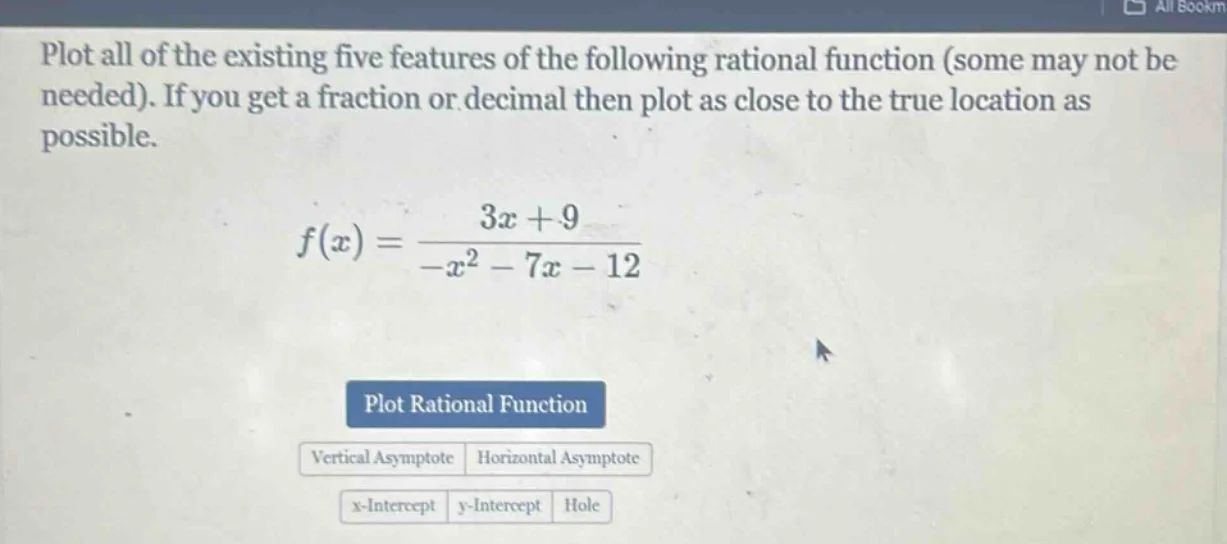
plot all of the existing five features of the following rational function (some may not be needed). if you get a fraction or decimal then plot as close to the true location as possible.
$f(x) = \frac{3x + 9}{-x^2 - 7x - 12}$
plot rational function
vertical asymptote horizontal asymptote
x - intercept y - intercept hole
Step1: Simplify the function
First, factor the numerator and the denominator.
The numerator: \(3x + 9 = 3(x + 3)\)
The denominator: \(-x^2 - 7x - 12 = - (x^2 + 7x + 12) = - (x + 3)(x + 4)\)
So the function becomes \(f(x) = \frac{3(x + 3)}{- (x + 3)(x + 4)} = \frac{3}{- (x + 4)}\) (after canceling the common factor \(x + 3\), but we need to note the domain: \(x
eq - 3\) and \(x
eq - 4\))
Step2: Find Vertical Asymptote
Vertical asymptotes occur where the denominator is zero (after canceling common factors). The denominator after canceling is \(-(x + 4)\), so set \(x + 4 = 0\), we get \(x = - 4\). Also, we need to check the canceled factor \(x + 3 = 0\) gives \(x = - 3\), but since we canceled \(x + 3\), we need to see if there is a hole or not. Wait, when we cancel \(x + 3\), the original function is undefined at \(x = - 3\) and \(x = - 4\). But after canceling, the simplified function is \(\frac{3}{- (x + 4)}\) which is undefined at \(x = - 4\) (vertical asymptote) and at \(x = - 3\), the simplified function is defined (since plugging \(x = - 3\) into \(\frac{3}{- (x + 4)}\) gives \(\frac{3}{- (-3 + 4)} = \frac{3}{-1} = - 3\)), so there is a hole at \(x = - 3\) (since the original function is undefined there but the simplified one is defined). Wait, no: the original function's denominator is \(-(x + 3)(x + 4)\), so when \(x = - 3\), denominator is zero, numerator is \(3(-3) + 9 = 0\), so it's a hole (since both numerator and denominator are zero at \(x = - 3\)). When \(x = - 4\), numerator is \(3(-4) + 9 = - 12 + 9 = - 3
eq 0\), so vertical asymptote at \(x = - 4\).
Step3: Find Horizontal Asymptote
For rational functions, if the degree of the numerator (\(n\)) is less than the degree of the denominator (\(m\)), the horizontal asymptote is \(y = 0\). Here, degree of numerator is 1, degree of denominator is 2, so \(n < m\), so horizontal asymptote is \(y = 0\).
Step4: Find x - Intercept
x - intercept is where \(f(x) = 0\), so set numerator equal to zero (denominator not zero). Numerator is \(3x + 9 = 0\), \(3x = - 9\), \(x = - 3\). But at \(x = - 3\), the function has a hole (since denominator is zero there), so there is no x - intercept (because the function is not defined at \(x = - 3\) in the original function, or wait, when we cancel, the simplified function is \(\frac{3}{- (x + 4)}\), which is never zero (since numerator is 3, a constant), so actually, there is no x - intercept? Wait, original function: numerator \(3x + 9 = 0\) when \(x = - 3\), but at \(x = - 3\), denominator is also zero, so it's a hole, not an x - intercept. So x - intercept: none? Wait, no: the x - intercept is a point where the graph crosses the x - axis, i.e., \(y = 0\). For the original function, \(f(x) = 0\) implies \(3x + 9 = 0\) (and denominator \(
eq 0\)). But \(3x + 9 = 0\) gives \(x = - 3\), where denominator is zero, so there is no x - intercept (because the function is not defined at \(x = - 3\) in the domain of the function, since denominator is zero there). Wait, but when we cancel, the simplified function is \(\frac{3}{- (x + 4)}\), which is never zero (since numerator is 3), so x - intercept: none.
Step5: Find y - Intercept
y - intercept is where \(x = 0\). Plug \(x = 0\) into \(f(x)\): \(f(0)=\frac{3(0)+9}{-0^2 - 7(0)-12}=\frac{9}{-12}=-\frac{3}{4}=-0.75\)
Step6: Find Hole
Hole occurs where both numerator and denominator are zero. As we saw, at \(x = - 3\), numerator \(3x + 9 = 0\) and denominator \(-x^2 - 7x - 12 = 0\), so the hole is at \(x = - 3\). To find the y - coordinate of the hole, plug \(x = - 3\) into the…

Snap & solve any problem in the app
Get step-by-step solutions on Sovi AI
Photo-based solutions with guided steps
Explore more problems and detailed explanations
- Vertical Asymptote: \(x = - 4\)
- Horizontal Asymptote: \(y = 0\)
- Hole: \((-3, - 3)\)
- y - Intercept: \((0, -\frac{3}{4})\) (or \((0, - 0.75)\))
- x - Intercept: None (because the only solution to \(f(x)=0\) is at a hole)