QUESTION IMAGE
Question
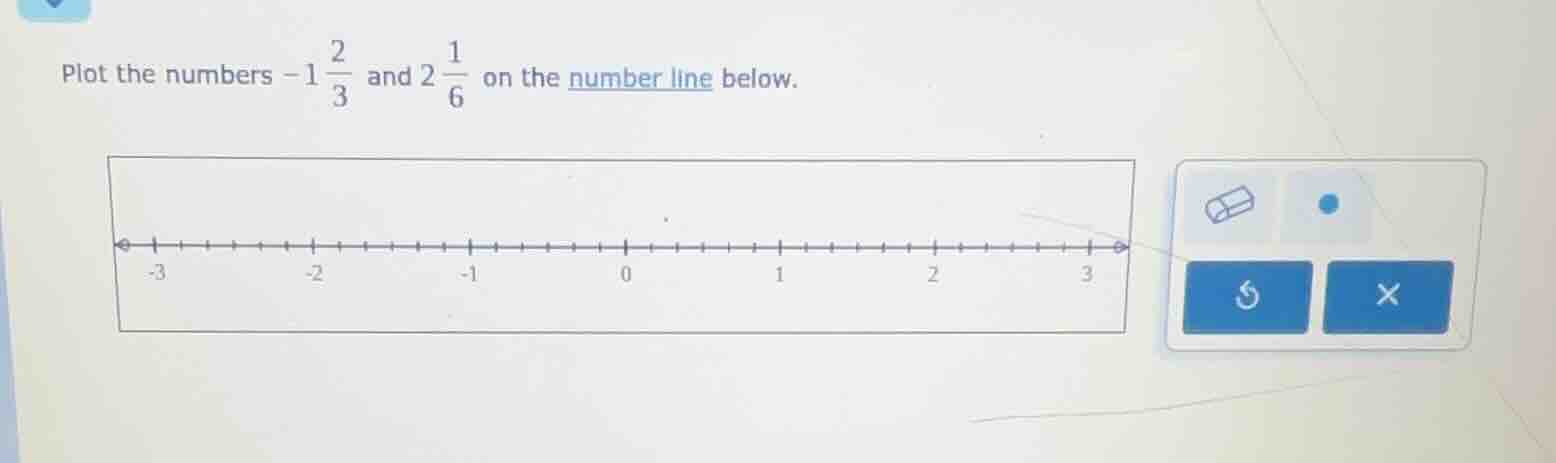
plot the numbers (-1\frac{2}{3}) and (2\frac{1}{6}) on the number line below.
Step1: Analyze \(-1\frac{2}{3}\)
First, convert \(-1\frac{2}{3}\) to an improper fraction or decimal for easier plotting. \(-1\frac{2}{3}=-\frac{5}{3}\approx - 1.67\). Now, look at the number line. The distance between -2 and -1 is divided into equal parts. Let's find the scale: from -3 to -2, -2 to -1, -1 to 0, 0 to 1, 1 to 2, 2 to 3, each interval (between two integers) is divided into 6 small ticks? Wait, no, let's count the ticks between -1 and 0: from -1 to 0, how many small ticks? Let's see, from -1 to 0, if we look at the number line, between -1 and 0, there are 6 small ticks? Wait, no, let's check the position of \(-1\frac{2}{3}\). \(-1\frac{2}{3}=-\frac{5}{3}\), and \(\frac{5}{3}\approx1.67\) units to the left of 0, but since it's negative, it's to the left of 0. Wait, actually, \(-1\frac{2}{3}\) is between -2 and -1? No, \(-1\frac{2}{3}\) is greater than -2 (since \(-2 = -\frac{6}{3}\), and \(-\frac{5}{3}>-\frac{6}{3}\)) and less than -1. So between -2 and -1, the distance from -1 is \(\frac{2}{3}\) units. Let's convert \(\frac{2}{3}\) to sixths: \(\frac{2}{3}=\frac{4}{6}\). So from -1, moving 4 ticks to the left (since it's negative, towards -2) would be \(-1 - \frac{4}{6}=-1\frac{4}{6}=-1\frac{2}{3}\). Wait, maybe better to find the scale: each small tick is \(\frac{1}{6}\) unit? Wait, let's check the number line: from 0 to 1, how many small ticks? Let's count: from 0 to 1, there are 6 small ticks? Wait, no, looking at the number line, between -3 and -2, -2 and -1, -1 and 0, 0 and 1, 1 and 2, 2 and 3, each interval (between two consecutive integers) has 6 small ticks? Wait, no, let's see the distance between -1 and 0: if we count the ticks, from -1 to 0, there are 6 small ticks? Wait, the number line has marks at -3, -2, -1, 0, 1, 2, 3. Between each pair of these, how many small ticks? Let's see, between -1 and 0: from -1 (the integer mark) to 0 (the integer mark), there are 6 small ticks? Wait, no, maybe each small tick is \(\frac{1}{6}\) unit? Wait, no, let's take \(-1\frac{2}{3}\). Let's convert \(-1\frac{2}{3}\) to sixths: \(-1\frac{2}{3}=-\frac{5}{3}=-\frac{10}{6}\). Wait, no, \(-1\frac{2}{3}= -1 - \frac{2}{3}= - \frac{3}{3}-\frac{2}{3}=-\frac{5}{3}\). Now, let's see the scale: from -1 to 0, if we have 6 small ticks, each tick is \(\frac{1}{6}\) unit. So \(-1\frac{2}{3}=-\frac{5}{3}=-\frac{10}{6}\). Wait, no, \(\frac{5}{3}=\frac{10}{6}\), so \(-\frac{5}{3}=-\frac{10}{6}\). But that would be 10 ticks to the left of 0, but 0 to -1 is 6 ticks (if each tick is \(\frac{1}{6}\)), so -1 is at 6 ticks left of 0. Then -10 ticks left of 0 would be at -1 (6 ticks) minus 4 ticks, so at -1 - \(\frac{4}{6}\) = -1\(\frac{2}{3}\), which matches. So the position of \(-1\frac{2}{3}\) is 4 ticks to the left of -1 (towards -2).
Step2: Analyze \(2\frac{1}{6}\)
\(2\frac{1}{6}\) is between 2 and 3. \(2\frac{1}{6}=\frac{13}{6}\). From 2 (the integer mark), moving 1 tick to the right (since each tick is \(\frac{1}{6}\) unit) would be \(2 + \frac{1}{6}=2\frac{1}{6}\).
Step3: Plot the points
For \(-1\frac{2}{3}\): Locate -1 on the number line, then move 4 small ticks to the left (towards -2) because \(\frac{2}{3}=\frac{4}{6}\), so 4 ticks of \(\frac{1}{6}\) each.
For \(2\frac{1}{6}\): Locate 2 on the number line, then move 1 small tick to the right (towards 3) because \(\frac{1}{6}\) is 1 tick of \(\frac{1}{6}\) each.

Snap & solve any problem in the app
Get step-by-step solutions on Sovi AI
Photo-based solutions with guided steps
Explore more problems and detailed explanations
To plot \(-1\frac{2}{3}\): Move 4 small ticks to the left of \(-1\) (towards \(-2\)) on the number line.
To plot \(2\frac{1}{6}\): Move 1 small tick to the right of \(2\) (towards \(3\)) on the number line.
(Note: Since this is a plotting task, the final answer is the correct positions as described above. If we were to represent the positions, \(-1\frac{2}{3}\) is 4 ticks left of \(-1\), and \(2\frac{1}{6}\) is 1 tick right of \(2\) on the given number line with each integer interval divided into 6 small ticks.)