QUESTION IMAGE
Question
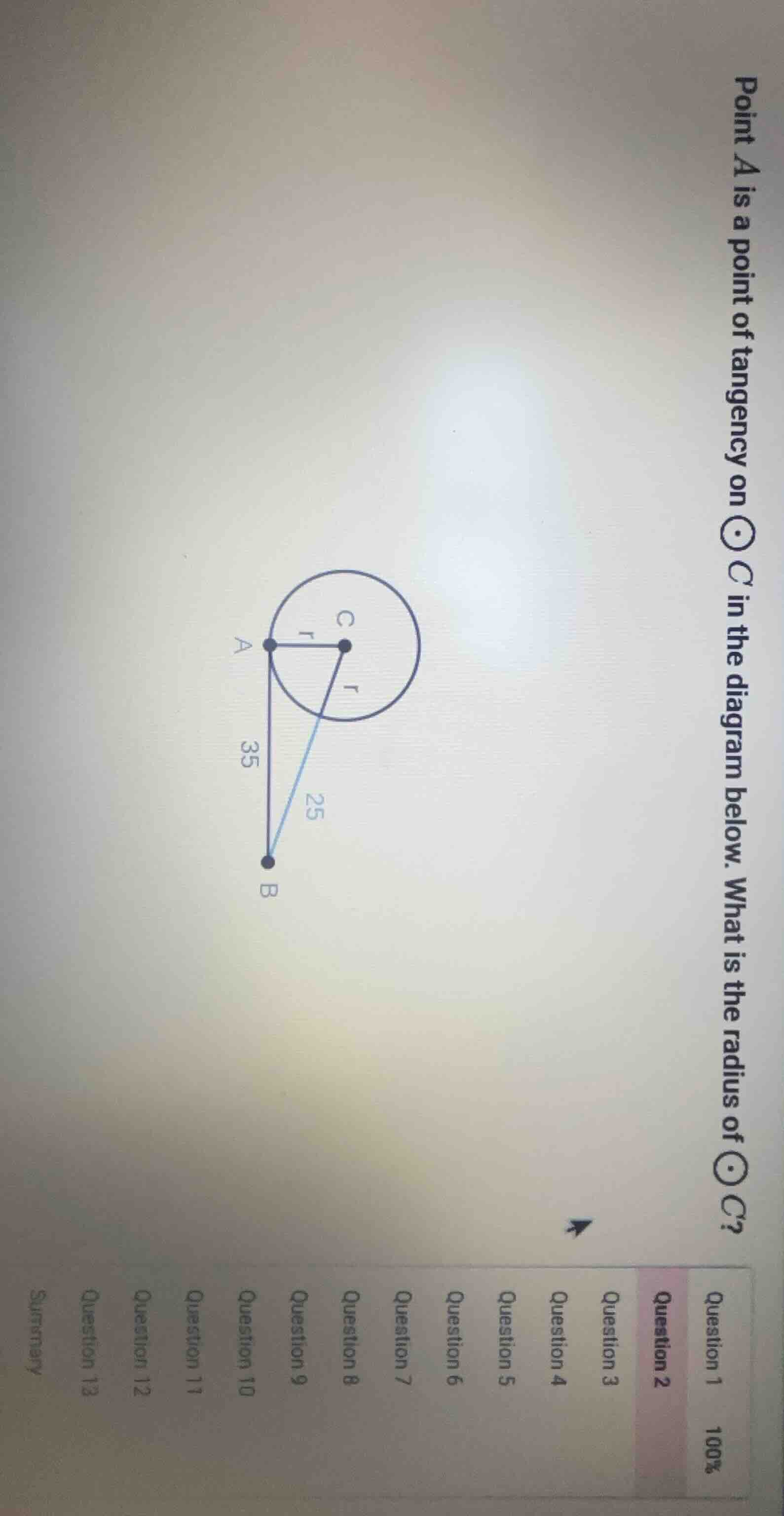
point a is a point of tangency on \\(\odot c\\) in the diagram below. what is the radius of \\(\odot c\\)?
Step1: Identify the right triangle
Since \( AB \) is tangent to \( \odot C \) at \( A \), \( CA \perp AB \) (tangent is perpendicular to radius at point of tangency). So \( \triangle CAB \) is a right triangle with \( \angle CAB = 90^\circ \), \( AB = 35 \), \( CB = 25 + r \) (wait, no, looking at the diagram, \( CB \) is the hypotenuse, \( CA = r \), \( AB = 35 \), and the length from \( C \) to the other point on the circle is \( r \), so \( CB = 25 + r \)? Wait, no, maybe the length from \( C \) to \( B \) is 25? Wait, no, the diagram shows \( CB \) as a line from \( C \) to \( B \), with \( CA = r \), \( AB = 35 \), and the segment from \( C \) to the circle (radius) is \( r \), and the length from \( C \) to \( B \) is 25? Wait, no, that can't be. Wait, maybe I misread. Wait, the length from \( C \) to \( B \) is 25? No, \( AB = 35 \), \( CA = r \), and \( CB \) is the hypotenuse. Wait, maybe the length from \( C \) to \( B \) is 25? No, that would make \( r \) negative. Wait, no, maybe the length from \( C \) to the point where the radius meets the circle is \( r \), and \( CB = 25 \)? No, that doesn't make sense. Wait, no, the correct approach: in a right triangle, \( CB^2 = CA^2 + AB^2 \). Wait, \( CA = r \), \( AB = 35 \), and \( CB = 25 + r \)? No, that would be if \( C \) to the circle is \( r \), and then from the circle to \( B \) is 25. Wait, no, the diagram: \( A \) is the point of tangency, so \( CA \perp AB \). So \( \triangle CAB \) is right-angled at \( A \). So \( CB \) is the hypotenuse, \( CA = r \), \( AB = 35 \), and \( CB = 25 + r \)? No, that can't be. Wait, maybe the length from \( C \) to \( B \) is 25? No, that would mean \( r^2 + 35^2 = 25^2 \), which is impossible. Wait, I must have misread. Wait, maybe the length from \( C \) to \( B \) is 25, and \( AB = 35 \), but that would be \( r^2 + 35^2 = 25^2 \), which is impossible. Wait, no, maybe the length from \( C \) to \( B \) is 25, and \( AB = 35 \), but that's not possible. Wait, maybe the length from \( C \) to \( B \) is 25, and \( CA = r \), \( AB = 35 \), so \( r^2 + 35^2 = (25 + r)^2 \)? Wait, no, that would be if \( CB = 25 + r \). Let's expand: \( r^2 + 1225 = 625 + 50r + r^2 \). Subtract \( r^2 \) from both sides: \( 1225 = 625 + 50r \). Then \( 50r = 600 \), so \( r = 12 \). Wait, that makes sense. So:
Step1: Apply Pythagorean theorem
In right triangle \( CAB \), \( \angle CAB = 90^\circ \), so \( CB^2 = CA^2 + AB^2 \). Let \( CA = r \), \( AB = 35 \), \( CB = 25 + r \) (since \( CB \) is the distance from center \( C \) to point \( B \), which is radius \( r \) plus the segment from the circle to \( B \), which is 25? Wait, no, maybe the segment from \( C \) to the circle is \( r \), and the segment from the circle to \( B \) is 25, so \( CB = r + 25 \). Then:
\( (r + 25)^2 = r^2 + 35^2 \)
Step2: Expand and simplify
Expand left side: \( r^2 + 50r + 625 = r^2 + 1225 \)
Subtract \( r^2 \) from both sides: \( 50r + 625 = 1225 \)
Subtract 625: \( 50r = 600 \)
Divide by 50: \( r = 12 \)

Snap & solve any problem in the app
Get step-by-step solutions on Sovi AI
Photo-based solutions with guided steps
Explore more problems and detailed explanations
The radius \( r \) is \( \boxed{12} \)