QUESTION IMAGE
Question
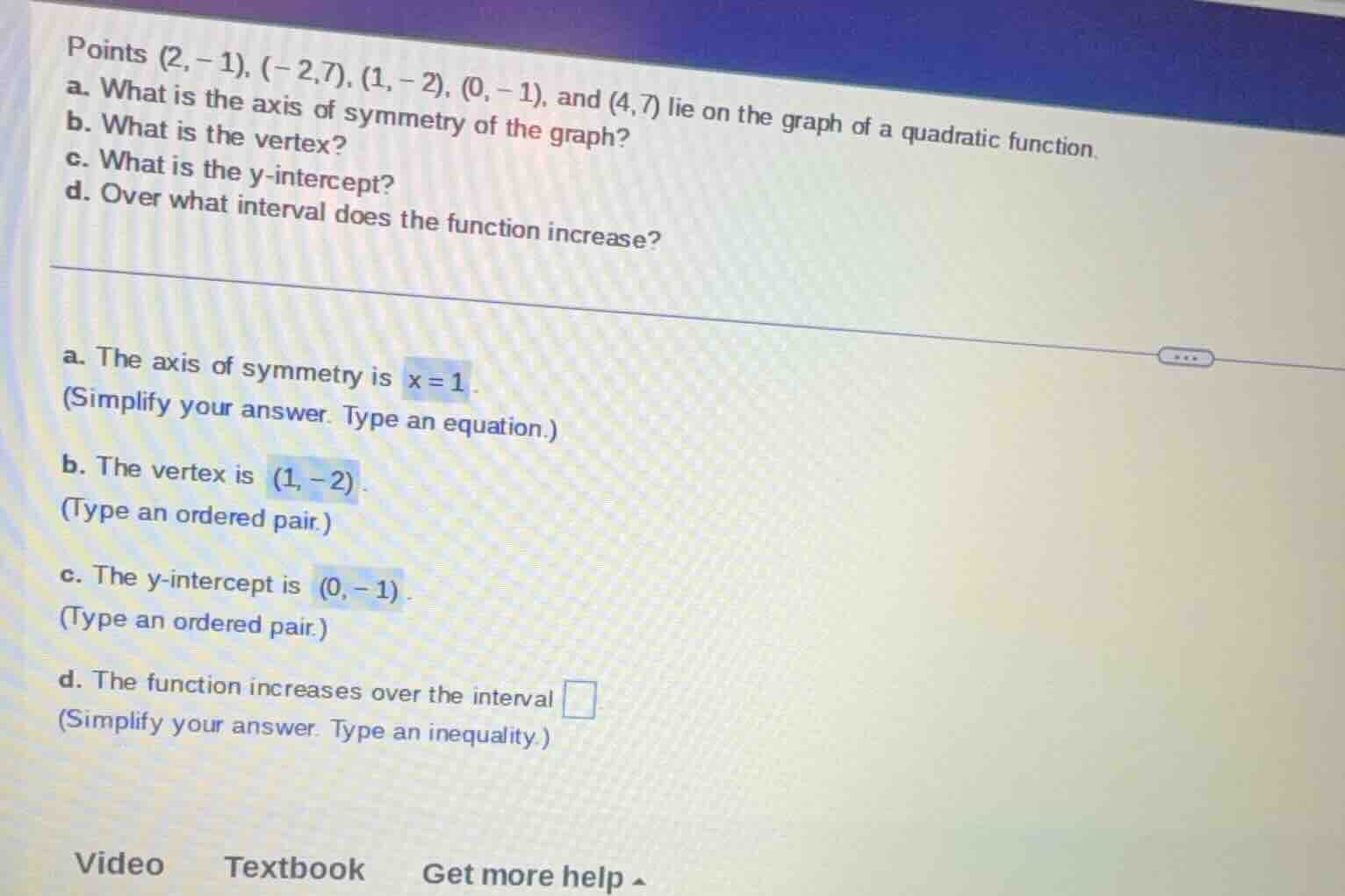
points (2, -1), (-2,7), (1, -2), (0, -1), and (4,7) lie on the graph of a quadratic function.
a. what is the axis of symmetry of the graph?
b. what is the vertex?
c. what is the y - intercept?
d. over what interval does the function increase?
a. the axis of symmetry is x = 1.
(simplify your answer. type an equation.)
b. the vertex is (1, -2).
(type an ordered pair.)
c. the y - intercept is (0, -1).
(type an ordered pair.)
d. the function increases over the interval
(simplify your answer. type an inequality.)
Part d
Step 1: Recall properties of quadratic functions
For a quadratic function, the graph is a parabola. If the vertex is \((h,k)\) and the axis of symmetry is \(x = h\), the function increases on one side of the axis of symmetry and decreases on the other. The direction (opening up or down) can be determined by the \(y\)-values. Here, the vertex is \((1, - 2)\). Let's check the \(y\)-values of points. For example, when \(x = 2\) (right of \(x = 1\)) \(y=-1\) which is greater than \(y=-2\) (at \(x = 1\)), and when \(x = 0\) (left of \(x = 1\)) \(y=-1\) which is greater than \(y=-2\)? Wait, no, wait. Wait, when \(x=-2\), \(y = 7\); \(x = 0\), \(y=-1\); \(x = 1\), \(y=-2\); \(x = 2\), \(y=-1\); \(x = 4\), \(y = 7\). So the parabola opens upwards (since the \(y\)-values increase as we move away from \(x = 1\) in both directions). So for a parabola that opens upwards, the function increases when \(x\) is greater than the \(x\)-coordinate of the vertex. The vertex has \(x\)-coordinate \(1\), so the function increases for \(x>1\), or in interval notation, \((1,\infty)\) or as an inequality \(x\geq1\) (but since at \(x = 1\) it's the minimum, the function is increasing for \(x>1\)).
Step 2: Determine the interval
Since the parabola opens upward (because the \(y\)-values at \(x=-2\) and \(x = 4\) are both \(7\), which are higher than the \(y\)-value at \(x = 1\) which is \(-2\)), the function increases to the right of the axis of symmetry \(x = 1\). So the interval where the function increases is \(x>1\) (or in interval notation \((1,\infty)\)). But the problem says "type an inequality", so we can write \(x\geq1\) (since at \(x = 1\) the slope changes from negative to positive, so the function is increasing for \(x\) greater than or equal to \(1\) when considering the vertex as the minimum point).

Snap & solve any problem in the app
Get step-by-step solutions on Sovi AI
Photo-based solutions with guided steps
Explore more problems and detailed explanations
\(x\geq1\)