QUESTION IMAGE
Question
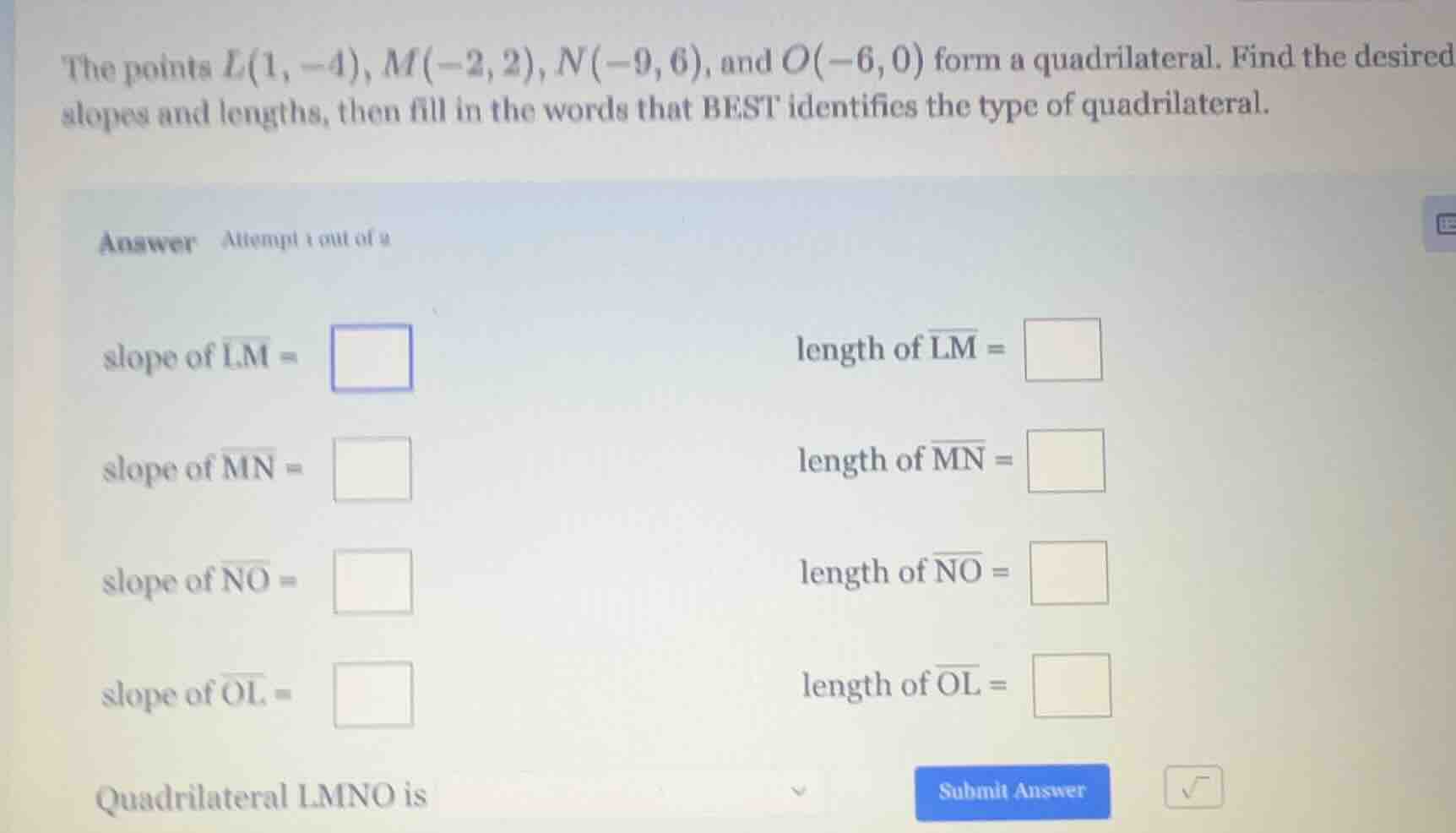
the points ( l(1, -4) ), ( m(-2, 2) ), ( n(-9, 6) ), and ( o(-6, 0) ) form a quadrilateral. find the desired slopes and lengths, then fill in the words that best identifies the type of quadrilateral.
answer attempt 1 out of 2
slope of ( overline{lm} = )
length of ( overline{lm} = )
( )
slope of ( overline{mn} = )
length of ( overline{mn} = )
( )
slope of ( overline{no} = )
length of ( overline{no} = )
( )
slope of ( overline{ol} = )
length of ( overline{ol} = )
( )
quadrilateral ( lmno ) is
Step1: Calculate slope of $\overline{LM}$
Slope formula: $m=\frac{y_2-y_1}{x_2-x_1}$
For $L(1,-4), M(-2,2)$:
$m_{\overline{LM}}=\frac{2-(-4)}{-2-1}=\frac{6}{-3}=-2$
Step2: Calculate length of $\overline{LM}$
Distance formula: $d=\sqrt{(x_2-x_1)^2+(y_2-y_1)^2}$
For $L(1,-4), M(-2,2)$:
$d_{\overline{LM}}=\sqrt{(-2-1)^2+(2-(-4))^2}=\sqrt{9+36}=\sqrt{45}=3\sqrt{5}$
Step3: Calculate slope of $\overline{MN}$
For $M(-2,2), N(-9,6)$:
$m_{\overline{MN}}=\frac{6-2}{-9-(-2)}=\frac{4}{-7}=-\frac{4}{7}$
Step4: Calculate length of $\overline{MN}$
For $M(-2,2), N(-9,6)$:
$d_{\overline{MN}}=\sqrt{(-9-(-2))^2+(6-2)^2}=\sqrt{49+16}=\sqrt{65}$
Step5: Calculate slope of $\overline{NO}$
For $N(-9,6), O(-6,0)$:
$m_{\overline{NO}}=\frac{0-6}{-6-(-9)}=\frac{-6}{3}=-2$
Step6: Calculate length of $\overline{NO}$
For $N(-9,6), O(-6,0)$:
$d_{\overline{NO}}=\sqrt{(-6-(-9))^2+(0-6)^2}=\sqrt{9+36}=\sqrt{45}=3\sqrt{5}$
Step7: Calculate slope of $\overline{OL}$
For $O(-6,0), L(1,-4)$:
$m_{\overline{OL}}=\frac{-4-0}{1-(-6)}=\frac{-4}{7}=-\frac{4}{7}$
Step8: Calculate length of $\overline{OL}$
For $O(-6,0), L(1,-4)$:
$d_{\overline{OL}}=\sqrt{(1-(-6))^2+(-4-0)^2}=\sqrt{49+16}=\sqrt{65}$
Step9: Classify the quadrilateral
Opposite sides have equal slopes (parallel) and equal lengths, so it is a parallelogram.

Snap & solve any problem in the app
Get step-by-step solutions on Sovi AI
Photo-based solutions with guided steps
Explore more problems and detailed explanations
slope of $\overline{LM} = -2$
length of $\overline{LM} = 3\sqrt{5}$
slope of $\overline{MN} = -\frac{4}{7}$
length of $\overline{MN} = \sqrt{65}$
slope of $\overline{NO} = -2$
length of $\overline{NO} = 3\sqrt{5}$
slope of $\overline{OL} = -\frac{4}{7}$
length of $\overline{OL} = \sqrt{65}$
Quadrilateral LMNO is a parallelogram