QUESTION IMAGE
Question
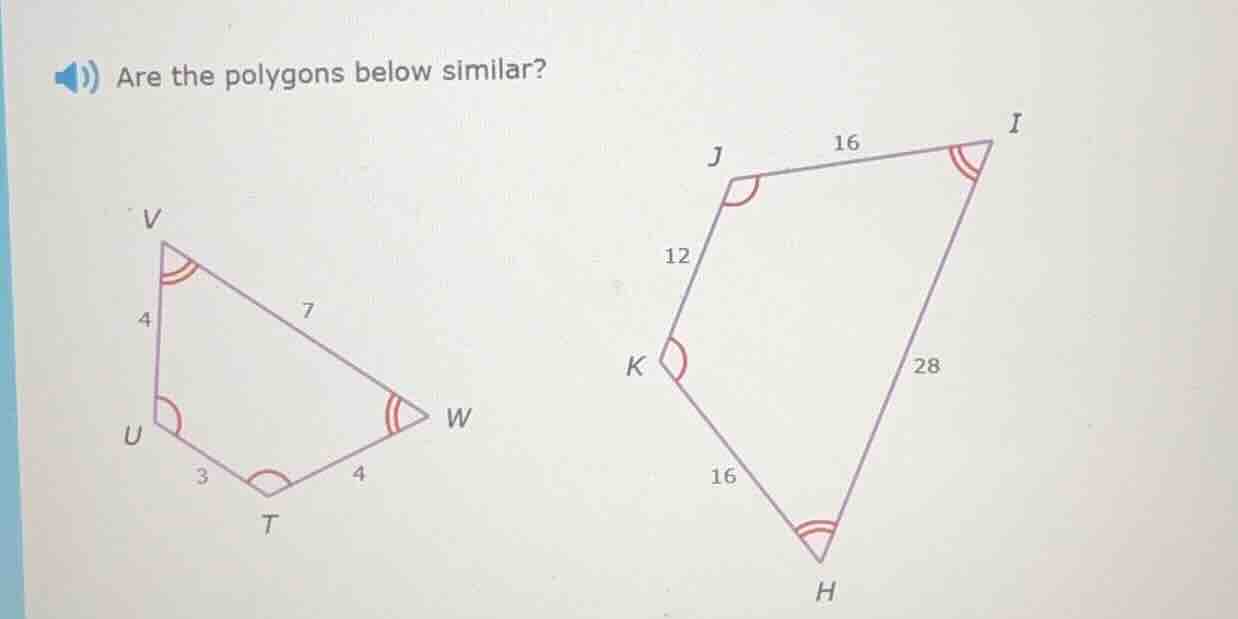
are the polygons below similar?
Step1: Identify corresponding sides
First, we need to match the sides of the two polygons. Let's list the side lengths of the first polygon (VUTW): \( VU = 4 \), \( UT = 3 \), \( TW = 4 \), \( WV = 7 \). The second polygon (JKIH): \( JK = 12 \), \( KI = 16 \), \( IH = 28 \), \( HJ = 16 \)? Wait, no, let's check the angles. The marked angles: in VUTW, angles at V, W, T, U? Wait, the first polygon is a quadrilateral? Wait, no, looking at the vertices: V, U, T, W. So sides: VU=4, UT=3, TW=4, WV=7. The second polygon: J, K, H, I? Wait, J, K, H, I? Wait, J to K is 12, K to H is 16, H to I is 28, I to J is 16? Wait, no, the first polygon: V, U, T, W (quadrilateral), sides: VU=4, UT=3, TW=4, WV=7. Second polygon: J, K, H, I (quadrilateral), sides: JK=12, KH=16, HI=28, IJ=16? Wait, no, maybe the correspondence is V->I, U->K, T->H, W->J? Wait, no, let's check the ratios. Let's pair the sides with the same angle marks. The angle at V (in VUTW) and angle at I (in JKIH) are marked, angle at W and angle at H, angle at T and angle at K, angle at U and angle at J? Wait, maybe better to list the sides in order. Let's assume the first quadrilateral has sides 4 (VU), 3 (UT), 4 (TW), 7 (WV). The second has sides 12 (JK), 16 (KH), 28 (HI), 16 (IJ)? Wait, no, maybe the sides are 12 (JK), 16 (KI), 28 (IH), 16 (HJ)? Wait, perhaps I misread. Let's look again: first polygon (left): vertices V, U, T, W. Sides: VU=4, UT=3, TW=4, WV=7. Angles: at V (marked), at U (marked), at T (marked), at W (marked). Second polygon (right): vertices J, K, I, H? Wait, J, K, H, I? Sides: JI=16, JK=12, KI=16, IH=28? Wait, no, J to I is 16, J to K is 12, K to H is 16, H to I is 28. So sides: JI=16, JK=12, KH=16, HI=28. Now, let's check the ratios of corresponding sides. Let's assume the correspondence is V->I, U->K, T->H, W->J. Then VU corresponds to IK? No, maybe VU (4) corresponds to JK (12), UT (3) corresponds to KH (16), TW (4) corresponds to HI (28), WV (7) corresponds to IJ (16)? Wait, no, that can't be. Wait, maybe the first polygon is a quadrilateral with sides 4, 3, 4, 7. The second is a quadrilateral with sides 12, 16, 28, 16? Wait, no, let's calculate the ratios. Let's take the sides with the same length in the first polygon: VU=4 and TW=4. In the second polygon, are there two sides with the same length? JK=12, KI=16, IH=28, IJ=16? Wait, KI=16 and IJ=16? So in the first polygon, two sides of length 4 (VU and TW), in the second, two sides of length 16 (KI and IJ). So maybe VU corresponds to KI (4 vs 16), TW corresponds to IJ (4 vs 16). Then the ratio would be 16/4=4. Now check the other sides: UT=3, so corresponding side should be 34=12. Is there a side of 12? JK=12. Then WV=7, corresponding side should be 74=28. IH=28. Perfect! So let's list the sides:
First polygon (VUTW) sides in order: VU=4, UT=3, TW=4, WV=7.
Second polygon (JKIH) sides in order: KI=16, JK=12, IJ=16, IH=28.
Wait, maybe the order is VU (4) -> KI (16), UT (3) -> JK (12), TW (4) -> IJ (16), WV (7) -> IH (28). Now check the ratios:
16/4 = 4, 12/3 = 4, 16/4 = 4, 28/7 = 4. All ratios are equal (4). Also, the corresponding angles (marked with the same arcs) should be equal. Since the angle marks are in the same positions, the angles are equal. For polygons to be similar, corresponding angles must be equal and corresponding sides must be in proportion. Here, all corresponding sides have a ratio of 4, and the angles (marked) are equal, so the polygons are similar.
Wait, but let me confirm the side order. If the first quadrilateral has sides 4, 3, 4, 7 (in order VU, UT, TW, WV) and the second has si…

Snap & solve any problem in the app
Get step-by-step solutions on Sovi AI
Photo-based solutions with guided steps
Explore more problems and detailed explanations
Yes, the polygons are similar because their corresponding angles are congruent (marked with equal arcs) and their corresponding sides are proportional (all ratios are 4: \( \frac{16}{4} = 4 \), \( \frac{12}{3} = 4 \), \( \frac{16}{4} = 4 \), \( \frac{28}{7} = 4 \)).