QUESTION IMAGE
Question
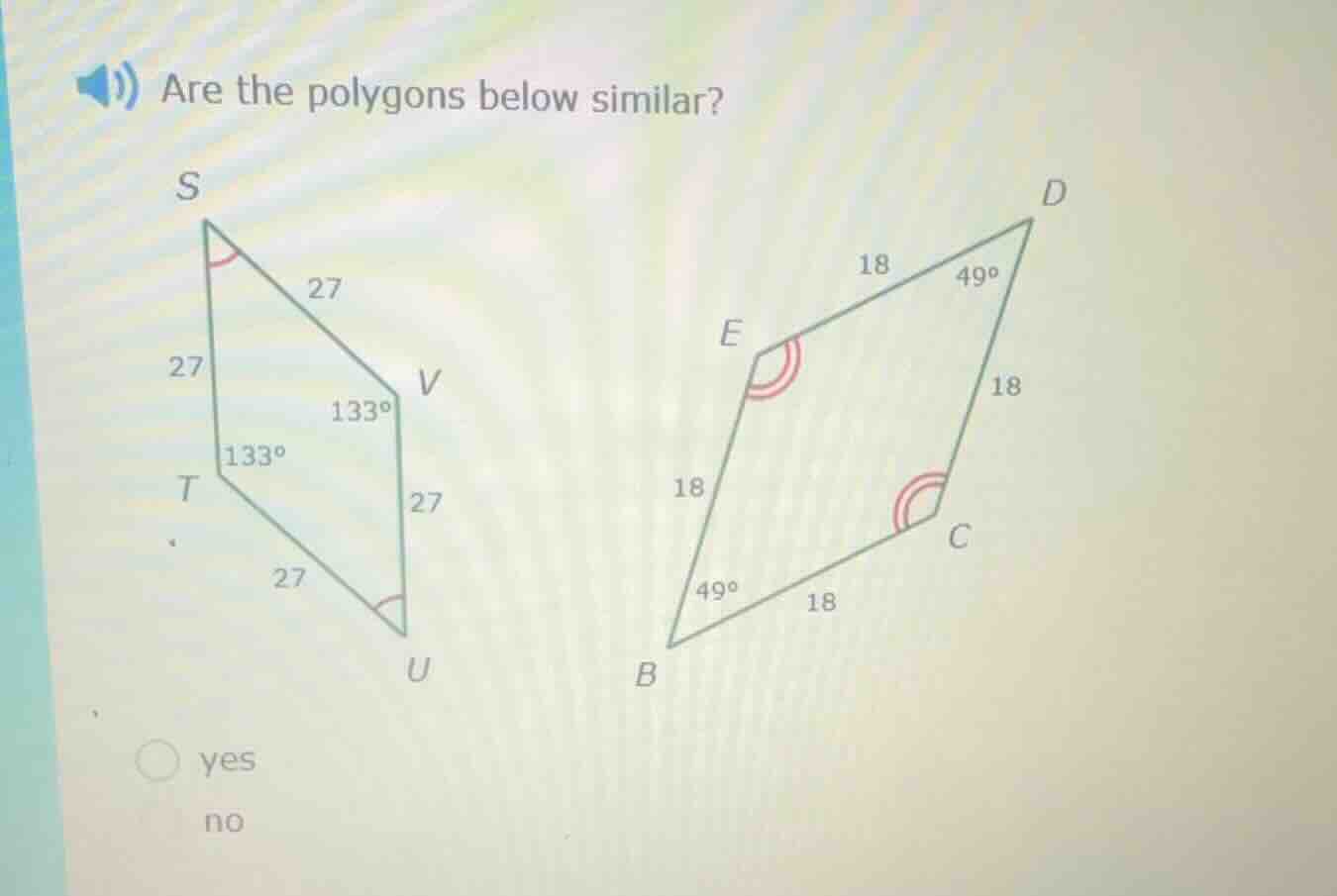
are the polygons below similar?
options: yes, no
Step1: Check Angle Conditions
For a quadrilateral, the sum of interior angles is \(360^\circ\). In the first quadrilateral (STUV), we know two angles are \(133^\circ\). Let the other two angles (at S and U) be \(x\). So \(2\times133^\circ + 2x=360^\circ\), \(266^\circ+2x = 360^\circ\), \(2x=94^\circ\), \(x = 47^\circ\)? Wait, no, wait the second quadrilateral (BCDE) has angles \(49^\circ\). Wait, maybe I made a mistake. Wait, looking at the markings: the first quadrilateral (STUV) has two angles of \(133^\circ\) and the other two angles (marked with red) – let's recalculate. Wait, the second quadrilateral (BCDE) has angles \(49^\circ\) and the other two angles (marked with double red) – let's check the angle measures. Wait, maybe the first quadrilateral: angles at T and V are \(133^\circ\), so the other two angles (S and U) should be \(\frac{360 - 2\times133}{2}=\frac{360 - 266}{2}=\frac{94}{2}=47^\circ\). But the second quadrilateral has angles \(49^\circ\). Wait, no, maybe the markings: the first quadrilateral has sides all 27 (ST=27, TU=27, UV=27, VS=27? Wait, ST=27, TU=27, UV=27, VS=27? So it's a rhombus? Wait, no, ST=27, TU=27, UV=27, VS=27? So all sides equal? Wait, the second quadrilateral has sides all 18 (BE=18, BC=18, CD=18, DE=18)? So it's a rhombus. Now, check angles: in the first rhombus, angles at T and V are \(133^\circ\), so the adjacent angles (S and U) are \(180 - 133 = 47^\circ\)? But the second rhombus has angles \(49^\circ\). Wait, that's a problem. Wait, maybe the angle markings: the red single mark on S (first quadrilateral) and the \(49^\circ\) on B and D (second quadrilateral) – maybe I misread. Wait, no, looking again: the first quadrilateral (STUV) has angles at T: \(133^\circ\), V: \(133^\circ\), and the other two angles (S and U) are equal (marked with red single arc). The second quadrilateral (BCDE) has angles at B: \(49^\circ\), D: \(49^\circ\), and the other two angles (E and C) are equal (marked with red double arc). Wait, maybe the first quadrilateral's angles at S and U: let's calculate again. Sum of angles in quadrilateral: \(360^\circ\). So \(133 + 133 + \angle S + \angle U = 360\). So \(\angle S + \angle U = 360 - 266 = 94\). Since it's a quadrilateral with all sides equal (a rhombus), opposite angles are equal, so \(\angle S=\angle U = 47^\circ\). The second quadrilateral: all sides equal (a rhombus), angles at B and D are \(49^\circ\), so opposite angles are equal, and adjacent angles are \(180 - 49 = 131^\circ\)? Wait, no, the markings on the second quadrilateral: the double red arcs are at E and C, so those angles should be equal, and the single red arcs (at B and D) are \(49^\circ\). Wait, this is confusing. Wait, maybe the problem is that the angle measures don't match. Wait, but maybe I made a mistake. Wait, the first quadrilateral: sides are all 27, so it's a rhombus with two angles \(133^\circ\) and two angles \(47^\circ\) (since \(133 + 133 + 47 + 47 = 360\)). The second quadrilateral: sides are all 18, so it's a rhombus with two angles \(49^\circ\) and two angles \(131^\circ\) (since \(49 + 49 + 131 + 131 = 360\)). Wait, but the angle measures don't match. Wait, but maybe the markings are different. Wait, the first quadrilateral: the red single arcs are at S and U, and the second quadrilateral's red single arcs are at B and D (49°), and double red at E and C. Wait, maybe the first quadrilateral's angles at S and U are 49°? Wait, no, \(133 + 133 + 49 + 49 = 1332 + 492 = 266 + 98 = 364
eq 360\). Oh, I see my mistake! Wait, the sum of interior angles of a quadrilateral is \(360^\ci…

Snap & solve any problem in the app
Get step-by-step solutions on Sovi AI
Photo-based solutions with guided steps
Explore more problems and detailed explanations
no