QUESTION IMAGE
Question
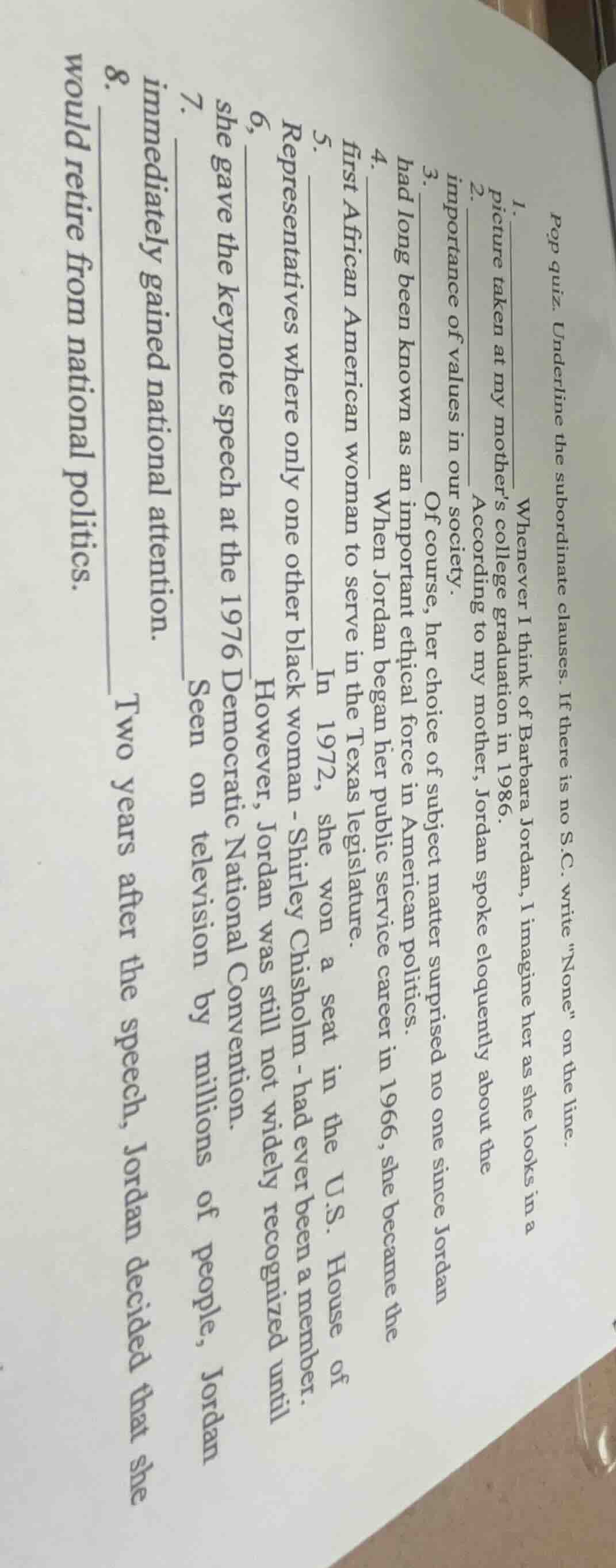
pop quiz. underline the subordinate clauses. if there is no s.c. write
one\ on the line.
- whenever i think of barbara jordan, i imagine her as she looks in a picture taken at my mothers college graduation in 1986.
- according to my mother, jordan spoke eloquently about the importance of values in our society.
- of course, her choice of subject matter surprised no one since jordan had long been known as an important ethical force in american politics.
- when jordan began her public service career in 1966, she became the first african american woman to serve in the texas legislature.
- in 1972, she won a seat in the u.s. house of representatives where only one other black woman - shirley chisholm - had ever been a member.
- however, jordan was still not widely recognized until she gave the keynote speech at the 1976 democratic national convention.
- seen on television by millions of people, jordan immediately gained national attention.
- two years after the speech, jordan decided that she would retire from national politics.
To solve this, we identify subordinate clauses (dependent clauses) in each sentence:
1.
Subordinate clause: Whenever I think of Barbara Jordan (adverbial clause, dependent on main clause "I imagine her...")
Underline: $\boldsymbol{\underline{\text{Whenever I think of Barbara Jordan}}}$, I imagine her as she looks in a picture taken at my mother’s college graduation in 1986.
2.
Subordinate clause: According to my mother (prepositional phrase acting as an adverbial clause, dependent)
Underline: $\boldsymbol{\underline{\text{According to my mother}}}$, Jordan spoke eloquently about the importance of values in our society.
3.
Subordinate clause: Of course, her choice of subject (noun phrase acting as a dependent clause? Wait, re - evaluate: The main clause is "surprised no one since Jordan had long been known...". Wait, correct subordinate clause: since Jordan had long been known as an important ethical force in American politics (adverbial clause of reason).
Underline: Of course, her choice of subject surprised no one $\boldsymbol{\underline{\text{since Jordan had long been known as an important ethical force in American politics}}}$.
4.
Subordinate clause: When Jordan began her public service career in 1966 (adverbial clause of time, dependent)
Underline: $\boldsymbol{\underline{\text{When Jordan began her public service career in 1966}}}$, she became the first African American woman to serve in the Texas legislature.
5.
Subordinate clause: In 1972 (adverbial phrase, and where only one other black woman - Shirley Chisholm - had ever been a member (adjectival clause modifying "U.S. House of Representatives"))
Underline: $\boldsymbol{\underline{\text{In 1972}}}$, she won a seat in the U.S. House of Representatives $\boldsymbol{\underline{\text{where only one other black woman - Shirley Chisholm - had ever been a member}}}$.
6.
Subordinate clause: However, Jordan was still not widely recognized until she gave the keynote speech at the 1976 Democratic National Convention (adverbial clause of time, dependent)
Wait, re - structure: The main clause is "However, Jordan was still not widely recognized" and the subordinate clause is until she gave the keynote speech at the 1976 Democratic National Convention (adverbial clause of time).
Underline: However, Jordan was still not widely recognized $\boldsymbol{\underline{\text{until she gave the keynote speech at the 1976 Democratic National Convention}}}$.
7.
Subordinate clause: Seen on television by millions of people (participial phrase acting as an adverbial clause, dependent)
Underline: $\boldsymbol{\underline{\text{Seen on television by millions of people}}}$, Jordan immediately gained national attention.
8.
Subordinate clause: Two years after the speech (adverbial phrase, and that she would retire from national politics (noun clause as object of "decided"))
Underline: $\boldsymbol{\underline{\text{Two years after the speech}}}$, Jordan decided $\boldsymbol{\underline{\text{that she would retire from national politics}}}$.
If a clause is independent, it has a subject and verb and can stand alone. Subordinate clauses cannot stand alone and function as adverbial, adjectival, or nominal clauses.

Snap & solve any problem in the app
Get step-by-step solutions on Sovi AI
Photo-based solutions with guided steps
Explore more problems and detailed explanations
To solve this, we identify subordinate clauses (dependent clauses) in each sentence:
1.
Subordinate clause: Whenever I think of Barbara Jordan (adverbial clause, dependent on main clause "I imagine her...")
Underline: $\boldsymbol{\underline{\text{Whenever I think of Barbara Jordan}}}$, I imagine her as she looks in a picture taken at my mother’s college graduation in 1986.
2.
Subordinate clause: According to my mother (prepositional phrase acting as an adverbial clause, dependent)
Underline: $\boldsymbol{\underline{\text{According to my mother}}}$, Jordan spoke eloquently about the importance of values in our society.
3.
Subordinate clause: Of course, her choice of subject (noun phrase acting as a dependent clause? Wait, re - evaluate: The main clause is "surprised no one since Jordan had long been known...". Wait, correct subordinate clause: since Jordan had long been known as an important ethical force in American politics (adverbial clause of reason).
Underline: Of course, her choice of subject surprised no one $\boldsymbol{\underline{\text{since Jordan had long been known as an important ethical force in American politics}}}$.
4.
Subordinate clause: When Jordan began her public service career in 1966 (adverbial clause of time, dependent)
Underline: $\boldsymbol{\underline{\text{When Jordan began her public service career in 1966}}}$, she became the first African American woman to serve in the Texas legislature.
5.
Subordinate clause: In 1972 (adverbial phrase, and where only one other black woman - Shirley Chisholm - had ever been a member (adjectival clause modifying "U.S. House of Representatives"))
Underline: $\boldsymbol{\underline{\text{In 1972}}}$, she won a seat in the U.S. House of Representatives $\boldsymbol{\underline{\text{where only one other black woman - Shirley Chisholm - had ever been a member}}}$.
6.
Subordinate clause: However, Jordan was still not widely recognized until she gave the keynote speech at the 1976 Democratic National Convention (adverbial clause of time, dependent)
Wait, re - structure: The main clause is "However, Jordan was still not widely recognized" and the subordinate clause is until she gave the keynote speech at the 1976 Democratic National Convention (adverbial clause of time).
Underline: However, Jordan was still not widely recognized $\boldsymbol{\underline{\text{until she gave the keynote speech at the 1976 Democratic National Convention}}}$.
7.
Subordinate clause: Seen on television by millions of people (participial phrase acting as an adverbial clause, dependent)
Underline: $\boldsymbol{\underline{\text{Seen on television by millions of people}}}$, Jordan immediately gained national attention.
8.
Subordinate clause: Two years after the speech (adverbial phrase, and that she would retire from national politics (noun clause as object of "decided"))
Underline: $\boldsymbol{\underline{\text{Two years after the speech}}}$, Jordan decided $\boldsymbol{\underline{\text{that she would retire from national politics}}}$.
If a clause is independent, it has a subject and verb and can stand alone. Subordinate clauses cannot stand alone and function as adverbial, adjectival, or nominal clauses.