QUESTION IMAGE
Question
population
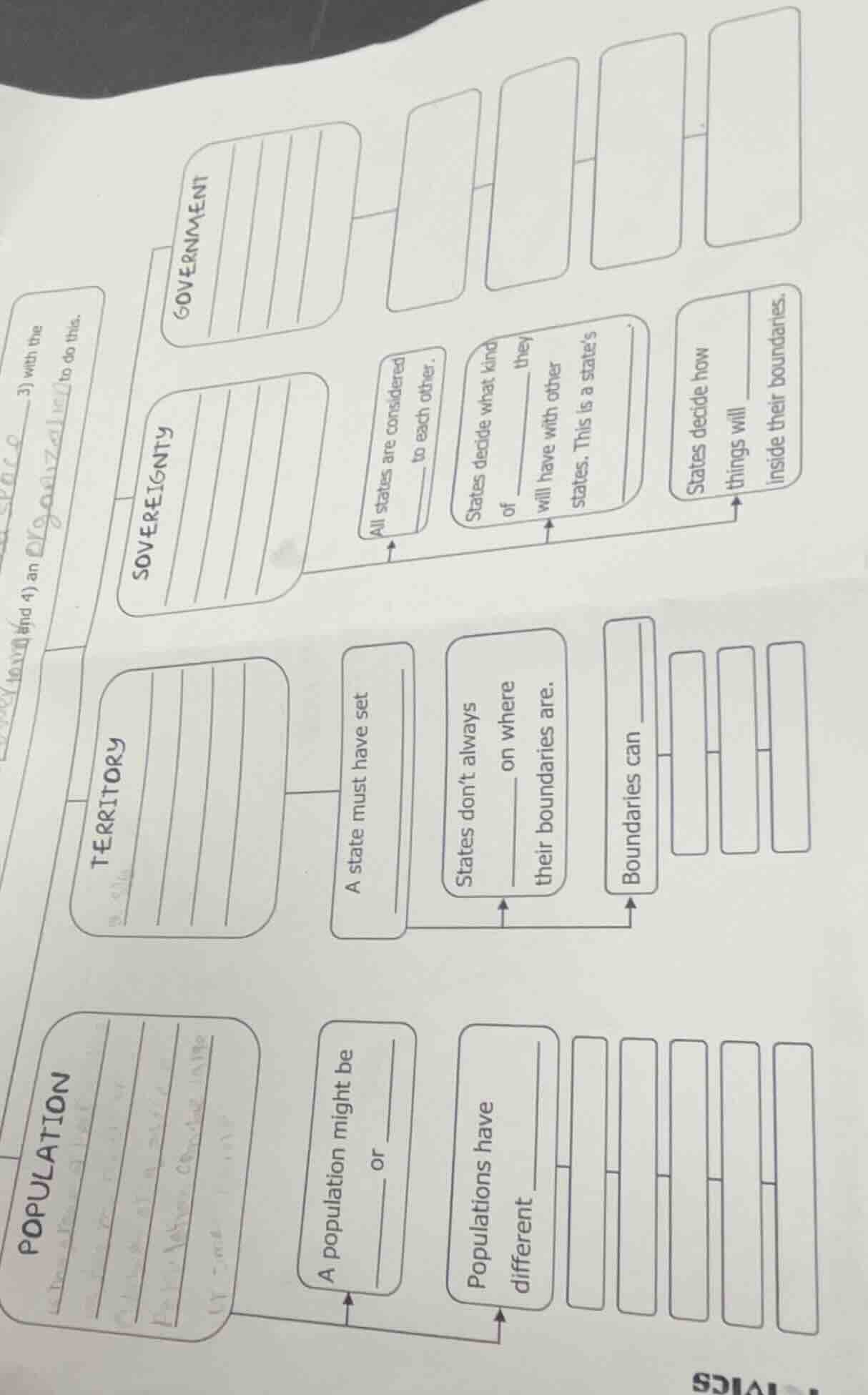
a population might be ____ or ____
populations have different ______
territory
a state must have set ______
states dont always ______ on where their boundaries are.
boundaries can ______
sovereignty
all states are considered ______ to each other.
states decide what kind of ____ they will have with other states. this is a states ____.
states decide how ______ things will inside their boundaries.
government
This is a fill - in - the - blank diagram related to the characteristics of a state (population, territory, sovereignty, government). For the "Population" section:
- A population might be homogeneous or heterogeneous. Homogeneous populations have similar characteristics (like shared culture, language), while heterogeneous populations have diverse characteristics.
- Populations have different sizes (number of people), densities (people per unit area), and compositions (age, gender, ethnic makeup etc.).
For the "Territory" section:
- A state must have set boundaries (a defined area of land, water, etc.).
- States don't always agree on where their boundaries are (disputes over territorial claims).
- Boundaries can be natural (like rivers, mountains) or artificial (like straight lines drawn by treaties).
For the "Sovereignty" section:
- All states are considered equal to each other (in the international system, each state has equal legal status).
- States decide what kind of relationship they will have with other states (diplomatic, economic, military etc.). This is a state's foreign policy.
- States decide how things will be governed inside their boundaries (domestic policy, laws, governance structure).
For the "Government" section:
A government is the organization with the power to do this (govern the state, make and enforce laws, provide services etc.).

Snap & solve any problem in the app
Get step-by-step solutions on Sovi AI
Photo-based solutions with guided steps
Explore more problems and detailed explanations
Population
- A population might be homogeneous or heterogeneous.
- Populations have different sizes, densities, compositions (e.g., age, ethnic, gender).
Territory
- A state must have set boundaries.
- States don't always agree on where their boundaries are.
- Boundaries can be natural (e.g., rivers, mountains) or artificial (e.g., treaty - drawn lines).
Sovereignty
- All states are considered equal to each other.
- States decide what kind of relationship they will have with other states. This is a state's foreign policy.
- States decide how things will be governed inside their boundaries.
Government
- An organization with the power to do this (govern the state).