QUESTION IMAGE
Question
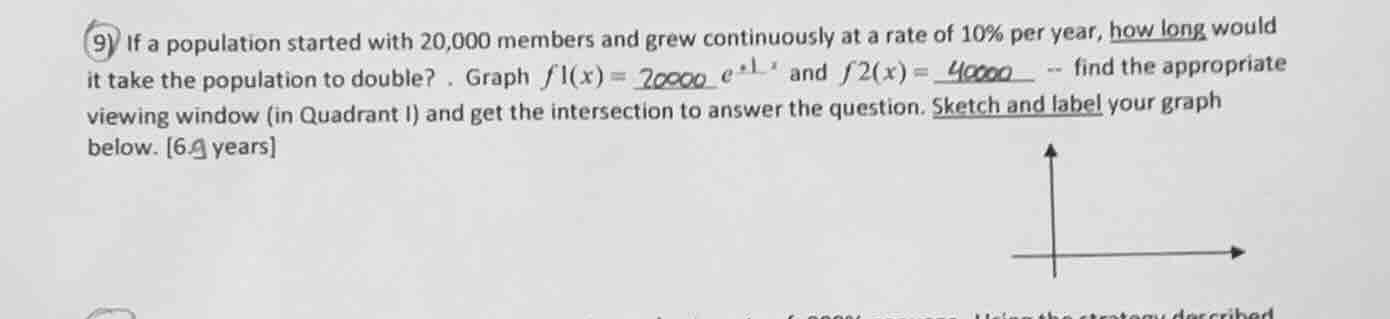
- if a population started with 20,000 members and grew continuously at a rate of 10% per year, how long would it take the population to double? . graph ( f1(x) = 20000 e^{0.1x} ) and ( f2(x) = 40000 ) -- find the appropriate viewing window (in quadrant i) and get the intersection to answer the question. sketch and label your graph below. 6.9 years
Step1: Recall the continuous growth formula
The formula for continuous population growth is \( P(t) = P_0 e^{rt} \), where \( P_0 \) is the initial population, \( r \) is the growth rate, and \( t \) is time. Here, \( P_0 = 20000 \), \( r = 0.1 \) (10% as a decimal), and we want to find \( t \) when \( P(t) = 2 \times 20000 = 40000 \). So the function \( f_1(x) = 20000e^{0.1x} \) (where \( x \) is time \( t \)) and \( f_2(x) = 40000 \).
Step2: Set up the equation and solve for \( t \)
Set \( 20000e^{0.1t} = 40000 \). Divide both sides by 20000: \( e^{0.1t} = 2 \). Take the natural logarithm of both sides: \( \ln(e^{0.1t}) = \ln(2) \). Using the property \( \ln(e^a) = a \), we get \( 0.1t = \ln(2) \). Then solve for \( t \): \( t = \frac{\ln(2)}{0.1} \).
Step3: Calculate the value
We know that \( \ln(2) \approx 0.6931 \), so \( t = \frac{0.6931}{0.1} = 6.931 \approx 6.9 \) years (or approximately 6.9 years, close to the given 6.9 years).

Snap & solve any problem in the app
Get step-by-step solutions on Sovi AI
Photo-based solutions with guided steps
Explore more problems and detailed explanations
Approximately \( \boldsymbol{6.9} \) years (or using more precise calculation, \( t = \frac{\ln 2}{0.1} \approx 6.93 \) years)