QUESTION IMAGE
Question
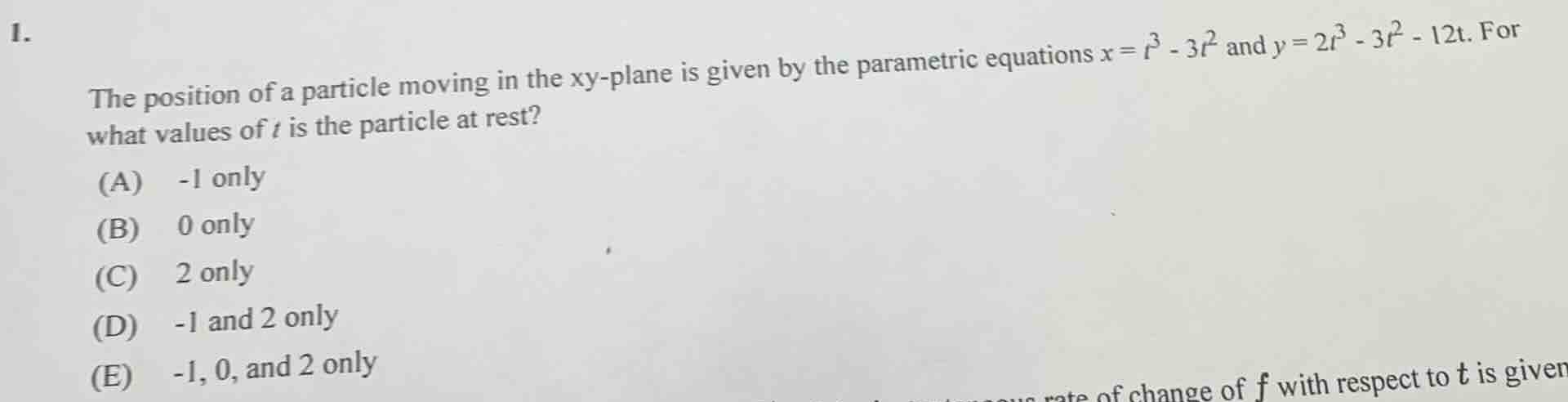
- the position of a particle moving in the xy - plane is given by the parametric equations $x = t^3 - 3t^2$ and $y = 2t^3 - 3t^2 - 12t$. for what values of $t$ is the particle at rest? (a) -1 only (b) 0 only (c) 2 only (d) -1 and 2 only (e) -1, 0, and 2 only
Step1: Find the derivatives of x and y with respect to t
To determine when the particle is at rest, we need to find when the velocity components \(\frac{dx}{dt}\) and \(\frac{dy}{dt}\) are both zero.
First, find \(\frac{dx}{dt}\) for \(x = t^3 - 3t^2\):
Using the power rule, \(\frac{dx}{dt}=3t^2 - 6t\)
Next, find \(\frac{dy}{dt}\) for \(y = 2t^3 - 3t^2 - 12t\):
Using the power rule, \(\frac{dy}{dt}=6t^2 - 6t - 12\)
Step2: Solve \(\frac{dx}{dt}=0\)
Set \(\frac{dx}{dt}=3t^2 - 6t = 0\)
Factor out \(3t\): \(3t(t - 2)=0\)
So, \(3t = 0\) or \(t - 2 = 0\)
This gives \(t = 0\) or \(t = 2\)
Step3: Solve \(\frac{dy}{dt}=0\)
Set \(\frac{dy}{dt}=6t^2 - 6t - 12 = 0\)
Divide both sides by 6: \(t^2 - t - 2 = 0\)
Factor the quadratic: \((t - 2)(t + 1)=0\)
So, \(t - 2 = 0\) or \(t + 1 = 0\)
This gives \(t = 2\) or \(t = - 1\)
Step4: Find the common solutions
The particle is at rest when both \(\frac{dx}{dt}=0\) and \(\frac{dy}{dt}=0\). We need to find the values of \(t\) that satisfy both equations.
From \(\frac{dx}{dt}=0\), solutions are \(t = 0, 2\)
From \(\frac{dy}{dt}=0\), solutions are \(t=-1, 2\)
The common solution is \(t = 2\)? Wait, no, wait. Wait, no, let's check again. Wait, when \(t = 2\), both \(\frac{dx}{dt}\) and \(\frac{dy}{dt}\) are zero? Wait, no, wait:
Wait, \(\frac{dx}{dt}\) at \(t=-1\): \(3(-1)^2-6(-1)=3 + 6=9
eq0\)
At \(t = 0\): \(\frac{dy}{dt}=6(0)^2-6(0)-12=-12
eq0\)
At \(t = 2\): \(\frac{dx}{dt}=3(2)^2-6(2)=12 - 12 = 0\) and \(\frac{dy}{dt}=6(2)^2-6(2)-12=24 - 12 - 12 = 0\)
Wait, but wait, let's re - check the factoring of \(\frac{dy}{dt}\):
\(y = 2t^3-3t^2 - 12t\), so \(\frac{dy}{dt}=6t^2-6t - 12\). Divide by 6: \(t^2 - t - 2=(t - 2)(t + 1)\), correct.
\(\frac{dx}{dt}=3t^2-6t = 3t(t - 2)\), correct.
So when \(t=-1\): \(\frac{dx}{dt}=3(1)-6(-1)=3 + 6 = 9
eq0\), so \(\frac{dx}{dt}\) is not zero.
When \(t = 0\): \(\frac{dy}{dt}=6(0)-6(0)-12=-12
eq0\), so \(\frac{dy}{dt}\) is not zero.
When \(t = 2\): \(\frac{dx}{dt}=3(4)-6(2)=12 - 12 = 0\), \(\frac{dy}{dt}=6(4)-6(2)-12=24 - 12 - 12 = 0\). Wait, but the options have D: - 1 and 2 only, E: - 1, 0, 2 only. Wait, I must have made a mistake.
Wait, no, wait. Wait, let's recalculate \(\frac{dx}{dt}\) at \(t=-1\):
\(\frac{dx}{dt}=3t^2-6t\), when \(t=-1\), \(3(-1)^2-6(-1)=3 + 6 = 9
eq0\)
At \(t = 0\): \(\frac{dx}{dt}=0-0 = 0\), \(\frac{dy}{dt}=0 - 0 - 12=-12
eq0\)
At \(t = 2\): \(\frac{dx}{dt}=3(4)-6(2)=12 - 12 = 0\), \(\frac{dy}{dt}=6(4)-6(2)-12=24 - 12 - 12 = 0\)
Wait, but the option D is - 1 and 2 only. Wait, maybe I made a mistake in the derivative of x?
Wait, \(x=t^3 - 3t^2\), derivative is \(3t^2-6t\), correct.
\(y = 2t^3-3t^2 - 12t\), derivative is \(6t^2-6t - 12\), correct.
Wait, maybe the question is asking for when both velocities are zero. So we need to find t where both dx/dt and dy/dt are zero.
So solve the system:
\(3t^2 - 6t = 0\) --> \(t(3t - 6)=0\) --> \(t = 0\) or \(t = 2\)
\(6t^2 - 6t - 12 = 0\) --> \(t^2 - t - 2 = 0\) --> \(t = 2\) or \(t=-1\)
The intersection of the solution sets \(\{0, 2\}\) and \(\{-1, 2\}\) is \(\{2\}\)? But option C is 2 only. But wait, let's check t = 2:
For \(x\): \(\frac{dx}{dt}=3(4)-6(2)=12 - 12 = 0\)
For \(y\): \(\frac{dy}{dt}=6(4)-6(2)-12=24 - 12 - 12 = 0\)
At t=-1: \(\frac{dx}{dt}=3(1)-6(-1)=3 + 6 = 9
eq0\), so not at rest.
At t = 0: \(\frac{dy}{dt}=6(0)-6(0)-12=-12
eq0\), so not at rest.
At t = 2: both are zero. So the answer should be C? But wait, the option D is - 1 and 2 only. Wait, maybe I made a mistake. Wait, let's re - evaluate.
Wait, maybe I messed up the derivative of x. Let'…

Snap & solve any problem in the app
Get step-by-step solutions on Sovi AI
Photo-based solutions with guided steps
Explore more problems and detailed explanations
C. 2 only