QUESTION IMAGE
Question
post test: exponential and logarithmic functions
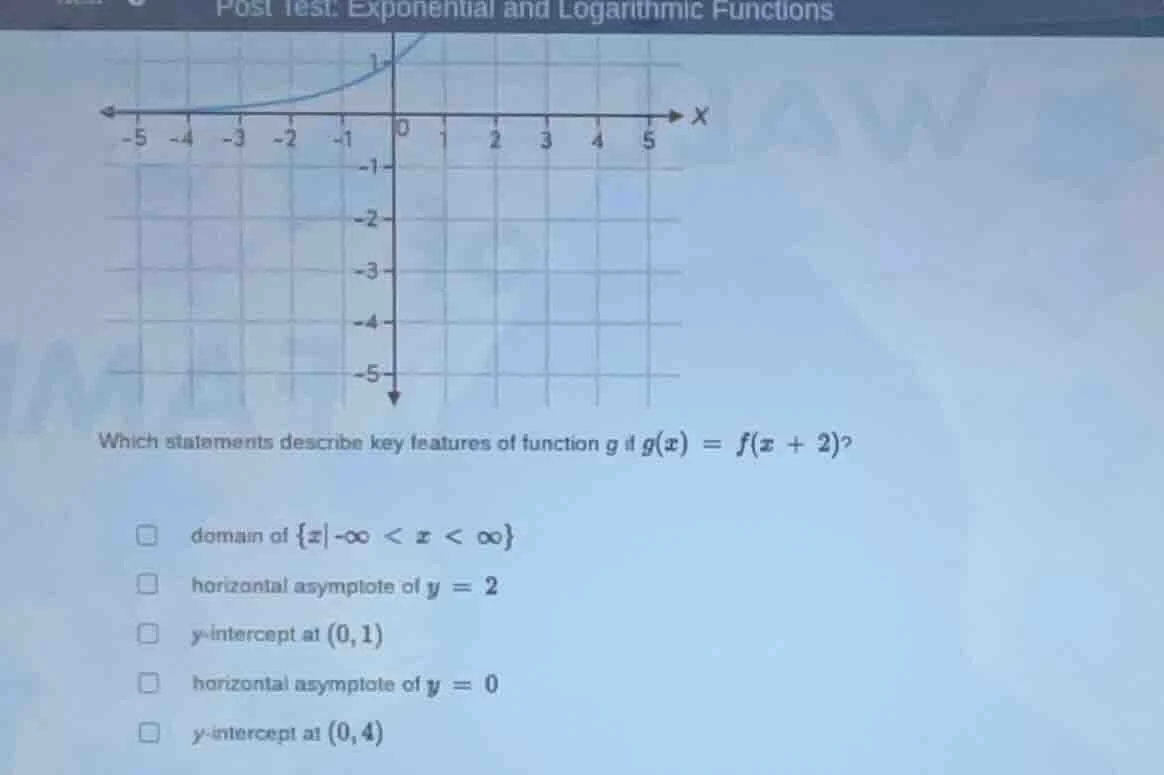
which statements describe key features of function g if $g(x) = f(x + 2)$?
\\(\square\\) domain of \\(\\{x|-\infty < x < \infty\\}\\)
\\(\square\\) horizontal asymptote of \\(y = 2\\)
\\(\square\\) \\(y\\)-intercept at \\((0,1)\\)
\\(\square\\) horizontal asymptote of \\(y = 0\\)
\\(\square\\) \\(y\\)-intercept at \\((0,4)\\)
To solve this, we analyze the transformation \( g(x) = f(x + 2) \) (horizontal shift left by 2 units) and the key features of exponential functions (since \( f(x) \) appears to be an exponential function from the graph):
Step 1: Domain of \( g(x) \)
For exponential functions (and their horizontal shifts), the domain is all real numbers. A horizontal shift does not change the domain. So the domain of \( g(x) \) is \( \{x \mid -\infty < x < \infty\} \).
Step 2: Horizontal Asymptote
A horizontal shift does not change the horizontal asymptote of an exponential function. From the graph of \( f(x) \), the horizontal asymptote is \( y = 0 \) (it approaches the x - axis, \( y = 0 \), as \( x \to -\infty \)). So \( g(x) \) also has a horizontal asymptote of \( y = 0 \).
Step 3: y - intercept of \( g(x) \)
The y - intercept occurs at \( x = 0 \). For \( g(x)=f(x + 2) \), when \( x = 0 \), \( g(0)=f(0 + 2)=f(2) \). From the graph of \( f(x) \), we assume \( f(x) \) is an exponential function (e.g., \( f(x)=a^x \), likely \( f(x)=2^x \) or similar). If \( f(x) \) passes through \( (0,1) \) (y - intercept of \( f(x) \) at \( (0,1) \)), then \( f(2) \) would be \( 4 \) (for \( f(x)=2^x \), \( f(2)=2^2 = 4 \)). So the y - intercept of \( g(x) \) is at \( (0,4) \), not \( (0,1) \).
Analyzing the Options:
- "domain of \( \{x \mid -\infty < x < \infty\} \)" is correct.
- "horizontal asymptote of \( y = 2 \)" is incorrect (horizontal asymptote is \( y = 0 \)).
- "y - intercept at \( (0,1) \)" is incorrect (y - intercept of \( g(x) \) is \( (0,4) \)).
- "horizontal asymptote of \( y = 0 \)" is correct.
- "y - intercept at \( (0,4) \)" is correct.

Snap & solve any problem in the app
Get step-by-step solutions on Sovi AI
Photo-based solutions with guided steps
Explore more problems and detailed explanations
- domain of \( \{x \mid -\infty < x < \infty\} \)
- horizontal asymptote of \( y = 0 \)
- y - intercept at \( (0,4) \)