QUESTION IMAGE
Question
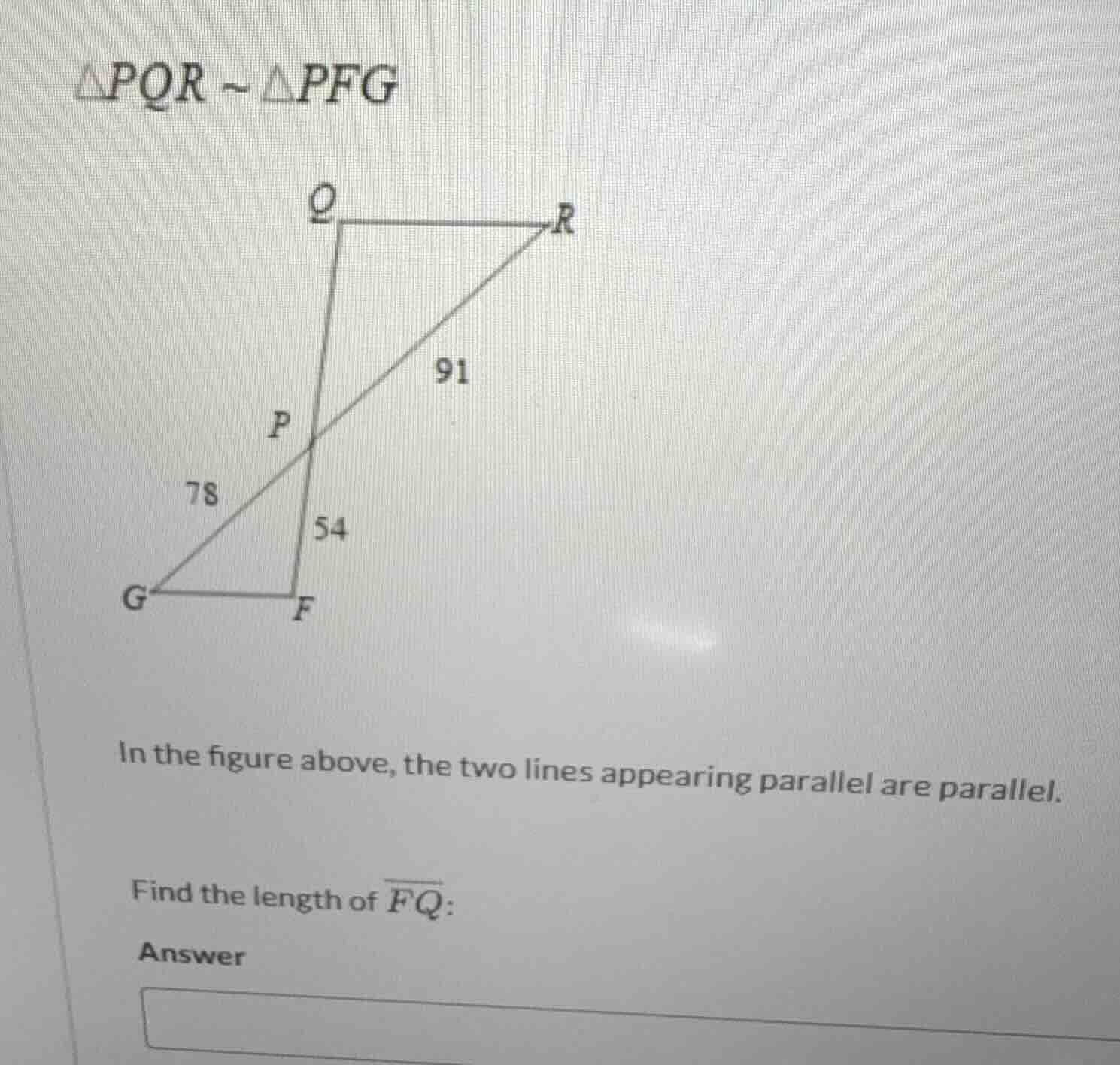
△pqr ~ △pfg
in the figure above, the two lines appearing parallel are parallel.
find the length of \\(\overline{fq}\\):
answer
Step1: Use Similar Triangles Proportion
Since \(\triangle PQR \sim \triangle PFG\), the corresponding sides are proportional. Let \(FQ = x\). Then \(PQ = x + 54\). The sides \(PR = 91\), \(PG = 78\), \(PF = 54\), and \(PQ = x + 54\), \(PF = 54\), \(PR = 91\), \(PG = 78\). So the proportion is \(\frac{PQ}{PF}=\frac{PR}{PG}\), which is \(\frac{x + 54}{54}=\frac{91}{78}\).
Step2: Solve the Proportion
Cross - multiply: \(78(x + 54)=54\times91\)
First, simplify the right - hand side: \(54\times91 = 4914\)
Left - hand side: \(78x+78\times54=78x + 4212\)
So the equation is \(78x+4212 = 4914\)
Subtract 4212 from both sides: \(78x=4914 - 4212=702\)
Divide both sides by 78: \(x=\frac{702}{78}=9\) Wait, no, wait. Wait, maybe I mixed up the sides. Wait, actually, the correct proportion should be \(\frac{PQ}{PF}=\frac{PR}{PG}\), but let's re - check. Wait, \(\triangle PQR\) and \(\triangle PFG\) are similar, so \(\frac{PQ}{PF}=\frac{PR}{PG}\). Wait, \(PQ\) corresponds to \(PF\)? No, wait, the correspondence: \(\triangle PQR\sim\triangle PFG\), so vertex \(P\) corresponds to \(P\), \(Q\) corresponds to \(F\), \(R\) corresponds to \(G\). So the sides: \(PQ\) corresponds to \(PF\), \(QR\) corresponds to \(FG\), \(PR\) corresponds to \(PG\). Wait, no, that's wrong. Wait, if the triangles are similar, the order of the letters matters. So \(\triangle PQR\sim\triangle PFG\) means \(P
ightarrow P\), \(Q
ightarrow F\), \(R
ightarrow G\). So \(PQ\) is corresponding to \(PF\), \(QR\) to \(FG\), \(PR\) to \(PG\). Wait, but the parallel lines are \(QR\) and \(FG\), so \(\angle Q=\angle F\) (corresponding angles), \(\angle R=\angle G\) (corresponding angles), so the similarity is correct as \(\triangle PQR\sim\triangle PFG\) with \(P\) as the common vertex. So the sides: \(PQ\) (from \(P\) to \(Q\)) and \(PF\) (from \(P\) to \(F\)) are corresponding, \(PR\) (from \(P\) to \(R\)) and \(PG\) (from \(P\) to \(G\)) are corresponding. So the proportion is \(\frac{PQ}{PF}=\frac{PR}{PG}\). Let \(FQ = x\), then \(PQ=PF + FQ=54 + x\), \(PF = 54\), \(PR = 91\), \(PG = 78\). So \(\frac{54 + x}{54}=\frac{91}{78}\)
Simplify \(\frac{91}{78}=\frac{13}{12}\) (dividing numerator and denominator by 7). So \(\frac{54 + x}{54}=\frac{13}{12}\)
Cross - multiply: \(12(54 + x)=54\times13\)
\(12\times54+12x = 702\)
\(648+12x = 702\)
\(12x=702 - 648 = 54\)
\(x=\frac{54}{12}=4.5\)? No, that's not right. Wait, I think I mixed up the correspondence. Let's do it again. The correct correspondence: Since \(QR\parallel FG\), then \(\triangle PQR\sim\triangle PFG\) with \(P\) as the common vertex, so the sides \(PR\) and \(PG\) are corresponding, \(PQ\) and \(PF\) are corresponding, and \(QR\) and \(FG\) are corresponding. Wait, but \(PR = 91\), \(PG = 78\), \(PF = 54\), and \(PQ=PF + FQ=54 + FQ\). So the proportion should be \(\frac{PR}{PG}=\frac{PQ}{PF}\), so \(\frac{91}{78}=\frac{54 + FQ}{54}\)
Simplify \(\frac{91}{78}=\frac{13}{12}\)
So \(\frac{13}{12}=\frac{54 + FQ}{54}\)
Multiply both sides by 54: \(54\times\frac{13}{12}=54 + FQ\)
\(54\times\frac{13}{12}=\frac{54\times13}{12}=\frac{702}{12}=58.5\)
Then \(58.5=54 + FQ\)
Subtract 54: \(FQ = 58.5 - 54 = 4.5\)? No, that can't be. Wait, maybe the correspondence is \(\frac{PF}{PQ}=\frac{PG}{PR}\). Let's try that. So \(\frac{54}{PQ}=\frac{78}{91}\)
Simplify \(\frac{78}{91}=\frac{6}{7}\) (dividing numerator and denominator by 13)
So \(\frac{54}{PQ}=\frac{6}{7}\)
Cross - multiply: \(6PQ = 54\times7\)
\(6PQ = 378\)
\(PQ=\frac{378}{6}=63\)
Then \(FQ=PQ - PF=63 - 54 = 9\). Ah, there we go. I had the proportion reversed. The correct proportion…

Snap & solve any problem in the app
Get step-by-step solutions on Sovi AI
Photo-based solutions with guided steps
Explore more problems and detailed explanations
\(9\)