QUESTION IMAGE
Question
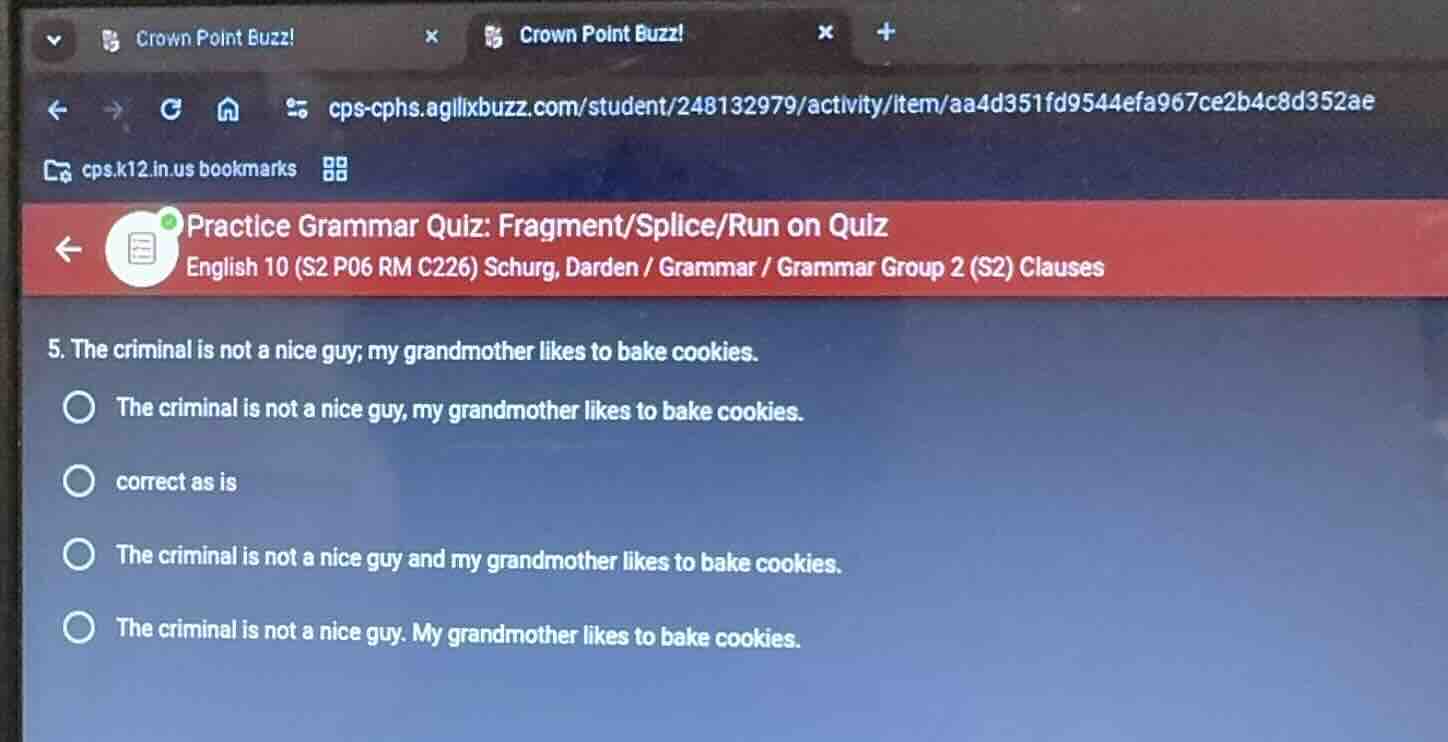
practice grammar quiz: fragment/splice/run on quiz
english 10 (s2 p06 rm c226) schurg, darden / grammar / grammar group 2 (s2) clauses
- the criminal is not a nice guy; my grandmother likes to bake cookies.
the criminal is not a nice guy, my grandmother likes to bake cookies.
correct as is
the criminal is not a nice guy and my grandmother likes to bake cookies.
the criminal is not a nice guy. my grandmother likes to bake cookies.
Brief Explanations
To determine the correct option, we analyze sentence structure. A semicolon can separate two independent clauses (as in the original), but let's check other options:
- The first option uses a comma to join two independent clauses, creating a comma splice (incorrect).
- The third option uses "and" to connect clauses, but the ideas are unrelated, making the sentence illogical.
- The fourth option splits the clauses into two separate sentences with a period (correct punctuation, but the original with a semicolon is also correct? Wait, no—wait, the original has a semicolon, but the ideas are unrelated. Wait, no, the question is about fragment, splice, or run - on. Wait, the original: "The criminal is not a nice guy; my grandmother likes to bake cookies." These are two independent clauses, and a semicolon is correct for separating them (as long as there's a logical connection, but maybe in the context of the quiz, the "correct as is" is wrong? Wait, no—wait, no, let's re - evaluate. Wait, the options:
- Option 1: comma splice (wrong).
- Option 2: "correct as is"—but the two clauses are unrelated. Wait, maybe the quiz is about punctuation. Wait, no, the original has a semicolon. Wait, but the fourth option is two sentences. Wait, no, let's check again. Wait, the original sentence: two independent clauses, semicolon is correct. But maybe the quiz considers that the ideas are unrelated, so the correct way is to make two separate sentences (option 4) or the original is correct? Wait, no, the original is "correct as is"? Wait, no, let's think about grammar rules. A semicolon can be used between two independent clauses that are related in thought. But these two clauses ("criminal not nice" and "grandmother bakes cookies") are not related. However, in the context of a grammar quiz about fragment, splice, run - on, the original uses a semicolon (correct punctuation for two independent clauses, even if the ideas are odd). Wait, but the fourth option is two sentences. Wait, maybe I made a mistake. Wait, the original sentence: "The criminal is not a nice guy; my grandmother likes to bake cookies." This is two independent clauses, semicolon is correct. So "correct as is" (option 2) is correct? Wait, no, maybe the quiz is designed so that the original is correct. Wait, let's check each option:
- Option 1: Comma splice (incorrect, as it uses a comma to join two independent clauses).
- Option 2: "correct as is"—the original has a semicolon, which is a valid way to separate two independent clauses (even if the content is unrelated, punctuation - wise it's correct).
- Option 3: Illogical connection with "and".
- Option 4: Splits into two sentences, which is also correct punctuation, but the original with a semicolon is also correct. Wait, but maybe in the quiz, the original is considered correct. Wait, no, maybe I misread. Wait, the original sentence: "The criminal is not a nice guy; my grandmother likes to bake cookies." This is two independent clauses, semicolon is correct. So "correct as is" (option 2) is correct.

Snap & solve any problem in the app
Get step-by-step solutions on Sovi AI
Photo-based solutions with guided steps
Explore more problems and detailed explanations
B. correct as is