QUESTION IMAGE
Question
practice & problem solving
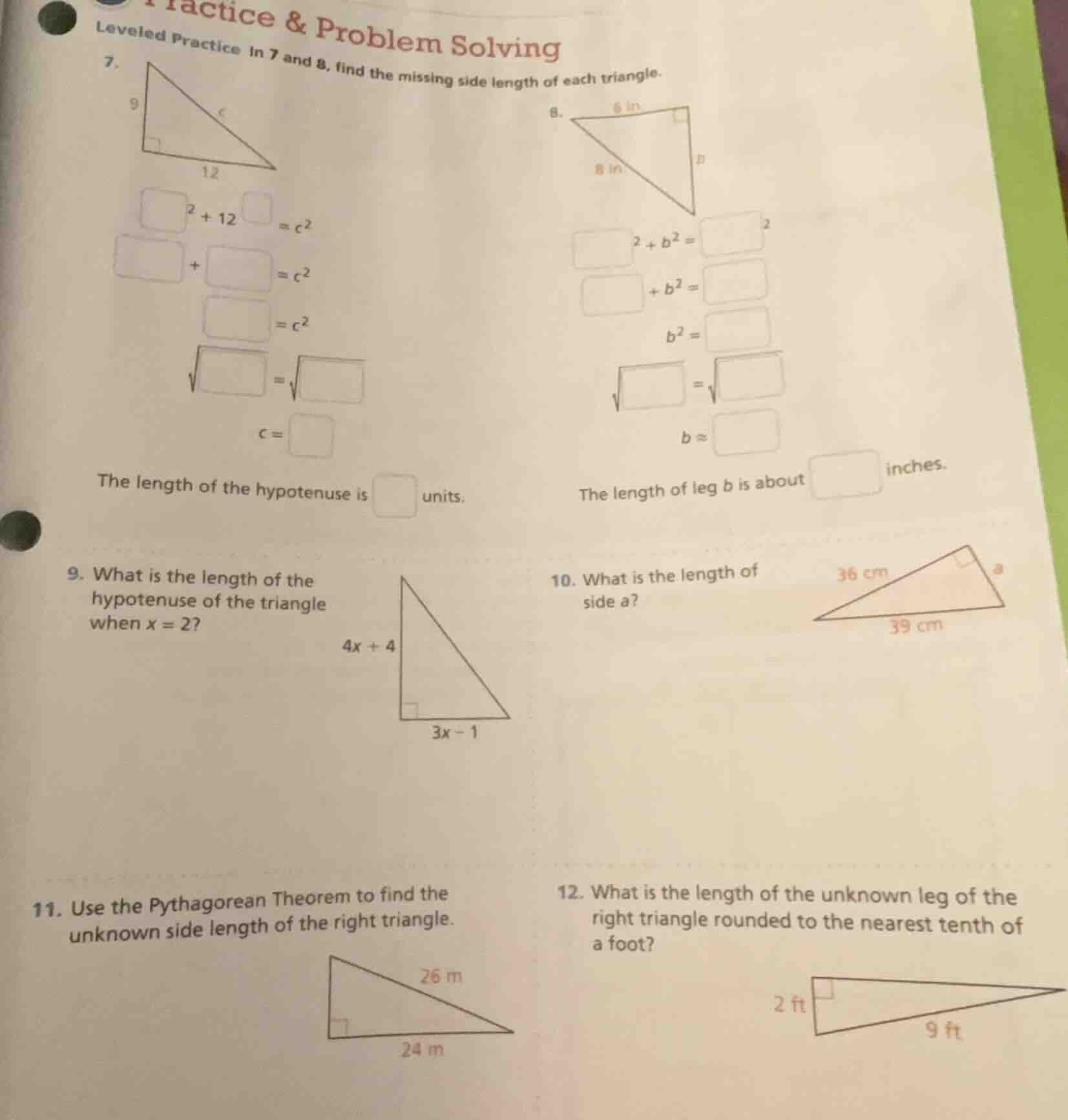
leveled practice in 7 and 8, find the missing side length of each triangle.
7.
the length of the hypotenuse is (square) units.
8.
the length of leg (b) is about (square) inches.
- what is the length of the hypotenuse of the triangle when (x = 2)?
- what is the length of side (a)?
- use the pythagorean theorem to find the unknown side length of the right triangle.
- what is the length of the unknown leg of the right triangle rounded to the nearest tenth of a foot?
Problem 7
Step1: Identify legs and hypotenuse
In a right triangle, the Pythagorean theorem is \(a^2 + b^2 = c^2\), where \(a\) and \(b\) are the legs, and \(c\) is the hypotenuse. Here, the legs are 9 and 12, so we substitute \(a = 9\) and \(b = 12\) into the formula: \(9^2 + 12^2 = c^2\)
Step2: Calculate the squares
Calculate \(9^2 = 81\) and \(12^2 = 144\), so the equation becomes \(81 + 144 = c^2\)
Step3: Sum the values
Add 81 and 144: \(81 + 144 = 225\), so \(225 = c^2\)
Step4: Take the square root
Take the square root of both sides: \(\sqrt{225} = \sqrt{c^2}\), which gives \(c = 15\)
Step1: Identify legs and hypotenuse
Using the Pythagorean theorem \(a^2 + b^2 = c^2\), here the hypotenuse \(c = 8\) in and one leg \(a = 6\) in, so the formula is \(6^2 + b^2 = 8^2\)
Step2: Calculate the squares
Calculate \(6^2 = 36\) and \(8^2 = 64\), so the equation becomes \(36 + b^2 = 64\)
Step3: Solve for \(b^2\)
Subtract 36 from both sides: \(b^2 = 64 - 36 = 28\)
Step4: Take the square root
Take the square root of 28: \(b=\sqrt{28}\approx5.3\) (rounded to one decimal place)
Step1: Substitute \(x = 2\) into the leg expressions
First, find the lengths of the legs. For the leg \(4x + 4\), substitute \(x = 2\): \(4(2)+4 = 8 + 4 = 12\). For the leg \(3x - 1\), substitute \(x = 2\): \(3(2)-1 = 6 - 1 = 5\)
Step2: Apply the Pythagorean theorem
Using \(a^2 + b^2 = c^2\) with \(a = 12\) and \(b = 5\), we get \(12^2 + 5^2 = c^2\)
Step3: Calculate the squares
Calculate \(12^2 = 144\) and \(5^2 = 25\), so \(144 + 25 = c^2\)
Step4: Sum and take the square root
Sum: \(144 + 25 = 169\), then \(\sqrt{169}=c\), so \(c = 13\)

Snap & solve any problem in the app
Get step-by-step solutions on Sovi AI
Photo-based solutions with guided steps
Explore more problems and detailed explanations
The length of the hypotenuse is \(\boldsymbol{15}\) units.