QUESTION IMAGE
Question
practice problems
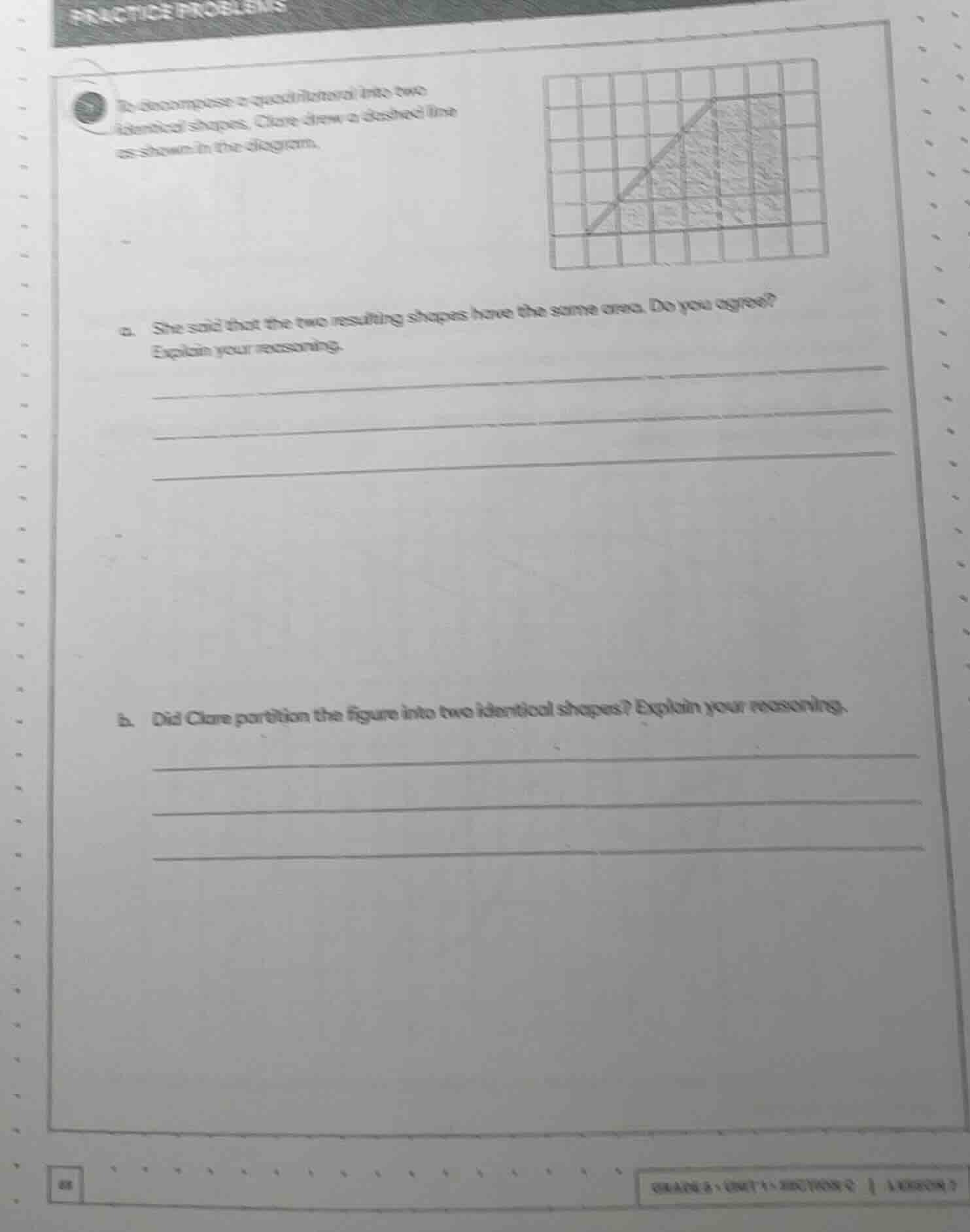
to decompose a quadrilateral into two identical shapes, clare drew a dashed line as shown in the diagram.
a. she said that the two resulting shapes have the same area. do you agree?
explain your reasoning.
b. did clare partition the figure into two identical shapes? explain your reasoning.
Part (a)
When a shape is divided into two parts by a line (the dashed line here), if the line is a line of symmetry or if the two parts are congruent in terms of the region they cover, their areas should be equal. Since Clare drew a line to decompose the quadrilateral into two shapes, and the decomposition is such that the two shapes are formed by splitting the original quadrilateral, each shape will have half the area of the original quadrilateral. So the two resulting shapes should have the same area.
To determine if the two shapes are identical, we need to check if they have the same shape and size. From the diagram (assuming the dashed line creates two triangles or other polygons), if the two shapes can be matched by translation, rotation, or reflection, they are identical. If the dashed line is a diagonal or a line that creates two congruent figures (e.g., two congruent triangles), then the partition is into two identical shapes. We can check the side lengths, angles, and overall shape. If the two shapes have the same number of sides, equal corresponding sides, and equal corresponding angles, they are identical.

Snap & solve any problem in the app
Get step-by-step solutions on Sovi AI
Photo-based solutions with guided steps
Explore more problems and detailed explanations
I agree. When a quadrilateral is decomposed into two shapes by a line (the dashed line here), the two shapes each take up half of the original quadrilateral's area, so their areas are equal.