QUESTION IMAGE
Question
practice questions - rational functions: asymptotes & function behavior
question id: 201649
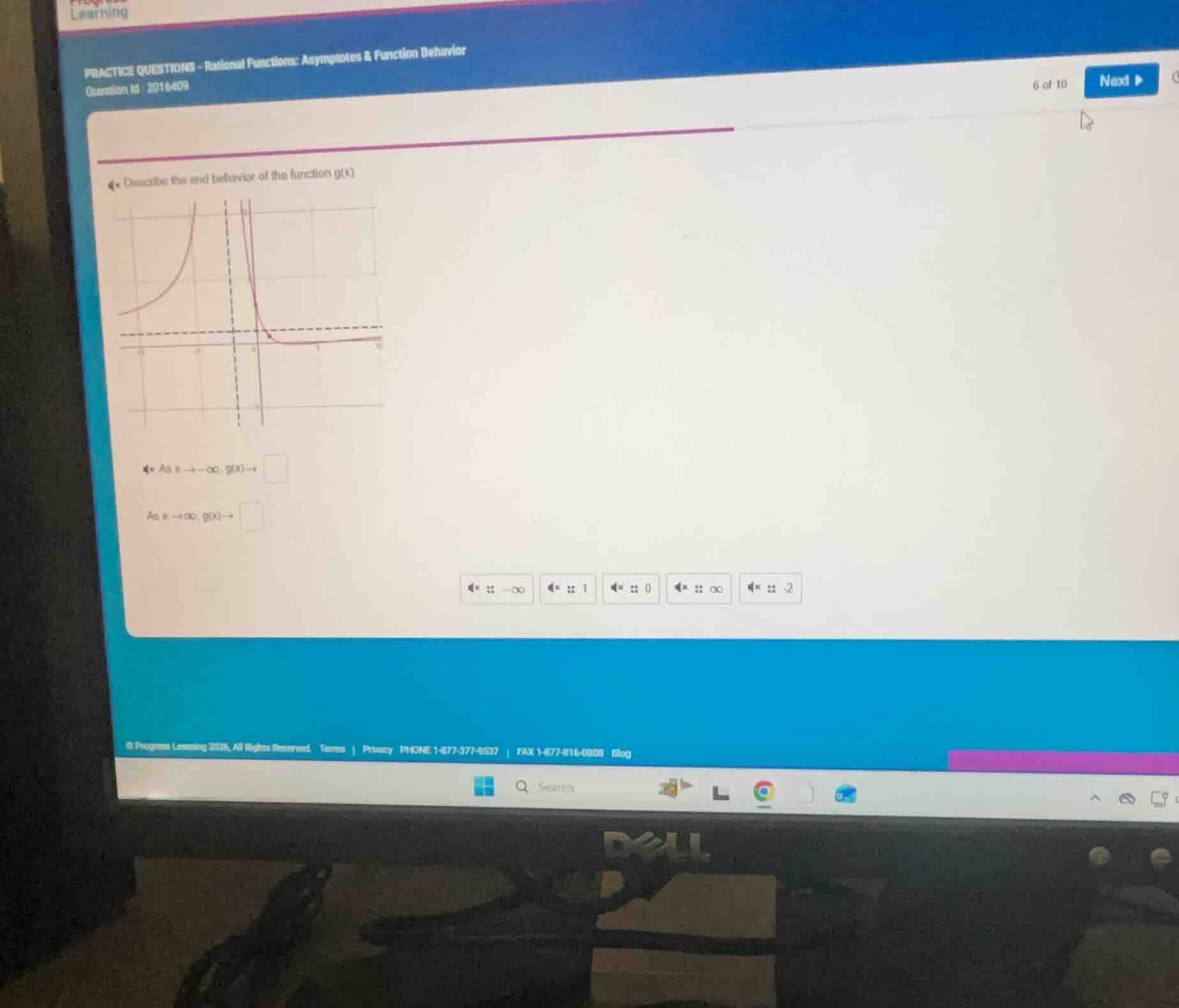
describe the end behavior of the function g(x)
as ( x \to -infty ), ( g(x) \to )
as ( x \to infty ), ( g(x) \to )
options: ( -infty ), ( 1 ), ( 0 ), ( infty ), ( -2 )
Step1: Analyze as \( x \to -\infty \)
Look at the left - hand side of the graph (as \( x \) approaches negative infinity). The graph is increasing without bound, so as \( x\to-\infty \), \( g(x)\to\infty \).
Step2: Analyze as \( x \to \infty \)
Look at the right - hand side of the graph (as \( x \) approaches positive infinity). The graph is approaching a horizontal asymptote. From the graph, we can see that as \( x\to\infty \), \( g(x)\to1 \) (since the horizontal dashed line seems to be at \( y = 1\)). Wait, no, looking at the options, the horizontal asymptote - like behavior: Wait, maybe I misread. Wait, the options have 0,1, - 2, \( \infty \), \( -\infty \). Wait, re - examining the graph: when \( x\to\infty \), the function approaches a horizontal line. Let's check the options. Wait, maybe the horizontal asymptote is \( y = 1\)? Wait, no, the options for the second part: when \( x\to\infty \), let's see the graph. The right - hand part of the graph, as \( x\) gets very large (positive), the function approaches a value. From the options, the possible values are 0,1, - 2. Wait, maybe the horizontal asymptote is \( y = 1\)? Wait, no, maybe I made a mistake. Wait, the first part: as \( x\to-\infty \), the graph is going up, so \( g(x)\to\infty \)? No, wait the left - hand side of the graph: when \( x\) is very negative, the graph is increasing, so as \( x\to-\infty \), \( g(x)\to\infty \)? Wait, no, the graph on the left: when \( x\) approaches negative infinity, the curve is going up, so \( g(x)\to\infty \)? But the options for the first blank (as \( x\to-\infty \)): the options are \( -\infty \), 1, 0, \( \infty \), - 2. Wait, maybe I got the direction wrong. Wait, maybe the left - hand side: when \( x\to-\infty \), the function is going to \( \infty \)? No, wait the graph: the left - most part of the graph, as \( x\) becomes more and more negative, the \( y\) - value is increasing, so \( g(x)\to\infty \) as \( x\to-\infty \). Then for \( x\to\infty \), the function approaches a horizontal line. Looking at the options, the horizontal line is at \( y = 1\)? Wait, the options for the second blank: 1 is an option. Wait, no, maybe the horizontal asymptote is \( y = 1\)? Wait, let's re - check.
Wait, maybe the first part: as \( x\to-\infty \), \( g(x)\to\infty \)? No, the graph on the left: when \( x\) is negative, the curve is going up, so as \( x\to-\infty \), \( g(x)\to\infty \). Then as \( x\to\infty \), the curve approaches a horizontal line, which is \( y = 1\) (from the options). Wait, but let's check the options again.
Wait, the problem is:
As \( x\to-\infty \), \( g(x)\to\)?
As \( x\to\infty \), \( g(x)\to\)?
First, as \( x\to-\infty \): the left - hand side of the graph, the function is increasing, so it goes to \( \infty \)? But the options have \( \infty \) as an option. Then as \( x\to\infty \), the function approaches a horizontal line, which is \( y = 1\) (since 1 is an option). Wait, but maybe I made a mistake. Wait, maybe the horizontal asymptote is \( y = 1\). So:
For \( x\to-\infty \), \( g(x)\to\infty \)? No, wait the graph: when \( x\) is negative, the curve is going up, so as \( x\) becomes more negative ( \( x\to-\infty \) ), \( y\) ( \( g(x) \)) becomes larger and larger, so \( g(x)\to\infty \).
For \( x\to\infty \), the curve approaches a horizontal line, which is \( y = 1\) (from the options, 1 is an option).
Wait, but let's check the options again. The options for the first blank (as \( x\to-\infty \)): \( -\infty \), 1, 0, \( \infty \), - 2.
The options for the second blank (as \( x\to\infty \…

Snap & solve any problem in the app
Get step-by-step solutions on Sovi AI
Photo-based solutions with guided steps
Explore more problems and detailed explanations
As \( x\to-\infty \), \( g(x)\to\infty \); As \( x\to\infty \), \( g(x)\to1 \)
So the first blank: \( \infty \), the second blank: 1