QUESTION IMAGE
Question
practice
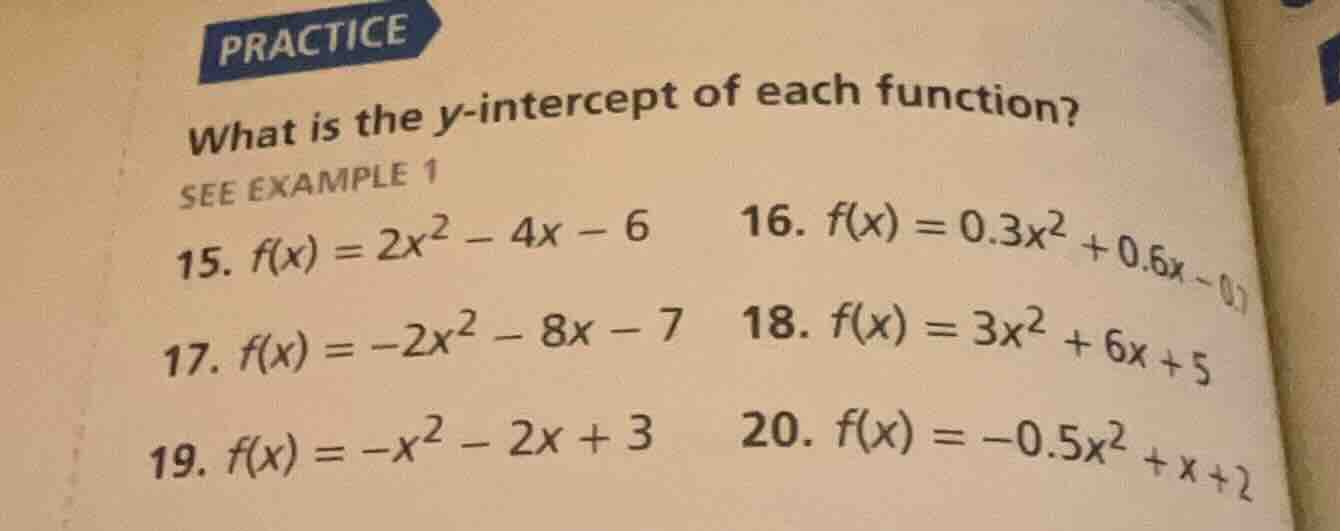
what is the y-intercept of each function?
see example 1
- $f(x) = 2x^2 - 4x - 6$ 16. $f(x) = 0.3x^2 + 0.6x - 0.7$
- $f(x) = -2x^2 - 8x - 7$ 18. $f(x) = 3x^2 + 6x + 5$
- $f(x) = -x^2 - 2x + 3$ 20. $f(x) = -0.5x^2 + x + 2$
Step1: Recall y-intercept definition
The y-intercept of a function $f(x)$ is the value of $f(0)$, found by substituting $x=0$ into the function.
Step2: Solve for problem 15
Substitute $x=0$ into $f(x)=2x^2-4x-6$:
$f(0)=2(0)^2 - 4(0) - 6 = -6$
Step3: Solve for problem 16
Substitute $x=0$ into $f(x)=0.3x^2+0.6x-0.7$:
$f(0)=0.3(0)^2 + 0.6(0) - 0.7 = -0.7$
Step4: Solve for problem 17
Substitute $x=0$ into $f(x)=-2x^2-8x-7$:
$f(0)=-2(0)^2 - 8(0) - 7 = -7$
Step5: Solve for problem 18
Substitute $x=0$ into $f(x)=3x^2+6x+5$:
$f(0)=3(0)^2 + 6(0) + 5 = 5$
Step6: Solve for problem 19
Substitute $x=0$ into $f(x)=-x^2-2x+3$:
$f(0)=-(0)^2 - 2(0) + 3 = 3$
Step7: Solve for problem 20
Substitute $x=0$ into $f(x)=-0.5x^2+x+2$:
$f(0)=-0.5(0)^2 + (0) + 2 = 2$

Snap & solve any problem in the app
Get step-by-step solutions on Sovi AI
Photo-based solutions with guided steps
Explore more problems and detailed explanations
- $\boldsymbol{-6}$
- $\boldsymbol{-0.7}$
- $\boldsymbol{-7}$
- $\boldsymbol{5}$
- $\boldsymbol{3}$
- $\boldsymbol{2}$