QUESTION IMAGE
Question
precision problems!
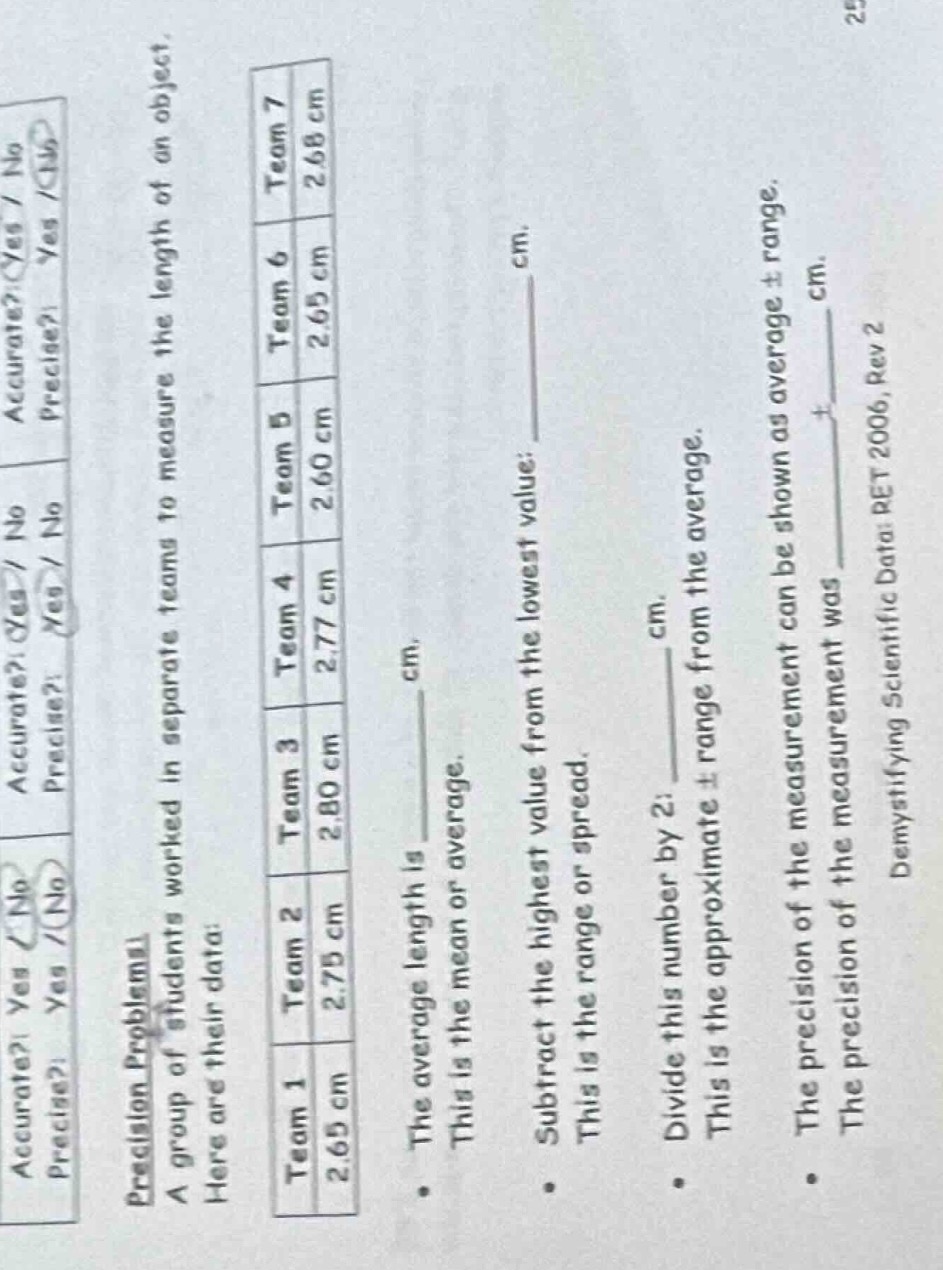
a group of students worked in separate teams to measure the length of an object.
here are their data:
| team | length (cm) |
|---|---|
| team 2 | 2.75 |
| team 3 | 2.80 |
| team 4 | 2.77 |
| team 5 | 2.60 |
| team 6 | 2.65 |
| team 7 | 2.68 |
- the average length is ______ cm.
this is the mean or average.
- subtract the highest value from the lowest value: ______ cm.
this is the range or spread.
- divide this number by 2: ______ cm.
this is the approximate ± range from the average.
- the precision of the measurement can be shown as average ± range.
the precision of the measurement was ____ ± ____ cm.
Step1: Calculate the average length
First, sum up all the length values: \(2.65 + 2.75 + 2.80 + 2.77 + 2.60 + 2.65 + 2.68\)
\[
\]
There are 7 teams, so the average is \(\frac{18.9}{7}=2.7\) cm.
Step2: Find the highest and lowest values
The values are \(2.65, 2.75, 2.80, 2.77, 2.60, 2.65, 2.68\). The highest value is \(2.80\) cm and the lowest is \(2.60\) cm. Subtract them: \(2.80 - 2.60 = 0.20\) cm.
Step3: Divide the range by 2
The range is \(0.20\) cm, so dividing by 2 gives \(\frac{0.20}{2}=0.10\) cm.
Step4: Express as average ± range/2
The average is \(2.7\) cm and the range from the average (half - range) is \(0.10\) cm, so it is \(2.7\pm0.10\) cm.

Snap & solve any problem in the app
Get step-by-step solutions on Sovi AI
Photo-based solutions with guided steps
Explore more problems and detailed explanations
- The average length is \(\boldsymbol{2.7}\) cm.
- Subtract the highest value from the lowest value: \(\boldsymbol{0.20}\) cm.
- Divide this number by 2: \(\boldsymbol{0.10}\) cm.
- The precision of the measurement was \(\boldsymbol{2.7\pm0.10}\) cm.