QUESTION IMAGE
Question
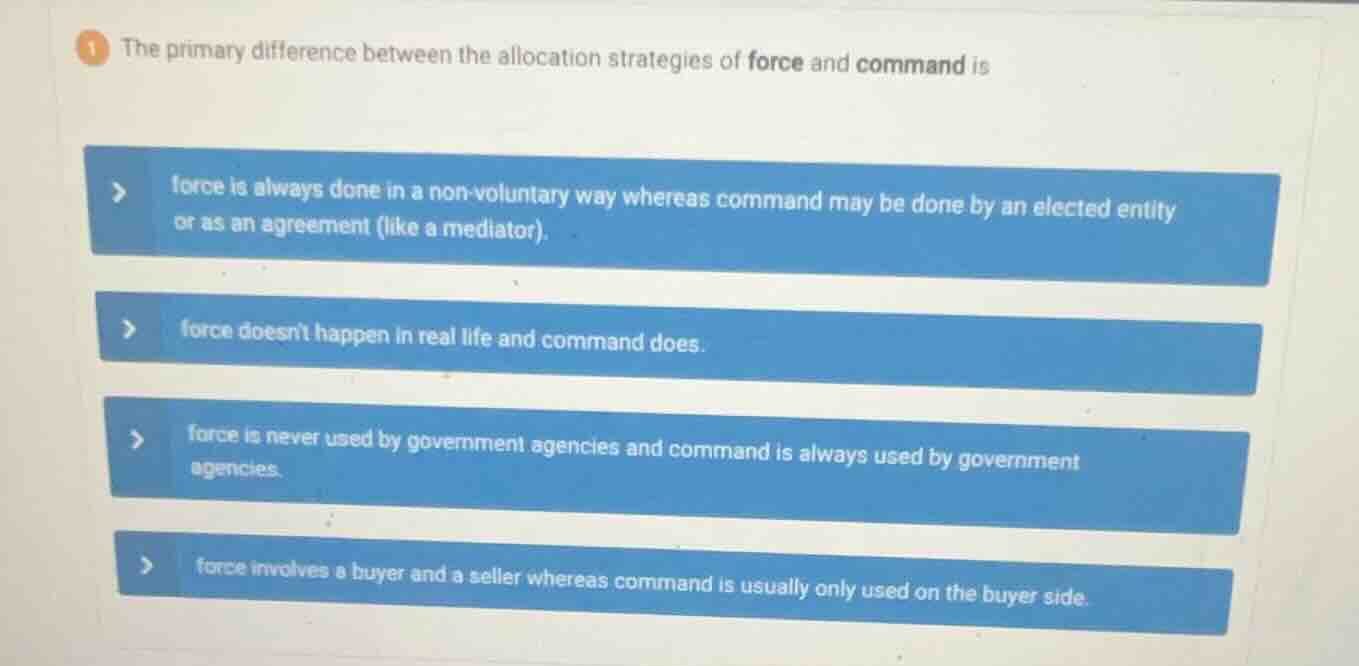
the primary difference between the allocation strategies of force and command is
- force is always done in a non - voluntary way whereas command may be done by an elected entity or as an agreement (like a mediator).
- force doesnt happen in real life and command does.
- force is never used by government agencies and command is always used by government agencies.
- force involves a buyer and a seller whereas command is usually only used on the buyer side.
Brief Explanations
- Analyze the first option: Force is non - voluntary (e.g., coercion), while command can come from an elected entity (like a government) or as an agreement (mediator - led). This aligns with the concepts of force (involuntary) and command (can be voluntary or from legitimate authority).
- The second option is wrong because force does happen in real life (e.g., theft, coercion).
- The third option is wrong as government agencies can use force (e.g., law enforcement using force to uphold laws) and command isn't always used by them in an absolute sense.
- The fourth option is wrong as force doesn't necessarily involve a buyer - seller relationship, and command's relation to buyer - seller is misrepresented.

Snap & solve any problem in the app
Get step-by-step solutions on Sovi AI
Photo-based solutions with guided steps
Explore more problems and detailed explanations
A. force is always done in a non - voluntary way whereas command may be done by an elected entity or as an agreement (like a mediator).