QUESTION IMAGE
Question
primary succession
primary succession:
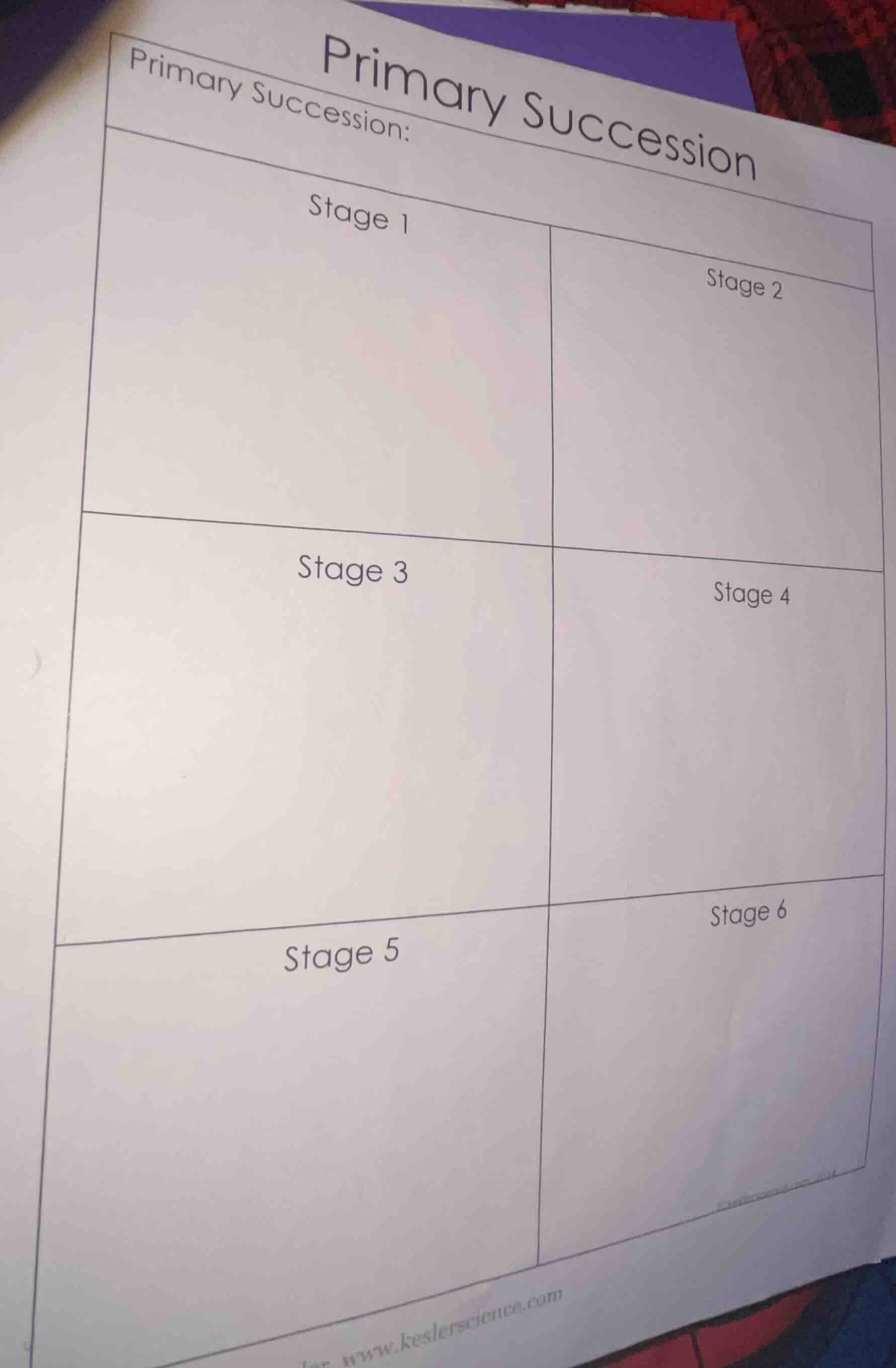
stage 1\tstage 2
stage 3\tstage 4
stage 5\tstage 6
www.keslerscience.com
To fill out the primary succession stages, we recall the process of primary succession (ecological succession on bare, lifeless surfaces like rock, sand, or lava flows):
Stage 1: Bare Rock
- No soil, only exposed rock (e.g., after a volcanic eruption or glacial retreat).
- Pioneer species (e.g., lichens, mosses) begin to colonize, as they can survive with little or no soil and help break down rock.
Stage 2: Pioneer Species (Lichens/Mosses)
- Lichens secrete acids to weather rock, and mosses grow in the thin layer of organic matter (from lichen decay) and trapped debris.
- This stage builds the first layer of soil (very thin, nutrient-poor).
Stage 3: Herbaceous Plants (Grasses, Ferns)
- As soil depth and nutrients increase, hardy herbaceous plants (grasses, ferns) take root.
- These plants further enrich the soil with organic matter (via roots and decay) and attract small animals (insects, worms) that help with decomposition.
Stage 4: Shrubs and Small Trees
- Deeper, more fertile soil supports shrubs (e.g., blueberry, rhododendron) and small trees (e.g., pine, birch).
- These plants create more shade, altering the microclimate and soil conditions.
Stage 5: Young Forest (Softwood Trees)
- Larger trees (e.g., pine, spruce) dominate, forming a young forest.
- The ecosystem becomes more complex, with a diverse understory of plants and animals.
Stage 6: Climax Community (Hardwood Forest)
- A stable, mature community (e.g., oak-hickory forest) forms.
- The climax community is self-sustaining, with a balanced mix of plants, animals, and decomposers, adapted to the local climate and soil.
You can summarize each stage in the table with key features (e.g., dominant organisms, soil development) to complete the worksheet.

Snap & solve any problem in the app
Get step-by-step solutions on Sovi AI
Photo-based solutions with guided steps
Explore more problems and detailed explanations
To fill out the primary succession stages, we recall the process of primary succession (ecological succession on bare, lifeless surfaces like rock, sand, or lava flows):
Stage 1: Bare Rock
- No soil, only exposed rock (e.g., after a volcanic eruption or glacial retreat).
- Pioneer species (e.g., lichens, mosses) begin to colonize, as they can survive with little or no soil and help break down rock.
Stage 2: Pioneer Species (Lichens/Mosses)
- Lichens secrete acids to weather rock, and mosses grow in the thin layer of organic matter (from lichen decay) and trapped debris.
- This stage builds the first layer of soil (very thin, nutrient-poor).
Stage 3: Herbaceous Plants (Grasses, Ferns)
- As soil depth and nutrients increase, hardy herbaceous plants (grasses, ferns) take root.
- These plants further enrich the soil with organic matter (via roots and decay) and attract small animals (insects, worms) that help with decomposition.
Stage 4: Shrubs and Small Trees
- Deeper, more fertile soil supports shrubs (e.g., blueberry, rhododendron) and small trees (e.g., pine, birch).
- These plants create more shade, altering the microclimate and soil conditions.
Stage 5: Young Forest (Softwood Trees)
- Larger trees (e.g., pine, spruce) dominate, forming a young forest.
- The ecosystem becomes more complex, with a diverse understory of plants and animals.
Stage 6: Climax Community (Hardwood Forest)
- A stable, mature community (e.g., oak-hickory forest) forms.
- The climax community is self-sustaining, with a balanced mix of plants, animals, and decomposers, adapted to the local climate and soil.
You can summarize each stage in the table with key features (e.g., dominant organisms, soil development) to complete the worksheet.