QUESTION IMAGE
Question
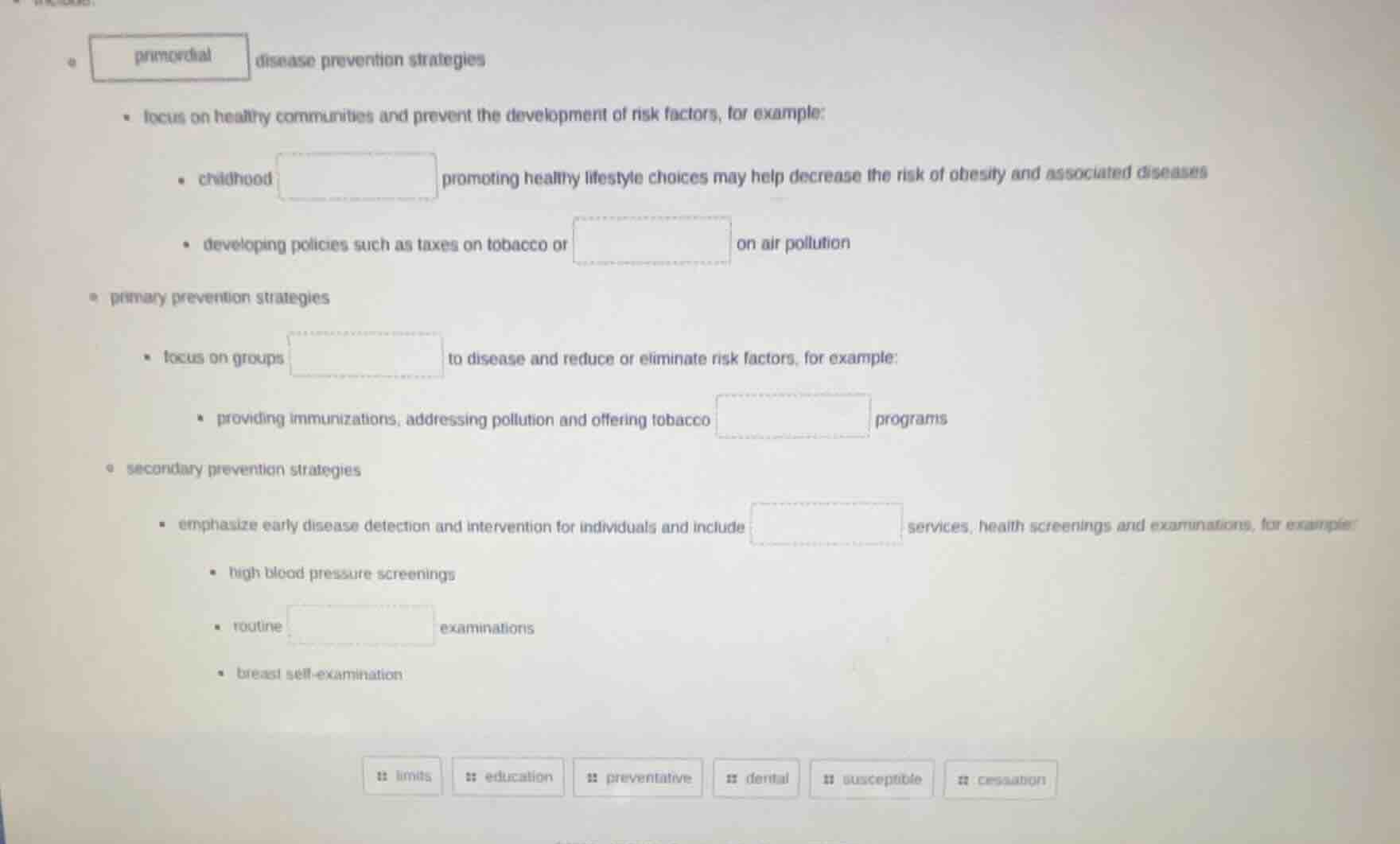
primordial disease prevention strategies - focus on healthy communities and prevent the development of risk factors, for example: - childhood \boxed{} promoting healthy lifestyle choices may help decrease the risk of obesity and associated diseases - developing policies such as taxes on tobacco or \boxed{} on air pollution - primary prevention strategies - focus on groups \boxed{} to disease and reduce or eliminate risk factors, for example: - providing immunizations, addressing pollution and offering tobacco \boxed{} programs - secondary prevention strategies - emphasize early disease detection and intervention for individuals and include \boxed{} services, health screenings and examinations, for example: - high blood pressure screenings - routine \boxed{} examinations - breast self - examination
To solve this fill - in - the - blank problem related to disease prevention strategies, we analyze each blank based on the context:
1. Childhood ______ (promoting healthy lifestyle choices...)
The context is about promoting healthy lifestyle choices in childhood to prevent diseases. The word "education" fits here as childhood education can involve teaching about healthy lifestyles. So the first blank (after childhood) is filled with "education".
2. Taxes on tobacco or ______ on air pollution
We need a word that means setting restrictions, similar to taxes (which are a form of restriction on tobacco use). "limits" is appropriate here as setting limits on air pollution is a policy measure. So this blank is filled with "limits".
3. Groups ______ to disease (primary prevention strategies)
The phrase "susceptible to disease" is a common term, meaning groups that are likely to get the disease. So this blank is filled with "susceptible".
4. Tobacco ______ programs
"Tobacco cessation programs" are programs to help people stop using tobacco. So this blank is filled with "cessation".
5. ______ services (secondary prevention strategies)
In secondary prevention, "preventative services" are common as they are about preventing the progression of disease. So this blank is filled with "preventative".
6. Routine ______ examinations
"Routine dental examinations" are a common form of health screening in secondary prevention. So this blank is filled with "dental".
Filled - in Text:
- primordial disease prevention strategies
- focus on healthy communities and prevent the development of risk factors, for example:
- childhood $\boldsymbol{education}$ promoting healthy lifestyle choices may help decrease the risk of obesity and associated diseases
- developing policies such as taxes on tobacco or $\boldsymbol{limits}$ on air pollution
- primary prevention strategies
- focus on groups $\boldsymbol{susceptible}$ to disease and reduce or eliminate risk factors, for example:
- providing immunizations, addressing pollution and offering tobacco $\boldsymbol{cessation}$ programs
- secondary prevention strategies
- emphasize early disease detection and intervention for individuals and include $\boldsymbol{preventative}$ services, health screenings and examinations, for example:
- high blood pressure screenings
- routine $\boldsymbol{dental}$ examinations
- breast self - examination
The answers for the blanks (in order) are: education, limits, susceptible, cessation, preventative, dental.

Snap & solve any problem in the app
Get step-by-step solutions on Sovi AI
Photo-based solutions with guided steps
Explore more problems and detailed explanations
To solve this fill - in - the - blank problem related to disease prevention strategies, we analyze each blank based on the context:
1. Childhood ______ (promoting healthy lifestyle choices...)
The context is about promoting healthy lifestyle choices in childhood to prevent diseases. The word "education" fits here as childhood education can involve teaching about healthy lifestyles. So the first blank (after childhood) is filled with "education".
2. Taxes on tobacco or ______ on air pollution
We need a word that means setting restrictions, similar to taxes (which are a form of restriction on tobacco use). "limits" is appropriate here as setting limits on air pollution is a policy measure. So this blank is filled with "limits".
3. Groups ______ to disease (primary prevention strategies)
The phrase "susceptible to disease" is a common term, meaning groups that are likely to get the disease. So this blank is filled with "susceptible".
4. Tobacco ______ programs
"Tobacco cessation programs" are programs to help people stop using tobacco. So this blank is filled with "cessation".
5. ______ services (secondary prevention strategies)
In secondary prevention, "preventative services" are common as they are about preventing the progression of disease. So this blank is filled with "preventative".
6. Routine ______ examinations
"Routine dental examinations" are a common form of health screening in secondary prevention. So this blank is filled with "dental".
Filled - in Text:
- primordial disease prevention strategies
- focus on healthy communities and prevent the development of risk factors, for example:
- childhood $\boldsymbol{education}$ promoting healthy lifestyle choices may help decrease the risk of obesity and associated diseases
- developing policies such as taxes on tobacco or $\boldsymbol{limits}$ on air pollution
- primary prevention strategies
- focus on groups $\boldsymbol{susceptible}$ to disease and reduce or eliminate risk factors, for example:
- providing immunizations, addressing pollution and offering tobacco $\boldsymbol{cessation}$ programs
- secondary prevention strategies
- emphasize early disease detection and intervention for individuals and include $\boldsymbol{preventative}$ services, health screenings and examinations, for example:
- high blood pressure screenings
- routine $\boldsymbol{dental}$ examinations
- breast self - examination
The answers for the blanks (in order) are: education, limits, susceptible, cessation, preventative, dental.