QUESTION IMAGE
Question
(b) problem
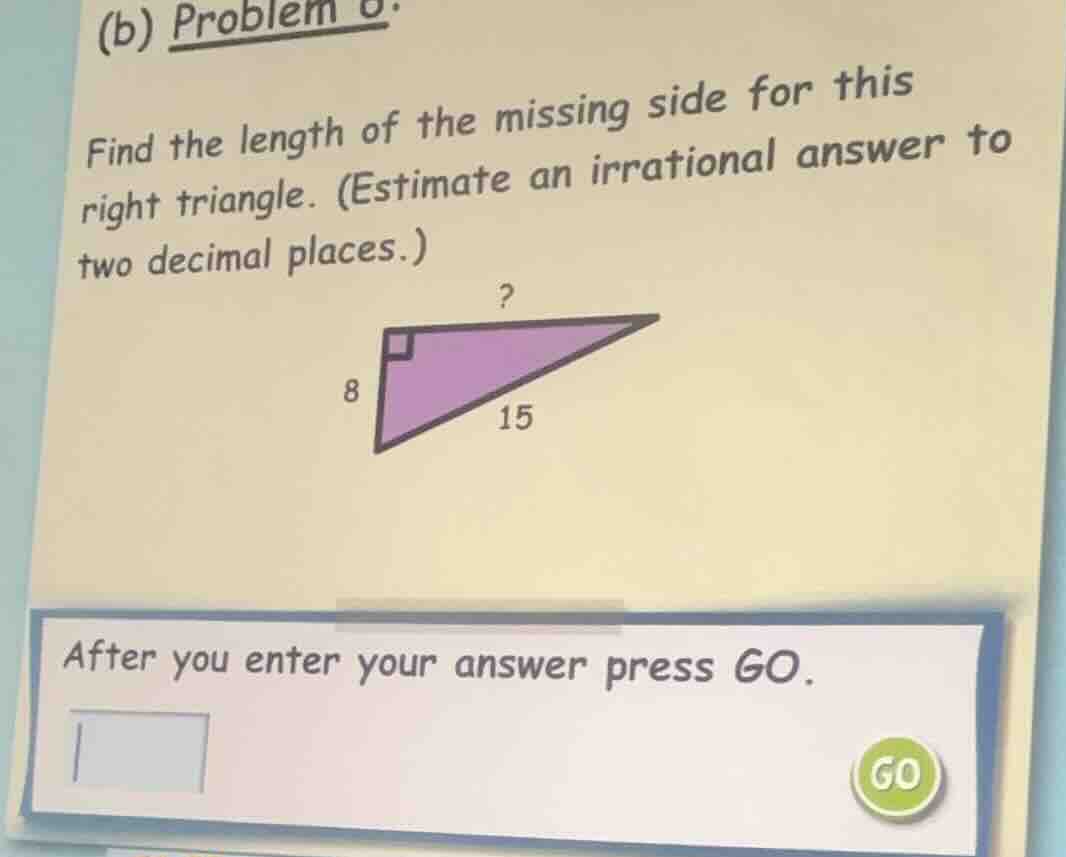
find the length of the missing side for this right triangle. (estimate an irrational answer to two decimal places.)
?
8
15
after you enter your answer press go.
go
Step1: Identify the formula
For a right triangle, we use the Pythagorean theorem: \(a^2 + b^2 = c^2\), where \(c\) is the hypotenuse, and \(a\), \(b\) are the legs. Here, the legs are 8 and 15, and we need to find the hypotenuse (the missing side).
Step2: Substitute the values
Substitute \(a = 8\) and \(b = 15\) into the formula: \(c^2 = 8^2 + 15^2\)
Calculate \(8^2 = 64\) and \(15^2 = 225\), so \(c^2 = 64 + 225 = 289\)? Wait, no, wait. Wait, 8 squared is 64, 15 squared is 225, sum is 289? But 17 squared is 289. Wait, but maybe I misread the triangle. Wait, the right angle is between 8 and the missing side? Wait, no, the diagram: the right angle is at the vertex with 8 and the missing side? Wait, no, the legs are 8 and the missing side, and hypotenuse is 15? Wait, no, the labels: the side with 8 is vertical, the side with 15 is the hypotenuse? Wait, no, the triangle has a right angle, one leg 8, one leg? Wait, no, the diagram: the right angle is between 8 and the horizontal side (missing), and the hypotenuse is 15? Wait, no, the numbers: 8, 15, and missing. Wait, maybe I got the legs wrong. Wait, let's re-examine. If it's a right triangle, and the two legs are 8 and the missing side, and hypotenuse is 15? No, 8-15-? Wait, 8 squared plus 15 squared is 64 + 225 = 289, square root of 289 is 17. Wait, but maybe the hypotenuse is 15? No, that can't be, because 8 and 15: 8 is a leg, 15 is the other leg? Wait, no, the right angle is between 8 and the missing side, so 8 and missing are legs, 15 is hypotenuse? Wait, no, 8^2 + x^2 = 15^2? Then x^2 = 225 - 64 = 161, x = sqrt(161) ≈12.69. Wait, I think I misread the diagram. Let's check again. The triangle: right angle, one leg 8, one leg? and hypotenuse 15? Or one leg 8, hypotenuse 15, and the other leg? Wait, the problem says "Find the length of the missing side". So let's clarify: in a right triangle, the Pythagorean theorem is \(a^2 + b^2 = c^2\), where \(c\) is hypotenuse (longest side). So if 8 and 15 are the two legs, then hypotenuse is sqrt(8²+15²)=sqrt(64+225)=sqrt(289)=17. But if 8 is a leg and 15 is hypotenuse, then the other leg is sqrt(15² -8²)=sqrt(225-64)=sqrt(161)≈12.69. Wait, the diagram: the right angle is at the vertex with 8 and the missing side, so 8 and missing are legs, 15 is hypotenuse? No, that would mean 8 and missing are legs, hypotenuse 15. Then missing side is sqrt(15² -8²)=sqrt(225-64)=sqrt(161)≈12.69. Wait, maybe I misread the labels. Let's assume that the two legs are 8 and 15, then hypotenuse is 17. But the diagram: the side with 8 is vertical, the side with 15 is the hypotenuse? No, the hypotenuse is the longest side. 15 is longer than 8, so if 8 is a leg, 15 is the hypotenuse, then the other leg is sqrt(15² -8²)=sqrt(161)≈12.69. Wait, the problem says "Estimate an irrational answer to two decimal places", so sqrt(161) is irrational. So let's recalculate. 15 squared is 225, 8 squared is 64, 225 - 64 = 161. Square root of 161: sqrt(161) ≈12.69 (since 12^2=144, 13^2=169, so between 12 and 13. 12.6^2=158.76, 12.7^2=161.29, so sqrt(161)≈12.69. Wait, but earlier I thought 8 and 15 are legs, but that gives 17, which is rational. So the problem says "estimate an irrational answer", so the missing side is a leg, hypotenuse is 15, and the other leg is 8. So the formula is \(c^2 = a^2 + b^2\), but if we need to find a leg, then \(a^2 = c^2 - b^2\). So let's do that. Let’s denote:
Let the hypotenuse \(c = 15\), one leg \(b = 8\), find the other leg \(a\).
Step1: Apply Pythagorean theorem for leg
The formula for a leg in a right triangle is \(a = \sqrt{c^2 - b^2}…

Snap & solve any problem in the app
Get step-by-step solutions on Sovi AI
Photo-based solutions with guided steps
Explore more problems and detailed explanations
12.69