QUESTION IMAGE
Question
problem 1
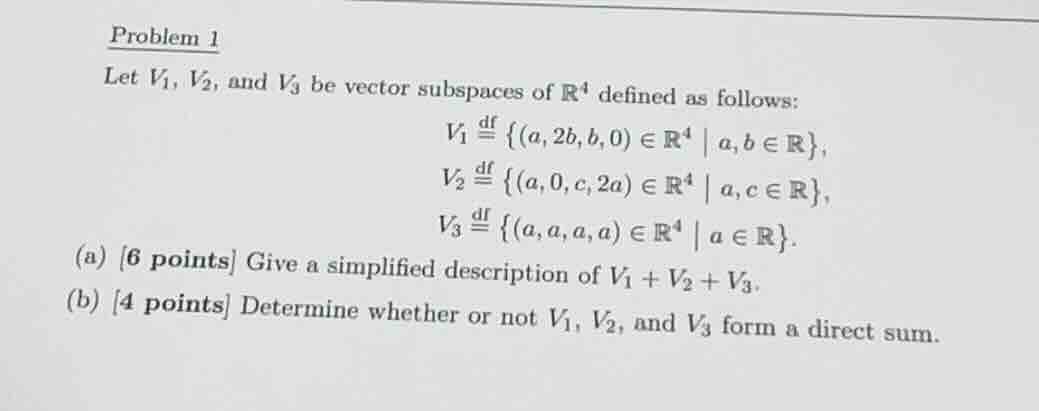
let ( v_1, v_2, ) and ( v_3 ) be vector subspaces of ( mathbb{r}^4 ) defined as follows:
v_1 stackrel{df}{=} {(a, 2b, b, 0) in mathbb{r}^4 mid a, b in mathbb{r}},
v_2 stackrel{df}{=} {(a, 0, c, 2a) in mathbb{r}^4 mid a, c in mathbb{r}},
v_3 stackrel{df}{=} {(a, a, a, a) in mathbb{r}^4 mid a in mathbb{r}}.
(a) 6 points give a simplified description of ( v_1 + v_2 + v_3 ).
(b) 4 points determine whether or not ( v_1, v_2, ) and ( v_3 ) form a direct sum.
Step1: Express general element of $V_1+V_2+V_3$
Take $v_1=(a,2b,b,0) \in V_1$, $v_2=(c,0,d,2c) \in V_2$, $v_3=(e,e,e,e) \in V_3$. Their sum is:
where $x_1=a+c+e$, $x_2=2b+e$, $x_3=b+d+e$, $x_4=2c+e$.
Step2: Solve for free variables
Rearrange to solve for $a,b,c,d,e$ in terms of $x_1,x_2,x_3,x_4$:
- From $x_2=2b+e$, get $b=\frac{x_2-e}{2}$
- From $x_4=2c+e$, get $c=\frac{x_4-e}{2}$
- Substitute $b$ into $x_3=b+d+e$: $d=x_3 - \frac{x_2-e}{2}-e = x_3-\frac{x_2}{2}-\frac{e}{2}$
- Substitute $c$ into $x_1=a+c+e$: $a=x_1 - \frac{x_4-e}{2}-e = x_1-\frac{x_4}{2}-\frac{e}{2}$
Since $a,b,c,d,e \in \mathbb{R}$, we can choose $e$ freely, and $x_1,x_2,x_3,x_4$ can be any real numbers (no constraints). Thus $V_1+V_2+V_3=\mathbb{R}^4$.
Step3: Check for direct sum condition
A sum $V_1+V_2+V_3$ is direct only if $V_1\cap(V_2+V_3)=\{0\}$, $V_2\cap(V_1+V_3)=\{0\}$, $V_3\cap(V_1+V_2)=\{0\}$.
Find a non-zero vector in $V_1\cap(V_2+V_3)$:
Take $v=(2,0,0,4) \in V_2$ (set $a=1,c=0$: $(1,0,0,2)$ scaled by 2) and $v'=(-2,0,0,-2) \in V_3$ (set $a=-2$). Their sum is $(0,0,0,2)
otin V_1$. Instead, take $v=( -2, 2, 1, 0) \in V_1$ (a=0,b=1), $v_2=(2,-2,-1,4) \in V_2$ (a=2,c=-1), $v_3=(0,0,0,-4) \in V_3$ (a=-4). A simpler check: find non-zero $v_1\in V_1$, $v_2\in V_2$, $v_3\in V_3$ such that $v_1+v_2+v_3=0$:
Set $e=2$, then $2b+2=0\Rightarrow b=-1$; $2c+2=0\Rightarrow c=-1$; $b+d+2=0\Rightarrow d=-1$; $a-1+2=0\Rightarrow a=-1$.
So $v_1=(-1,-2,-1,0)$, $v_2=(-1,0,-1,-2)$, $v_3=(2,2,2,2)$ are non-zero, and $v_1+v_2+v_3=0$. Thus the intersection is non-trivial.
---

Snap & solve any problem in the app
Get step-by-step solutions on Sovi AI
Photo-based solutions with guided steps
Explore more problems and detailed explanations
(a) $V_1+V_2+V_3 = \mathbb{R}^4$
(b) $V_1$, $V_2$, and $V_3$ do not form a direct sum.