QUESTION IMAGE
Question
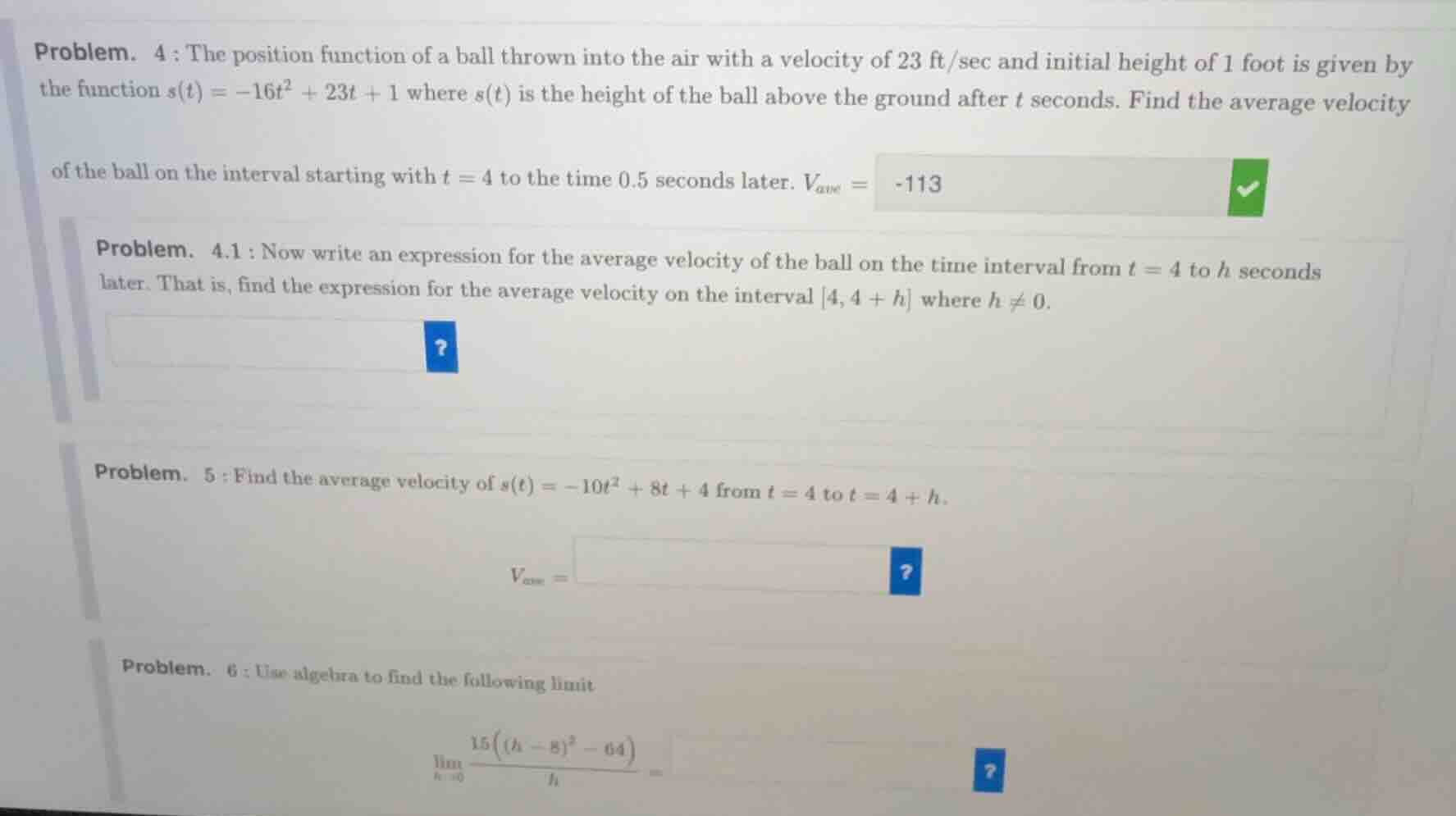
problem. 4 : the position function of a ball thrown into the air with a velocity of 23 ft/sec and initial height of 1 foot is given by the function $s(t) = -16t^2 + 23t + 1$ where $s(t)$ is the height of the ball above the ground after $t$ seconds. find the average velocity of the ball on the interval starting with $t = 4$ to the time 0.5 seconds later. $v_{ave} = -113$
problem. 4.1 : now write an expression for the average velocity of the ball on the time interval from $t = 4$ to $h$ seconds later. that is, find the expression for the average velocity on the interval $4, 4 + h$ where $h \
eq 0$.
problem. 5 : find the average velocity of $s(t) = -10t^2 + 8t + 4$ from $t = 4$ to $t = 4 + h$.
$v_{ave} = $
problem. 6 : use algebra to find the following limit
$\lim_{h \to 0} \frac{15\left((h - 8)^2 - 64\
ight)}{h} = $
Problem 4.1
Step1: Recall average velocity formula
The formula for average velocity \( V_{ave} \) over the interval \([a, b]\) is \( V_{ave}=\frac{s(b)-s(a)}{b - a} \). Here, \( a = 4 \) and \( b=4 + h \), so we need to find \( s(4 + h) \) and \( s(4) \), then substitute into the formula.
Step2: Find \( s(4 + h) \)
Given \( s(t)=- 16t^{2}+23t + 1 \), substitute \( t = 4+h \):
\[
\]
Step3: Find \( s(4) \)
Substitute \( t = 4 \) into \( s(t) \):
\[
\]
Step4: Substitute into average velocity formula
\[
\]
Step1: Recall average velocity formula
The formula for average velocity \( V_{ave} \) over \([a,b]\) is \( V_{ave}=\frac{s(b)-s(a)}{b - a} \). Here, \( a = 4 \), \( b = 4+h \), so find \( s(4 + h) \) and \( s(4) \).
Step2: Find \( s(4 + h) \)
Given \( s(t)=-10t^{2}+8t + 4 \), substitute \( t = 4 + h \):
\[
\]
Step3: Find \( s(4) \)
Substitute \( t = 4 \) into \( s(t) \):
\[
\]
Step4: Substitute into average velocity formula
\[
\]
Step1: Factor the numerator
Notice that \( (h - 8)^{2}-64=(h - 8)^{2}-8^{2} \), which is a difference of squares. Using \( a^{2}-b^{2}=(a - b)(a + b) \), where \( a=h - 8 \) and \( b = 8 \):
\[
\]
Step2: Simplify the limit expression
The limit is \( \lim_{h
ightarrow0}\frac{15((h - 8)^{2}-64)}{h} \). Substitute the factored form of the numerator:
\[
\]
(We can cancel \( h \) since \( h
ightarrow0 \) but \( h
eq0 \) when taking the limit)
Step3: Evaluate the limit
Substitute \( h = 0 \) into \( 15(h - 16) \):
\[
15(0 - 16)=-240
\]

Snap & solve any problem in the app
Get step-by-step solutions on Sovi AI
Photo-based solutions with guided steps
Explore more problems and detailed explanations
\( -16h - 105 \)