QUESTION IMAGE
Question
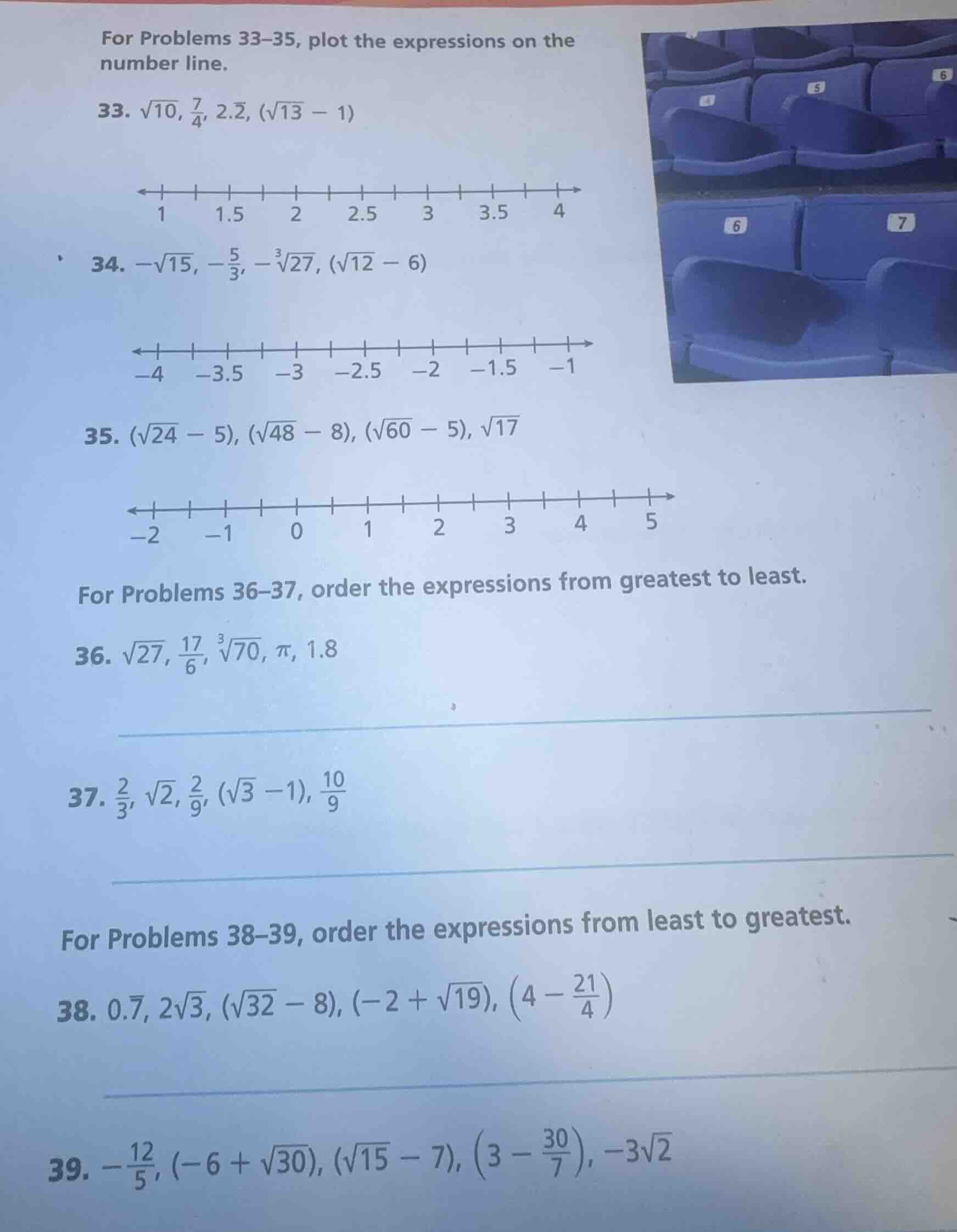
for problems 33–35, plot the expressions on the number line.
- $sqrt{10}, \frac{7}{4}, 2.\overline{2}, (\sqrt{13} - 1)$
number line from 1 to 4 with marks at 1, 1.5, 2, 2.5, 3, 3.5, 4
- $-\sqrt{15}, -\frac{5}{3}, -\sqrt3{27}, (\sqrt{12} - 6)$
number line from -4 to -1 with marks at -4, -3.5, -3, -2.5, -2, -1.5, -1
- $(\sqrt{24} - 5), (\sqrt{48} - 8), (\sqrt{60} - 5), \sqrt{17}$
number line from -2 to 5 with marks at -2, -1, 0, 1, 2, 3, 4, 5
for problems 36–37, order the expressions from greatest to least.
- $sqrt{27}, \frac{17}{6}, \sqrt3{70}, \pi, 1.8$
- $\frac{2}{3}, \sqrt{2}, \frac{2}{9}, (\sqrt{3} - 1), \frac{10}{9}$
for problems 38–39, order the expressions from least to greatest.
- $0.\overline{7}, 2\sqrt{3}, (\sqrt{32} - 8), (-2 + \sqrt{19}), \left(4 - \frac{21}{4}\
ight)$
- $-\frac{12}{5}, (-6 + \sqrt{30}), (\sqrt{15} - 7), \left(3 - \frac{30}{7}\
ight), -3\sqrt{2}$
Let's solve Problem 36: Order the expressions \(\sqrt{27}\), \(\frac{17}{6}\), \(\sqrt[3]{70}\), \(\pi\), \(1.8\) from greatest to least.
Step 1: Approximate each expression
- For \(\sqrt{27}\): We know that \(\sqrt{25} = 5\) and \(\sqrt{36}=6\), so \(\sqrt{27}\approx 5.196\) (since \(27\) is between \(25\) and \(36\), and closer to \(25\), but actually \(\sqrt{27}=3\sqrt{3}\approx 3\times1.732 = 5.196\)? Wait, no, wait: \(\sqrt{25}=5\), \(\sqrt{36}=6\), but \(27 = 9\times3\), so \(\sqrt{27}=3\sqrt{3}\approx 3\times1.732 = 5.196\)? Wait, no, \(3^2=9\), \(5^2=25\), \(6^2=36\). Wait, \(\sqrt{27}\) is \(3\sqrt{3}\approx 5.196\)? Wait, no, \(5^2 = 25\), \(6^2=36\), so \(\sqrt{27}\) is between \(5\) and \(6\), approximately \(5.196\).
- For \(\frac{17}{6}\): Divide \(17\) by \(6\). \(6\times2 = 12\), \(17 - 12 = 5\), so \(\frac{17}{6}\approx 2.833\).
- For \(\sqrt[3]{70}\): We know that \(\sqrt[3]{64}=4\) and \(\sqrt[3]{125}=5\), so \(\sqrt[3]{70}\) is between \(4\) and \(5\). Let's calculate: \(4^3 = 64\), \(5^3=125\), so \(\sqrt[3]{70}\approx 4.121\) (since \(70 - 64 = 6\), so a bit more than \(4\)).
- For \(\pi\): \(\pi\approx 3.1416\).
- For \(1.8\): It's already a decimal, \(1.8\).
Step 2: Compare the approximate values
Now we have the approximate values:
- \(\sqrt{27}\approx 5.196\)
- \(\frac{17}{6}\approx 2.833\)
- \(\sqrt[3]{70}\approx 4.121\)
- \(\pi\approx 3.1416\)
- \(1.8\)
Now, ordering from greatest to least:
\(\sqrt{27}\) (≈5.196) is the largest, then \(\sqrt[3]{70}\) (≈4.121), then \(\pi\) (≈3.1416), then \(\frac{17}{6}\) (≈2.833), then \(1.8\).
Wait, wait, I made a mistake earlier. Wait, \(\sqrt{27}\): \(5^2 = 25\), \(6^2=36\), so \(\sqrt{27}\) is \(3\sqrt{3}\approx 5.196\)? Wait, no, \(3\sqrt{3}\) is about \(5.196\), but \(\sqrt[3]{70}\) is about \(4.121\), \(\pi\) is about \(3.14\), \(\frac{17}{6}\) is about \(2.83\), \(1.8\). So the order from greatest to least is:
\(\sqrt{27}\), \(\sqrt[3]{70}\), \(\pi\), \(\frac{17}{6}\), \(1.8\)
Wait, let's recheck the approximations:
- \(\sqrt{27}\): \(5^2 = 25\), \(6^2 = 36\), so \(\sqrt{27} \approx 5.196\) (correct, since \(5.196^2 \approx 27\))
- \(\sqrt[3]{70}\): \(4^3 = 64\), \(5^3 = 125\), so \(\sqrt[3]{70} \approx 4.121\) (correct, since \(4.121^3 \approx 70\))
- \(\pi \approx 3.1416\) (correct)
- \(\frac{17}{6} \approx 2.833\) (correct, \(6 \times 2.833 \approx 17\))
- \(1.8\) (correct)
So comparing the values: \(5.196 > 4.121 > 3.1416 > 2.833 > 1.8\)
So the order is \(\sqrt{27}\), \(\sqrt[3]{70}\), \(\pi\), \(\frac{17}{6}\), \(1.8\)

Snap & solve any problem in the app
Get step-by-step solutions on Sovi AI
Photo-based solutions with guided steps
Explore more problems and detailed explanations
\(\sqrt{27}\), \(\sqrt[3]{70}\), \(\pi\), \(\frac{17}{6}\), \(1.8\)