QUESTION IMAGE
Question
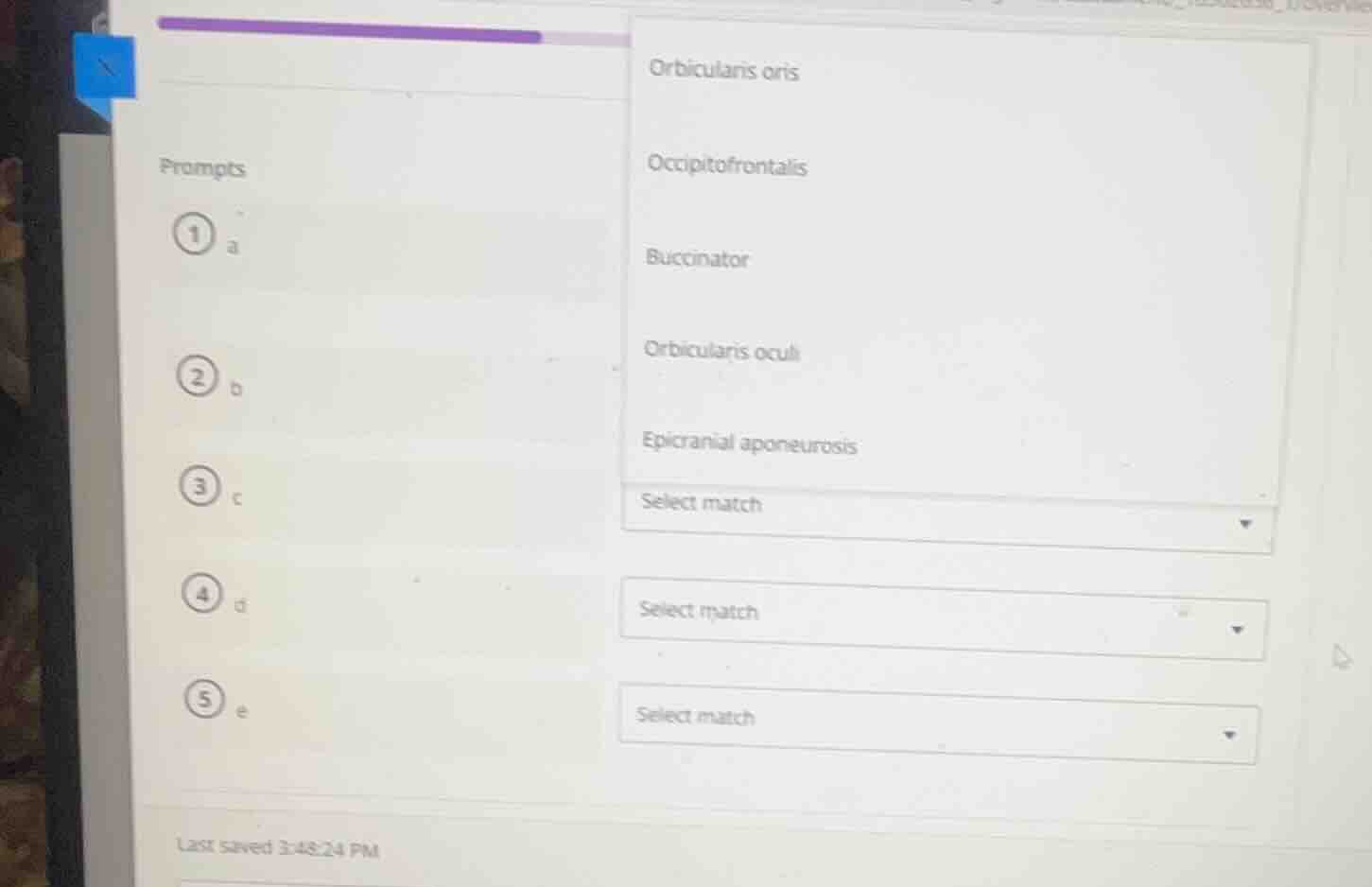
prompts
1 a
2 b
3 c
4 d
5 e
orbicularis oris
occipitofrontalis
buccinator
orbicularis oculi
epicranial aponeurosis
select match
select match
select match
last saved 3:48:24 pm
To solve this muscle - matching problem, we need to recall the functions and locations of each muscle:
Step 1: Analyze Orbicularis oris
The orbicularis oris is a muscle that surrounds the mouth. It is mainly responsible for movements related to the mouth, such as closing the lips. So, if one of the prompts (a - e) is related to the mouth - surrounding muscle, it should match with Orbicularis oris.
Step 2: Analyze Occipitofrontalis
The occipitofrontalis is a muscle of the scalp. It has two parts: the occipital part (at the back of the head) and the frontal part (at the front of the forehead). It is involved in movements of the scalp and forehead, like raising the eyebrows. If a prompt is about the scalp/forehead muscle, it should match with Occipitofrontalis.
Step 3: Analyze Buccinator
The buccinator is a muscle of the cheek. It helps in actions like blowing and chewing by compressing the cheeks. If a prompt is related to the cheek muscle, it should match with Buccinator.
Step 4: Analyze Orbicularis oculi
The orbicularis oculi is a muscle that surrounds the eye. It is responsible for closing the eye, like when we blink or squint. If a prompt is about the eye - surrounding muscle, it should match with Orbicularis oculi.
Step 5: Analyze Epicranial aponeurosis
The epicranial aponeurosis (also known as the galea aponeurotica) is a tough, tendinous sheet that connects the occipital and frontal parts of the occipitofrontalis muscle. It is part of the scalp's muscular - aponeurotic system. If a prompt is about the aponeurosis of the scalp, it should match with Epicranial aponeurosis.
Assuming the common matching (this may vary depending on the specific prompt descriptions which are not fully visible, but based on typical muscle - function knowledge):
- If prompt a is about the eye - surrounding muscle, then a matches with Orbicularis oculi.
- If prompt b is about the mouth - surrounding muscle, then b matches with Orbicularis oris.
- If prompt c is about the cheek muscle, then c matches with Buccinator.
- If prompt d is about the scalp muscle (occipitofrontalis - related), then d matches with Occipitofrontalis.
- If prompt e is about the scalp's aponeurosis, then e matches with Epicranial aponeurosis.
Since the exact prompts (a - e) descriptions are not fully provided, but based on standard muscle anatomy:
- If the first prompt (a) is about the eye muscle:
- Match: a - Orbicularis oculi
- If the second prompt (b) is about the mouth muscle:
- Match: b - Orbicularis oris
- If the third prompt (c) is about the cheek muscle:
- Match: c - Buccinator
- If the fourth prompt (d) is about the scalp muscle:
- Match: d - Occipitofrontalis
- If the fifth prompt (e) is about the scalp aponeurosis:
- Match: e - Epicranial aponeurosis
(Note: The above matches are based on typical muscle - function - to - prompt associations. The actual match may depend on the specific wording of the prompts which are not fully shown in the image.)

Snap & solve any problem in the app
Get step-by-step solutions on Sovi AI
Photo-based solutions with guided steps
Explore more problems and detailed explanations
To solve this muscle - matching problem, we need to recall the functions and locations of each muscle:
Step 1: Analyze Orbicularis oris
The orbicularis oris is a muscle that surrounds the mouth. It is mainly responsible for movements related to the mouth, such as closing the lips. So, if one of the prompts (a - e) is related to the mouth - surrounding muscle, it should match with Orbicularis oris.
Step 2: Analyze Occipitofrontalis
The occipitofrontalis is a muscle of the scalp. It has two parts: the occipital part (at the back of the head) and the frontal part (at the front of the forehead). It is involved in movements of the scalp and forehead, like raising the eyebrows. If a prompt is about the scalp/forehead muscle, it should match with Occipitofrontalis.
Step 3: Analyze Buccinator
The buccinator is a muscle of the cheek. It helps in actions like blowing and chewing by compressing the cheeks. If a prompt is related to the cheek muscle, it should match with Buccinator.
Step 4: Analyze Orbicularis oculi
The orbicularis oculi is a muscle that surrounds the eye. It is responsible for closing the eye, like when we blink or squint. If a prompt is about the eye - surrounding muscle, it should match with Orbicularis oculi.
Step 5: Analyze Epicranial aponeurosis
The epicranial aponeurosis (also known as the galea aponeurotica) is a tough, tendinous sheet that connects the occipital and frontal parts of the occipitofrontalis muscle. It is part of the scalp's muscular - aponeurotic system. If a prompt is about the aponeurosis of the scalp, it should match with Epicranial aponeurosis.
Assuming the common matching (this may vary depending on the specific prompt descriptions which are not fully visible, but based on typical muscle - function knowledge):
- If prompt a is about the eye - surrounding muscle, then a matches with Orbicularis oculi.
- If prompt b is about the mouth - surrounding muscle, then b matches with Orbicularis oris.
- If prompt c is about the cheek muscle, then c matches with Buccinator.
- If prompt d is about the scalp muscle (occipitofrontalis - related), then d matches with Occipitofrontalis.
- If prompt e is about the scalp's aponeurosis, then e matches with Epicranial aponeurosis.
Since the exact prompts (a - e) descriptions are not fully provided, but based on standard muscle anatomy:
- If the first prompt (a) is about the eye muscle:
- Match: a - Orbicularis oculi
- If the second prompt (b) is about the mouth muscle:
- Match: b - Orbicularis oris
- If the third prompt (c) is about the cheek muscle:
- Match: c - Buccinator
- If the fourth prompt (d) is about the scalp muscle:
- Match: d - Occipitofrontalis
- If the fifth prompt (e) is about the scalp aponeurosis:
- Match: e - Epicranial aponeurosis
(Note: The above matches are based on typical muscle - function - to - prompt associations. The actual match may depend on the specific wording of the prompts which are not fully shown in the image.)