QUESTION IMAGE
Question
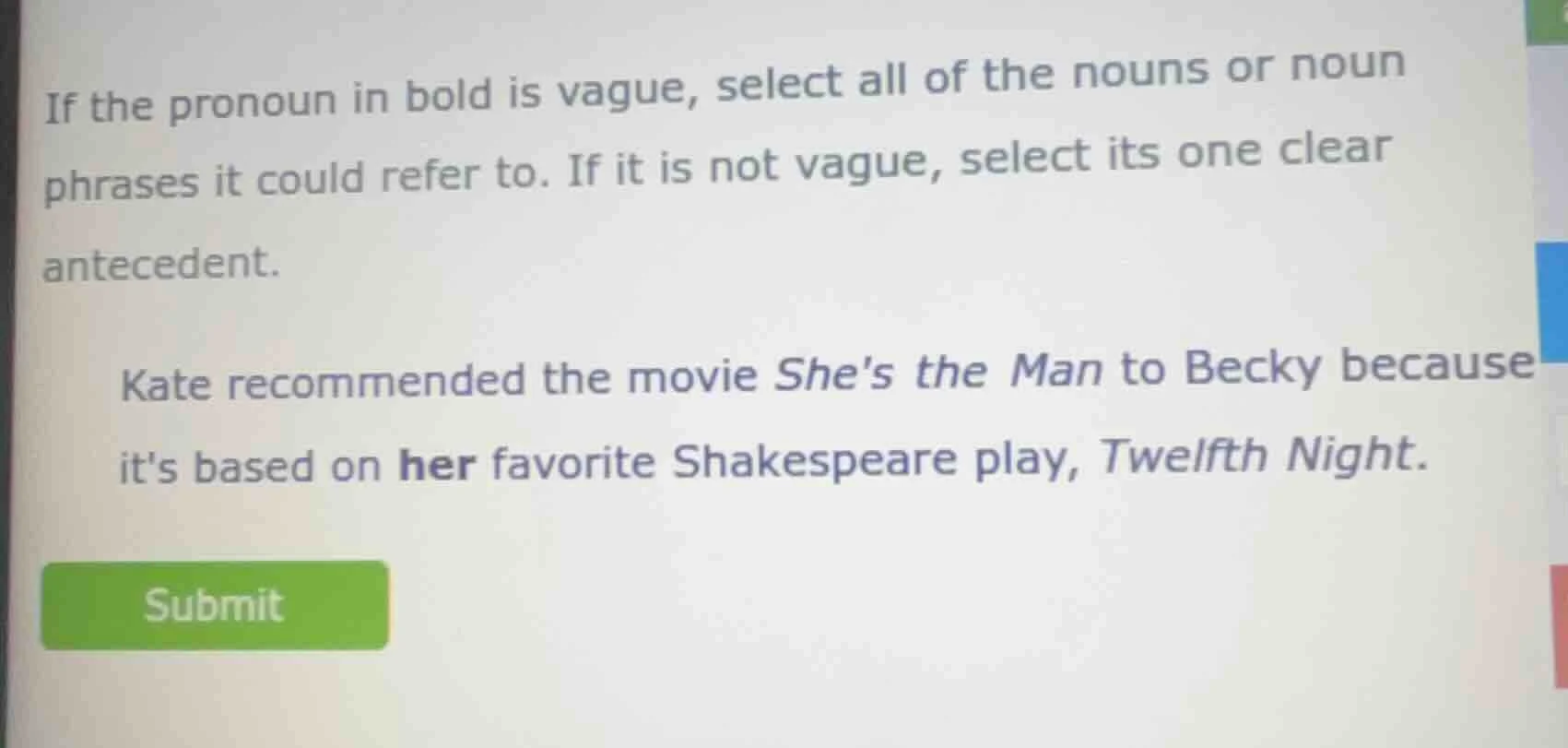
if the pronoun in bold is vague, select all of the nouns or noun phrases it could refer to. if it is not vague, select its one clear antecedent. kate recommended the movie shes the man to becky because its based on her favorite shakespeare play, twelfth night.
We analyze the pronoun "her" in the sentence. The possible antecedents are the female nouns in the sentence, which are Kate and Becky. We need to check which one "her" refers to. Looking at the context, Kate recommended the movie to Becky, and the play is based on "her" (Kate's or Becky's?) favorite. But since Kate is the one recommending, it's more likely "her" refers to Kate? Wait, no—wait, the sentence structure: Kate recommended the movie to Becky because it's based on her (whose?) favorite play. Wait, maybe it's ambiguous? Wait, no, let's re - read. The movie is recommended by Kate to Becky, and the reason is it's based on "her" (the person whose favorite play it is) favorite Shakespeare play. So the possible nouns are Kate and Becky. Wait, but let's check the grammar. The pronoun "her" is a possessive pronoun. The antecedent should be a female noun. The female nouns in the sentence are Kate and Becky. So we need to see which one "her" could refer to. But maybe in the context, since Kate is the one doing the recommending, maybe "her" refers to Kate? Wait, no, maybe it's ambiguous. Wait, the problem says "if the pronoun is vague, select all nouns or noun phrases it could refer to; if not, select its one clear antecedent". So let's list the female nouns: Kate and Becky. So "her" could refer to either Kate or Becky? Wait, no, maybe I'm overcomplicating. Wait, the sentence: Kate recommended the movie to Becky because it's based on her (Kate's or Becky's) favorite play. So the possible antecedents are Kate and Becky. So we need to select all the nouns or noun phrases "her" could refer to. The female nouns are Kate and Becky. Wait, but let's check the original sentence again. "Kate recommended the movie She's the Man to Becky because it's based on her favorite Shakespeare play, Twelfth Night." So "her" is a possessive pronoun. The possible antecedents are the female nouns in the sentence, which are Kate and Becky. So we should select both? Wait, but maybe the intended answer is Kate? Wait, no, maybe I made a mistake. Wait, let's think about the logic. If Kate is recommending the movie to Becky, and the reason is that the movie is based on "her" (Kate's) favorite play, that makes sense. But it could also be Becky's. So the pronoun "her" is vague, so we need to select all possible antecedents, which are Kate and Becky? Wait, no, the nouns in the sentence are Kate, Becky, movie, play, etc. But "her" is a feminine possessive, so the antecedent must be a feminine noun. The feminine nouns are Kate and Becky. So we should select both Kate and Becky? Wait, but maybe the problem considers it vague, so we need to select all possible noun phrases. The noun phrases for female are "Kate" and "Becky". So the answer should be Kate and Becky? Wait, no, let's check the problem again. The problem says "select all of the nouns or noun phrases it could refer to" if vague. So the nouns or noun phrases are "Kate" and "Becky".

Snap & solve any problem in the app
Get step-by-step solutions on Sovi AI
Photo-based solutions with guided steps
Explore more problems and detailed explanations
Kate, Becky